Best Day Trips from Barcelona: Eight Assessed, One Refused
Distance decides almost nothing about a day trip. What decides it is which of four transport geometries the place sits on — the metropolitan hill railway, the high-speed line north, the coastal stopping train, or a bus. Eight excursions judged on the shape of the day, and one that should be refused.
Every list of day trips from Barcelona is really a list of distances, and distance is the least useful thing to know. Sitges is thirty-five kilometres away and gives back a half day. Montserrat is fifty and takes a whole one. Girona is a hundred and is easier to reach than either, because it sits on a high-speed line. Cadaqués is a hundred and seventy and, without a car, is not a day trip at all — it is an overnight pretending to be one. What governs all of this is not how far a place is but which piece of infrastructure it happens to stand on.
Catalonia gives Barcelona four of those, and each produces a characteristic shape of day. The FGC lines out of Plaça Espanya climb into the metropolitan hills and the Llobregat valley, which makes for short outward legs and a final ascent by rack railway or cable car. The high-speed line north puts Girona and Figueres within an hour, which is faster than crossing Barcelona at rush hour. The coastal and inland stopping trains — Rodalies — reach Sitges, Tarragona and Vic cheaply and slowly, with the frequency that actually decides whether a day works. And a handful of famous places have no useful rail at all, which is the single most under-reported fact in this subject.
So this page is organised by the shape of the day rather than by rank. Each destination is answered on the same points: why go, how you get there, the realistic door-to-door burden, how long the place needs, what must be booked, whether the season matters, what it does or does not combine with, whether the account here is documented or assessed, and who should skip it. Two combinations that are widely sold as single days are judged honestly, and one much-loved destination is refused outright.
Montserrat is the one excursion where the journey is the argument rather than the overhead — an hour of train, then a rack railway up a wall of conglomerate to a monastery built on a ledge. Nothing else within reach of Barcelona changes the scale of a day like this.
What is documented, and what is assessed
Six of the eight were visited. Montserrat was reached in August 2023 and the photographs on this page are from that day.Girona, Figueres,Tarragona, Sitges andColònia Güell were all taken from a six-night stay in August 2024, and each has its own chronicle on this site with the full sequencing — this page only makes the decision and then points you there. Sitges and Colònia Güell carry no photograph here, because no unused frame of either exists in the library; the visit is recorded, the picture is not.
Vic and the Penedès are markedassessed. So is the refusal at the end. Those verdicts rest on transport, opening patterns and the geometry of the day rather than on memory, and they say so where they appear. Journey times are approximate and current as of 4 August 2026; frequencies and last returns move, and the official planners are linked rather than transcribed.
One practical note that applies to everything below. The Rodalies and FGC journeys here run on zoned integrated fares, so a trip to Sitges or Colònia Güell costs a little more than a metro ride and rather less than most visitors expect; the high-speed trains to Girona and Figueres are separate commercial fares and are the only ones worth booking ahead for price. Do not buy a multi-journey city card expecting it to cover an excursion — the zone matters, and the machines at Sants will sell you the right thing if you name the destination rather than the line.
Eight Excursions at a Glance
Take this one first: Montserrat, if you have a full day and reasonable weather. Girona, if you would rather have a town than a mountain. Both are better first trips than anything else here.
The two genuine half days: Colònia Güell, twenty minutes out on the FGC and back before lunch. Sitges, forty minutes down the coast, if what you want is a swim and a white town rather than sightseeing.
Book before you go: The Dalí Theatre-Museum at Figueres. Any Penedès cellar. Nothing else here needs advance purchase, though Montserrat combined tickets save queuing.
The one to refuse: The Costa Brava villages — Cadaqués above all. No useful rail, two and three-quarter hours each way by bus, and a day that is mostly coach window.
By the Shape of the Day
Half dayColònia Güell · Sitges. Out and back with the afternoon or the morning intact.
MountainMontserrat. A full day, an hour of train and a rack railway, and the only real change of scale.
Full daysGirona · Tarragona · Vic. Towns that fill a day and resent being halved.
MuseumFigueres. A journey made for one building, and the question of whether to bolt Girona onto it.
Coast & vinesSitges and Tarragona on one line; the Penedès on another. Sea or cava, not both.
RefusedThe Costa Brava. Beautiful, and not reachable and returnable in a civilised day without a car.
I.
The Half Day
Two places that give the rest of the day back, which is a rarer property than it sounds
A half day is the most valuable shape here, because it does not force a choice against Barcelona itself. Both of these can be done in a morning and leave the afternoon in the city intact.
1. Colònia Güell
The best short excursion from Barcelona, and the one that changes how you read the Sagrada Família. Eusebi Güell built a textile colony on the Llobregat in the 1890s — workers' housing, a school, a co-operative, a theatre — and had Gaudí build its church. Only the crypt was finished, and it is the crypt that matters: this is where Gaudí worked out the structure of everything that came after, using an upside-down model of strings and small weights to find the line of thrust, then building the result in brick with leaning columns and a ribbed vault that follows no geometry a nineteenth-century engineer would recognise. You can see the basilica's whole structural argument here, thirty years early, in one low room.
The colony around it is the other half, and most visitors give it ten minutes when it deserves forty. This was a planned industrial village of the kind Catalonia built dozens of along its rivers — a mill, and beside it housing, a school, a co-operative shop, a doctor and a theatre, all in the same red brick and all designed by Gaudí's collaborator Francesc Berenguer i Mestres and others in the Modernisme idiom. Walking the streets makes the crypt legible as something other than a folly: it was the parish church of an actual community of some eight hundred workers, and the reason it was never finished is that the textile business failed. Industrial paternalism in brick, with a masterpiece in the basement.
Why go the intellectual origin of the Sagrada Família, and a rare surviving industrial colony around it ·Getting there FGC lines S3, S4, S8 or S9from Plaça Espanya to Colònia Güell, about 20 minutes, then a short signed walk · Door to door around 40 minutes each way from central Barcelona ·Time on site 1½ hours for the crypt and the colony streets · Booking none needed. Crypt with audio guide€10, guided visit €13, and aCombinat Güell at €15.10 that bundles the train with the visit; open weekdays 10:00–17:00 and weekends and holidays 10:00–15:00, closed on a handful of feast days. Details onthe colony's own site · Season irrelevant; it is indoors and never crowded · Combine with nothing — go back into Barcelona and use the afternoon ·Documented, with the full account inits own chronicle ·Verdict the highest return per hour of any trip on this page · Skip if you have no interest in how buildings stand up.
2. Sitges
A white seaside town forty minutes down the coast, with a church on a rock above the sand, a grid of narrow lanes behind it, a long promenade and a row of Modernisme villas built by Catalans who had made money in Cuba. It has been a painters' town, a resort and, since the 1970s, one of the most established gay holiday towns in the Mediterranean, and it carries all three without apparent strain.
The important judgement is about intent. Sitges is not a sightseeing destination and will disappoint anyone who arrives determined to see things; there are two small museums and the church, and that is the inventory. As a place to swim, eat lunch by the water and walk a promenade for three hours, it is excellent — and that is the version to take.
The one thing worth knowing if you want more than a beach: Sitges was a working artists' colony before it was a resort. The painter Santiago Rusiñol bought two fishermen's cottages on the rock beside the church in the 1890s, filled them with wrought iron, ceramics and two El Grecos, and made the house — Cau Ferrat — the centre of Catalan Modernisme for a decade; the movement held its festivals here before Barcelona took it over. The house is now a museum, next door to another in the neighbouring villa, and together they take about ninety minutes. That is enough to turn a swim into a day with an argument in it.
Why go a swim and a white town, with almost no transport friction · Getting there RodaliesR2 Sud from Sants or Passeig de Gràcia, about40 minutes, frequent all day ·Door to door under an hour each way ·Time on site 3 to 5 hours ·Booking none, and nothing to buy ·Season the whole point in summer; out of season it is a pretty town with a closed beach, and February's carnival is a different proposition entirely · Combine with Tarragona in principle, and see the honest verdict on that below ·Documented — visited in August 2024, recorded inthe Tarragona and Sitges chronicle, though no photograph of it survives unused here ·Verdict the best half day if you want the sea rather than a monument · Skip if you are not swimming and are not interested in a promenade.
Both of these give the afternoon back. Everything that follows takes the whole day.
II.
The Mountain Day
One destination, a genuine change of scale, and a journey with three moving parts
3. Montserrat
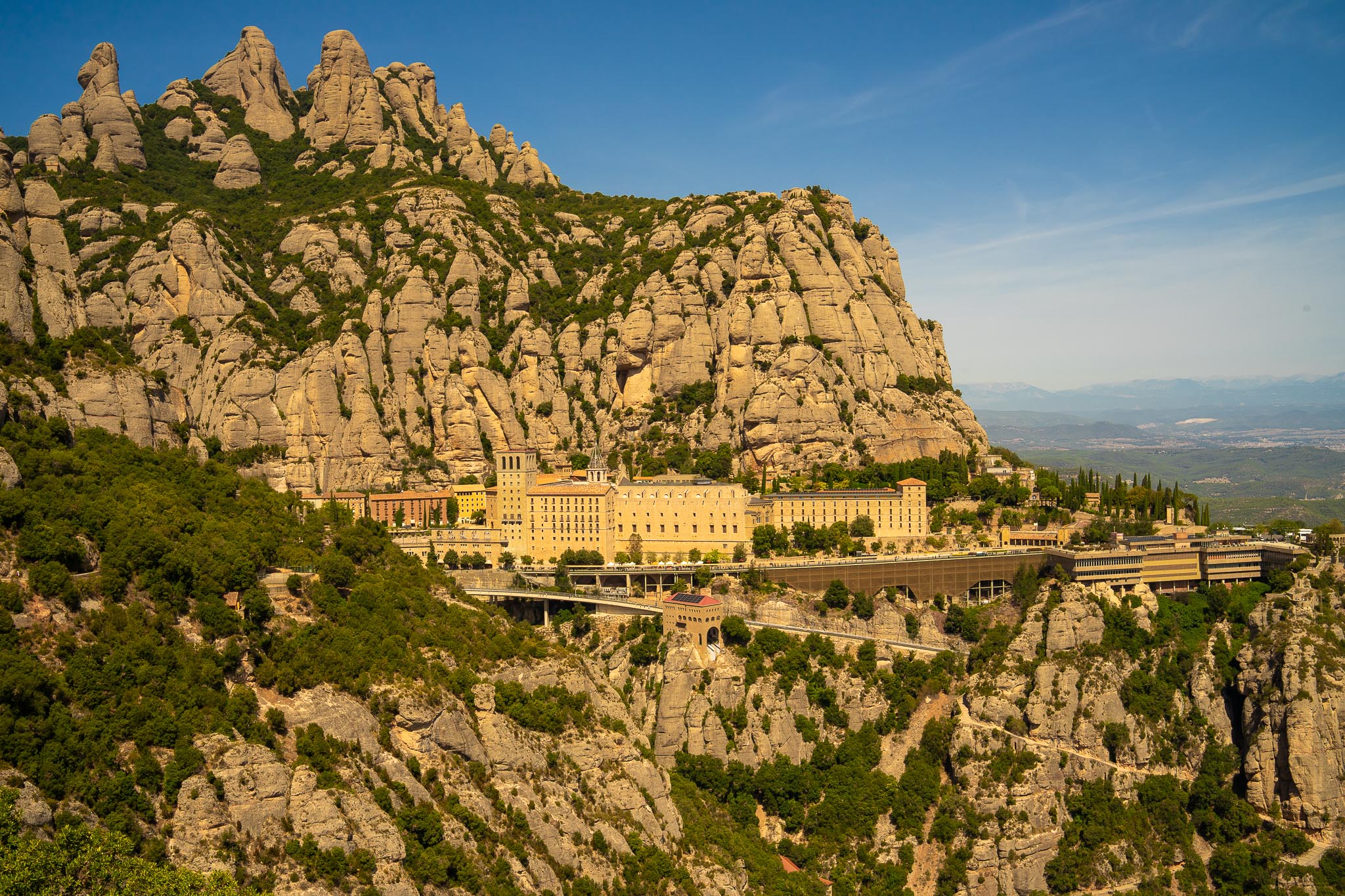
The one excursion that does something no part of Barcelona can. Montserrat is a massif of conglomerate — cemented river gravel, eroded into a thousand rounded pinnacles, so it reads less like a mountain than like a wall of stone fingers — and a Benedictine monastery has stood on a ledge halfway up it since the eleventh century. It holdsLa Moreneta, a polychrome Romanesque carving of the Virgin from the late twelfth century, blackened by age and candle smoke, who is the patron of Catalonia; the abbey was a centre of Catalan cultural resistance under Franco; and the Escolania, the boys' choir attached to it, is among the oldest in Europe.
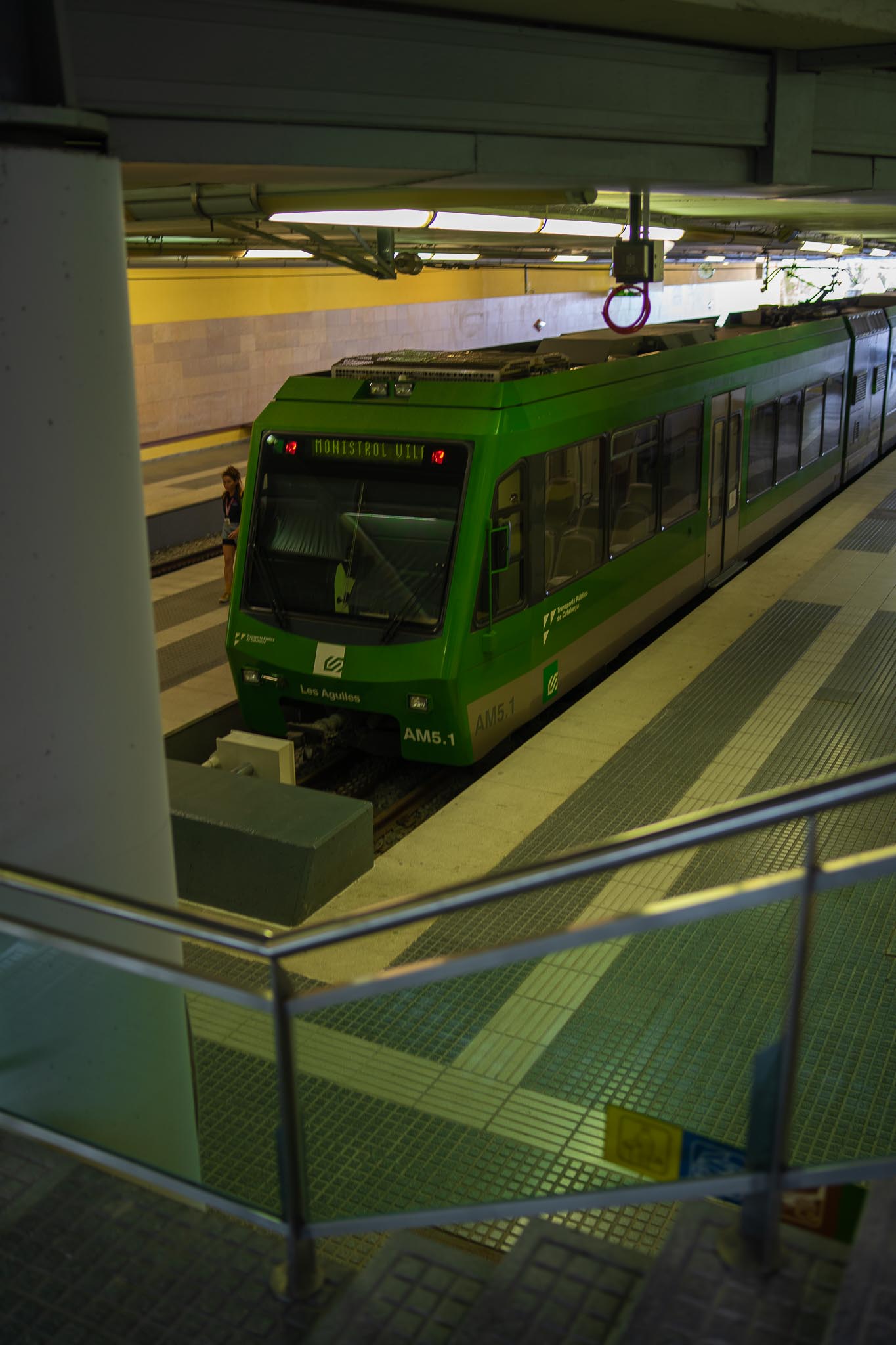
What makes it a full day is the journey, which has three parts and is also the best thing about it. Take FGC line R5 from Plaça Espanya up the Llobregat for about an hour, then change for the final ascent — either the cremallera, the rack railway that climbs from Monistrol de Montserrat in a little under twenty minutes, or the aeri, the cable car from the station before it, which is faster, more dramatic and closes in high wind. Reckon ninety minutes each way from the middle of Barcelona. Once up there, two short funiculars go higher: Sant Joan for the ridge walks, Santa Cova for the chapel on the pilgrim path.
The one piece of timing that matters: the Escolania sings theSalve Regina and the Virolai in the basilica at aroundone o'clock on weekdays and around midday on Sundays, which means the choir, not the trains, sets your departure. The choir also takes an annual break, so check the abbey's calendar rather than assuming.
Why go the only real change of landscape within reach, plus a monastery that is a Catalan institution rather than a monument ·Getting there FGC R5 from Plaça Espanya, then rack railway or cable car ·Door to door about 90 minutes each way ·Time on site 4 to 6 hours, more if you walk ·Booking not essential, but the combined tickets remove most of the queuing: Trans Montserrat from about€50 covers metro, train, rack railway, both funiculars and the audiovisual space; Tot Montserrat from about€71.50 adds the museum and a buffet lunch. Both allow a week to return. The basilica is open 07:00–20:00. Seethe sanctuary's own visitor site andthe rack railway ·Season matters more here than anywhere else on this page — cloud can erase the entire point, and the cable car stops in wind. Check the forecast the night before and be willing to swap the day ·Combine with nothing. It is the day ·Documented — visited August 2023 ·Verdict the best full day from Barcelona, and the first one to take · Skip if the weather is against you, or if two funiculars and a rack railway sound like work rather than pleasure.
The second leg. The rack railway is not a novelty bolted onto the visit — it is how you gain the last few hundred metres, and the change of gradient at the bottom of it is the moment the day stops being a train ride.
III.
The Strong Full Days
Three towns that fill a day properly, and resent being halved to fit another
These are not sights but towns, and the mistake with all three is arriving at noon and leaving at four. Each rewards a slow arrival, a long lunch and an unhurried walk, which is precisely what gets sacrificed when a second destination is added.
4. Girona
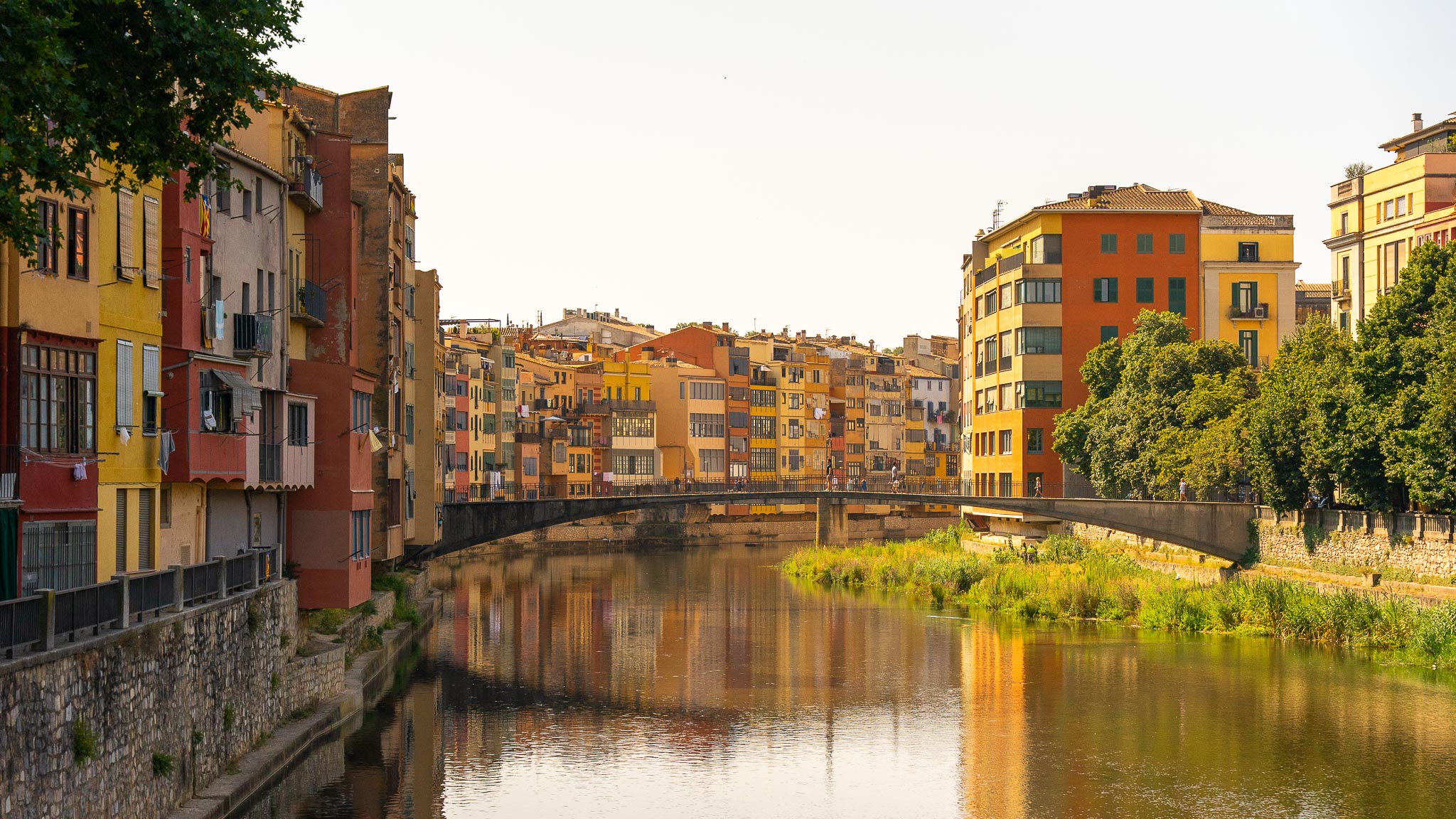
The best town in Catalonia for a day, and the easiest good trip on this page because the high-speed line does the work. Girona stacks up above the Onyar in tiers: the painted houses hanging over the water, a cathedral reached by ninety steps with the widest Gothic nave in the world behind its baroque front, and El Call, one of the best-preserved Jewish quarters in Europe, a knot of stepped stone lanes that survived because the town simply built around it after the expulsion of 1492. You can also walk the Roman and medieval walls almost the whole way round the old town, which is the best hour there and the one most visitors miss.
Two further things make it a full day rather than a long morning. TheBanys Àrabs are a twelfth-century bath house, Romanesque in construction and Islamic in plan, with a domed and columned changing room that is the single most photographed interior in the town for good reason. And Sant Feliu, the older church below the cathedral, holds Roman and early Christian sarcophagi built into its walls — the town's earlier layer, casually reused. Girona also eats well out of proportion to its size, which is the practical argument for staying into the evening rather than catching the five o'clock train: the light on the Onyar at eight is the thing people remember, and it is exactly what a combined day removes.
Why go a complete medieval town, a great cathedral and a walkable circuit of walls, all within four hundred metres ·Getting there Renfe AVE or Avant from Barcelona Sants, about 38 minutes; the slower Rodalies R11 also runs and costs less ·Door to door about an hour each way ·Time on site 5 to 7 hours ·Booking the train, if you want the fast one at a sane price. Nothing in the town needs it ·Season good year round; the flower festival in May transforms it and fills it ·Combine with Figueres — possible, and argued below ·Documented — visited August 2024, sequenced inthe Figueres and Girona chronicle · Verdict the best full day that is a town rather than a mountain · Skip if you have already had your fill of medieval old towns.
Late afternoon on the Onyar, which is the hour Girona is for and the hour a combined day with Figueres removes. The argument against squeezing two towns into one day is visible here rather than theoretical.
5. Tarragona
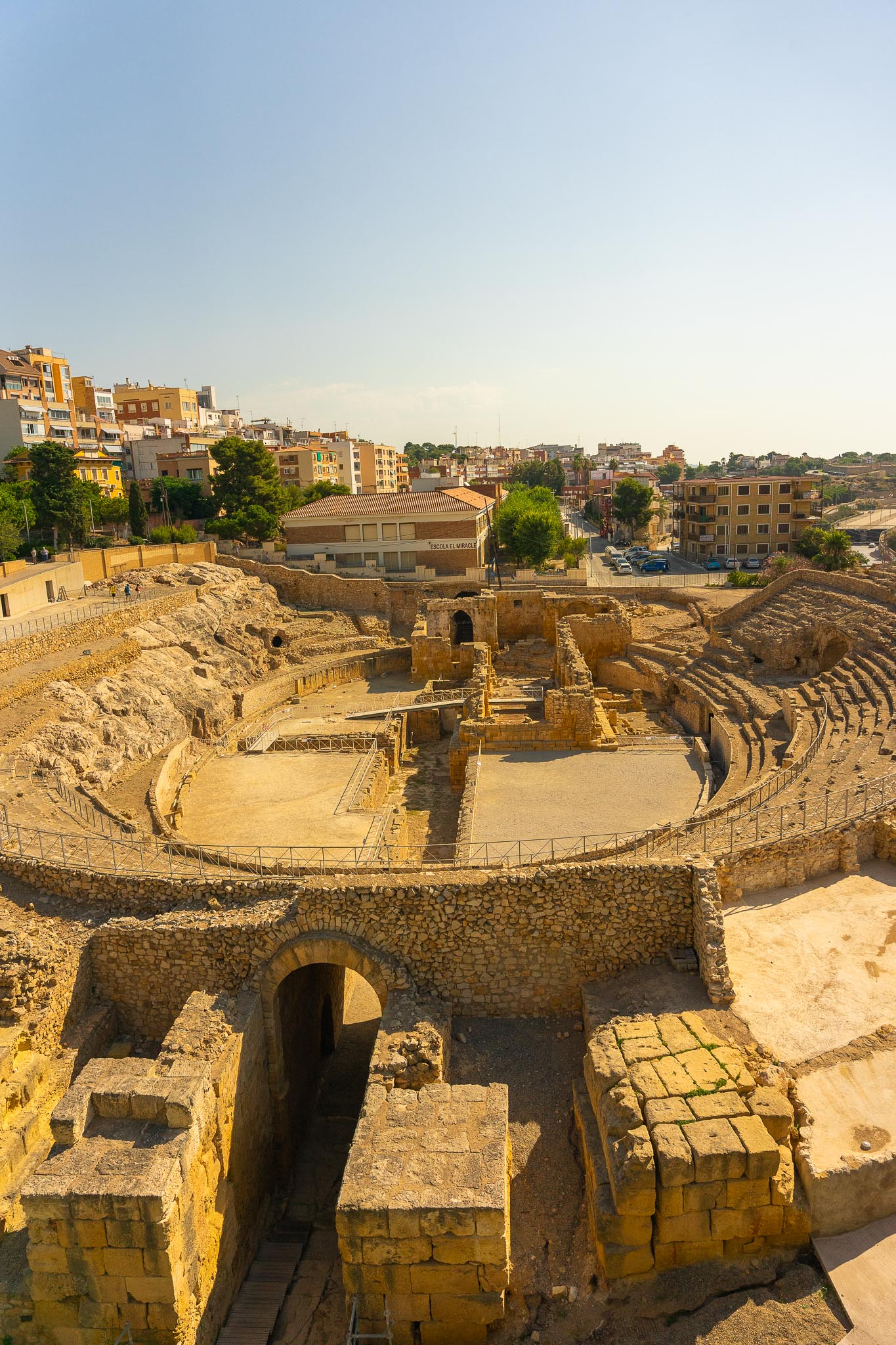
The best Roman site in Catalonia and a working provincial city that has never quite decided to become a tourist town, which is much of its appeal. As Tarraco this was the capital of Rome's largest Iberian province, and what survives is unusually legible: an amphitheatre cut into the slope directly above the sea, a circus whose vaults run under the streets of the old town, a provincial forum, long stretches of wall along the Passeig Arqueològic, and a cathedral built on the temple that stood at the top of the terraced city. The joint ticket across the Roman sites is the obvious purchase — a single site is around€5 and the combined ticket around€15, so it pays for itself at the third.
Two things are worth seeking out beyond the ticketed sites. ThePasseig Arqueològic runs between the Roman wall and the later medieval rampart, so you walk a corridor with two thousand years on one side and fifteen hundred on the other, above gardens and out towards the sea — the best half hour in the city. And theMonument als Castellers, a bronze human tower of cast figures standing on each other's shoulders in a city-centre square, is the clearest statement anywhere of what the castell tradition actually is: not a spectacle but a feat of collective engineering, with the smallest child climbing last.
One transport trap deserves naming. Tarragona has two stations: the central one served by the slow Rodalies coastal lines, and Camp de Tarragona, the high-speed station, which sits about ten kilometres inland and needs a shuttle bus. The fast train is not faster once you have added the transfer at both ends, and it is the commonest way to lose an hour on this trip.
Why go Roman remains you walk through rather than look at, in a city that is still a port · Getting thereRodalies R14, R15 or R16 to Tarragona central, roughly1 hour 10 to 1 hour 30 ·Door to door about 1½ hours each way ·Time on site 5 to 6 hours ·Booking none. Buy the joint Roman ticket on arrival; details onthe city heritage service's own page ·Season the archaeology is unshaded, so in July and August do the amphitheatre and the walls early and the cathedral at midday · Combine with Sitges, in theory — verdict below ·Documented — visited August 2024, inthe Tarragona and Sitges chronicle · Verdict the right choice for anyone who would rather have Rome than the Middle Ages ·Skip if ruins without reconstruction leave you cold.
The amphitheatre with the town immediately above it, and a Visigothic church planted in the middle of the arena. Tarragona's Roman remains are not a park you enter but something the modern city is built around.
6. Vic
Assessed rather than visited. An inland cathedral town in a plain that traps fog, and the one destination on this page that is not on anybody's standard list. Its case rests on two things. The first is thePlaça Major, an enormous arcaded square that has held a market on Tuesdays and Saturdays for something over a thousand years, and which on those days is a genuine agricultural market rather than a heritage performance — Vic is the centre of a real charcuterie industry, and the llonganissa in the food guide's vocabulary comes from here. The second is the Museu Episcopal, a Romanesque and Gothic collection strong enough to be discussed in the same breath as the MNAC.
The reason this is marked assessed is simple: the argument rests on the market calendar and the rail timetable rather than on having stood in the square. It is included because those two things are unusually decisive — go on a Tuesday or a Saturday and it is a fine day; go on a Thursday and you have taken a two-and-a-half-hour round trip to see a large empty square.
Why go a working market town and a serious medieval museum, with almost no visitors ·Getting there Rodalies R3 from Barcelona, about 1 hour 15, roughly every half hour, then a five-minute walk · Door to door about 1½ hours each way ·Time on site 4 to 5 hours ·Booking none · Season the fog is real in winter and the market is better in autumn; check theRodalies planner for the return, which thins in the evening ·Combine with nothing ·Assessed · Verdict a strong day on a market morning and a weak one otherwise ·Skip if your dates do not include a Tuesday or a Saturday.
IV.
The Museum Journey
A two-hour round trip made for one building, and whether it needs a second destination
7. Figueres
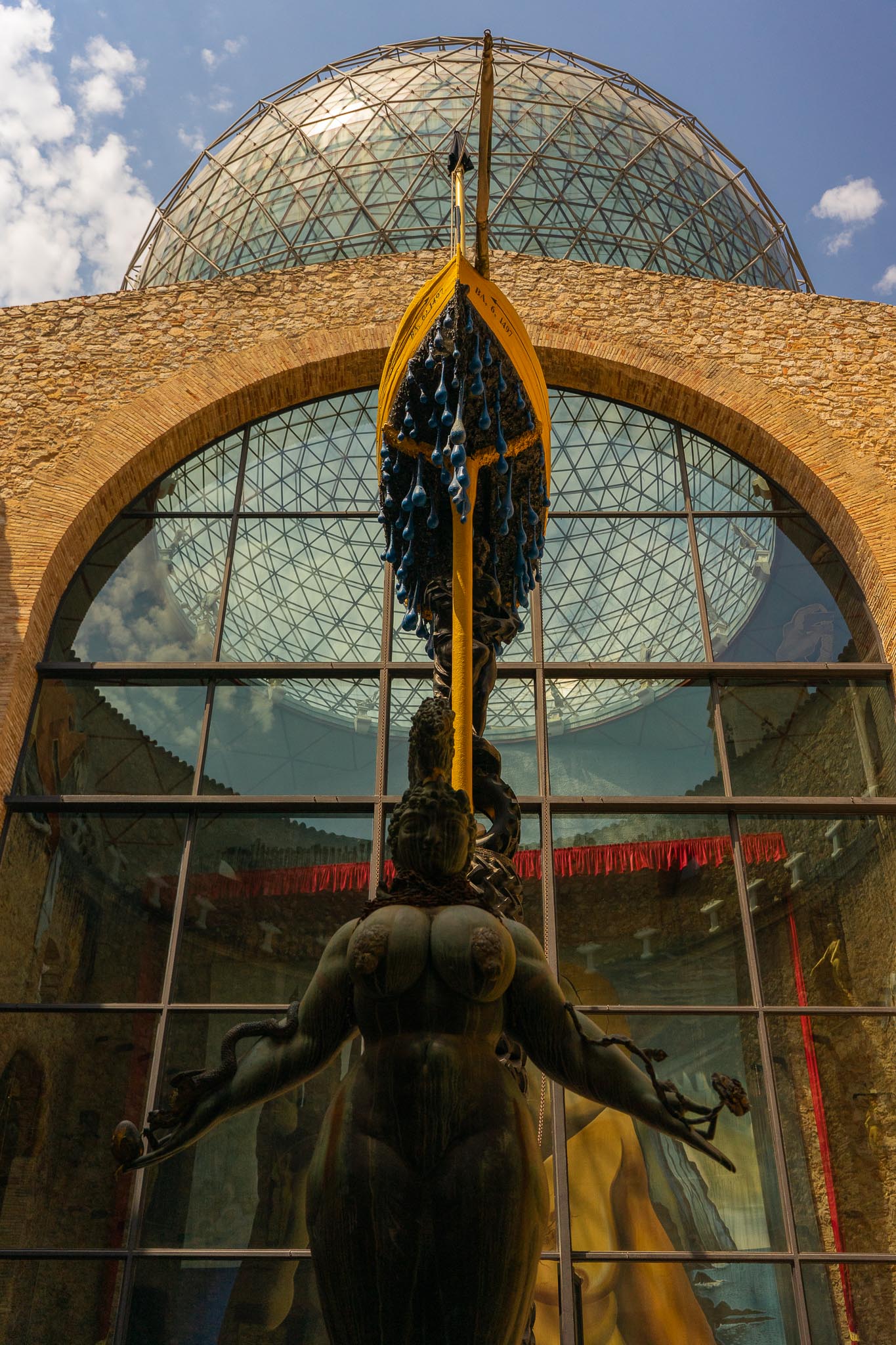
Figueres is a modest town with one extraordinary thing in it, and the honest framing is that you are travelling for a building rather than for a place. Dalí took the burnt-out municipal theatre of his home town and spent the last fourteen years of his life turning it into aTheatre-Museum — a single total work rather than a collection, with a geodesic dome over the old auditorium, a courtyard holding a Cadillac you can make rain inside, the Mae West room that assembles into a face from one fixed viewpoint, and Dalí himself buried under the floor. Rooms 23 and 24 hold the jewellery he designed, which most visitors walk past.
It is genuinely one of the strangest museums in Europe and it takes two to three hours. What it does not do is fill a day: outside the museum Figueres offers a pleasant square, a good market and a fortress on the hill, and by mid-afternoon a visitor is usually looking at the timetable. Which is why almost everyone bolts something onto it — and why the next section exists.
Why go a museum built by its own subject as a single surrealist object · Getting there RenfeAVE or Avant from Sants to Figueres-Vilafant, about55 minutes, then a fifteen-minute walk or a local bus ·Door to door about 1¼ hours each way ·Time on site 2 to 3 hours in the museum ·Bookingyes — this is the one museum on this page to buy ahead. General admission is around€18.50 online against €20.50 at the desk, rising to about €22 / €24 in July and August; it opens daily in July and August and closes on Mondays for the rest of the year, with access ending 45 minutes before closing. Seethe Dalí Foundation's own visit page ·Season the museum is indoors; only the Monday closure and the August pricing matter ·Combine with Girona, with reservations — see below ·Documented — visited August 2024, inthe Figueres and Girona chronicle · Verdict worth the journey for the building, not for the town · Skip if Dalí strikes you as a showman rather than an artist; this will not change your mind.
The dome over the old theatre auditorium, and one of the courtyard figures beneath it. The building is not a container for the work — it is the work, which is why two hours inside it are not interchangeable with two hours in any other museum.
V.
The Coast and the Vines
Two lines south-west out of Barcelona, and the choice between salt water and cava
8. The Penedès — cava country
Assessed rather than visited. The most under-used rail day trip from Barcelona, and the only one on this page whose subject is a drink. Forty-five minutes out on the Rodalies R4 isSant Sadurní d'Anoia, a town of some fifteen thousand people with something approaching ninety cava houses in and around it, including the vast Codorníu cellars — a modernista complex by Puig i Cadafalch with kilometres of tunnels beneath it. Five minutes further on is Vilafranca del Penedès, the wine capital proper, with a wine museum and a Saturday market, and a claim to be the home of thecastellers, the human-tower tradition.
The reason it is under-used is that it requires one phone call or one web form more than the other trips here: cellars are working wineries and almost all of them need a booked tour. Turn up unbooked in Sant Sadurní and you will find a pleasant town and locked gates. Book two visits and a lunch, and it is among the best days on this page — and it pairs withwhat the food guide says about drinking Catalan better than anything else here.
Why go the cellars where cava is actually made, and a countryside twenty minutes from the coast that feels a long way from it ·Getting there Rodalies R4 from Sants or Plaça Catalunya — Sant Sadurní about 45 minutes, Vilafranca about 50 ·Door to door about an hour each way ·Time on site 5 to 6 hours for two cellars and lunch ·Bookingessential, and the whole day depends on it · Season harvest in late August and September is the most interesting and the busiest; cellars close over Christmas and some Mondays ·Combine with nothing, and do not drive ·Assessed — the verdict rests on the rail geometry and on the cellars' own booking requirements rather than on a visit ·Verdict the best day here for anyone who would rather drink than sightsee · Skip if you will not book ahead, or you do not drink.
The question is never how far a place is. It is which piece of infrastructure it stands on, and whether the last train back leaves before the day is finished.
On combining two destinations
Two pairings are sold everywhere as single days, and both were done on the stays behind this site. Neither verdict is the flattering one.
Figueres and Girona. This one isgenuinely efficient rather than merely possible, and it is the rare case where the arithmetic works: both towns sit on the same high-speed line, they are about twenty minutes apart, and Figueres cannot fill a day while Girona can absorb whatever is left of one. Do it in that order — Figueres first, on an early train, museum at opening, then south to Girona for the afternoon and the evening on the river. What you lose is Girona's morning and the walls at their best. What you gain is a day that is full rather than padded. For a first visit with limited days, take the combination; if you have a week, split them and give Girona its own slow day. Do not attempt it in reverse, and do not attempt it at all on a Monday, when the museum is shut for most of the year.
Tarragona and Sitges. This is the weaker of the two and the honest verdict is a useful contrast that is too ambitious for most visitors. Both sit on the coastal line south, which makes the map look obliging, but Tarragona alone is a five-hour town and Sitges is only worth stopping for if you are going to swim or eat properly — and neither survives being given two hours. It is also strongly seasonal: in summer the day works because the light lasts until nine and a late swim is pleasant, while between November and March Sitges contributes a closed promenade and you have spent an hour of train on it. The recommendation is to take Tarragona alone if the Roman city is what you came for, and Sitges alone as a half day if it is not. Combine them only in high summer, with an early start, accepting Tarragona will be the compressed half.
The general rule behind both verdicts: a second destination costs the first one its best hour, which is usually late afternoon. Add one only when the first place genuinely cannot fill a day.
The one to refuse
Assessed. Somebody will tell you to go toCadaqués — the white village on the Cap de Creus where Dalí lived at Portlligat — or to Tossa de Mar, or Calella de Palafrugell. They are among the most beautiful places on the Mediterranean and they are not day trips from Barcelona, for one structural reason: the Costa Brava villages have no useful railway. The line north runs inland to Girona and Figueres, and the coast is reached by bus from Barcelona Nord — around two and three-quarter hours each way to Cadaqués, on a road that spends its last forty minutes climbing a headland. That is five and a half hours of coach for perhaps four hours on the ground, governed by a return departure you must not miss.
The correct answer is not to compress it but to change its category:sleep there. Two nights on the Costa Brava, reached via Girona or Figueres so the journey buys you two destinations rather than one, is one of the best short trips in Spain. Attempted in a day it is mostly window. If you only have a day and you want that coastline, take Sitges instead and accept that it is a different and lesser thing — or take Girona, which is where the road to the Costa Brava starts anyway.
What did not make the eight
Four were considered and left out, and each has a reader it would suit.Sant Cugat del Vallès has a genuinely fine Romanesque monastery cloister and is twenty minutes out on the FGC — but it is a prosperous commuter town around it, and the cloister is an hour rather than a day, which makes it a better half-morning than an excursion.Cardona, with its castle and the extraordinary salt mountain beside it, is the most interesting omission and fails on transport alone: it needs a bus and most of a day of travelling.Mataró is thirty minutes up the coast on the R1 and holds an early Gaudí commission, but the town does not reward the rest of the day. And Montseny, the wooded massif behind Vic, is a superb place that assumes a car and defeats anyone without one.
📍 Catalonia — Excursions from Barcelona
🚆 8 assessed · verified 4 August 2026
Which line, and roughly how long
FGC from Plaça Espanya — Colònia Güell on S3/S4/S8/S9, about 20 minutes. Montserrat on R5, about an hour to the foot of the mountain.
High-speed north from Sants — Girona about 38 minutes, Figueres-Vilafant about 55. The fastest and least tiring journeys here.
Rodalies south and inland — Sitges about 40 minutes on the R2 Sud; Tarragona 1 hour 10 to 1 hour 30 on the R14/R15/R16; the Penedès about 45 minutes on the R4; Vic about 1 hour 15 on the R3.
Bus only — the Costa Brava villages, from Barcelona Nord. This is the whole reason they are refused above.
Plan and confirm onRodalies de Catalunya andFGC, and check service alerts before an early start — engineering work is concentrated in summer.
What must be booked
The Dalí Theatre-Museum — buy online, both to save money and to fix a slot.
Penedès cellars — essential. Without a booking the entire day fails.
Montserrat combined tickets — optional, and worth it to avoid three separate queues.
High-speed trains — worth booking ahead for price rather than availability.
The traps
Camp de Tarragona is not Tarragona. The high-speed station is about ten kilometres inland and needs a shuttle. Use the central station and the slow train.
Mondays close the Dalí museum outside July and August, which breaks the Figueres–Girona combination.
Vic without its market is a long round trip to a large empty square. Tuesdays and Saturdays only.
The Montserrat cable car stops in high wind, and cloud can remove the view entirely. Have the rack railway as your fallback and the forecast as your decider.
Last returns thin out on the Rodalies lines well before they do on the metro. Check the evening service before you commit to a late dinner in Tarragona or Vic.
Choosing, if you only have one day
One day, good weather, want the biggest change — Montserrat.
One day, want a town — Girona.
One day, want Rome — Tarragona.
Half a day only — Colònia Güell, and keep the afternoon in Barcelona.
Do not leave the city at all if it is your only full day and you have not yet seen the Sagrada Família. Thesingle-day route is the better use of it, andthe experiences guidemakes the same argument at greater length.
Eight destinations, and the pattern behind them is not about beauty. The trips that work are the ones where the infrastructure does the effort — an FGC line that climbs, a high-speed train that makes a hundred kilometres feel like a suburb, a coastal stopping service frequent enough that a missed train costs twenty minutes rather than a day. The trips that fail are the ones where you supply the effort yourself, and the Costa Brava fails on exactly that ground while being lovelier than most of the places recommended here.
Which leads to the last piece of advice, and it argues against this page. Barcelona is a better base than most cities and a worse one to leave early: on a stay of three days or fewer, every excursion here costs you the city itself, and the city is not finished. Take one day trip on a five-day stay, two on a week, and spend the rest where you are. The week that holds three of these isrecorded here, and the road that arrives in Barcelona in the first place isfour weeks overland from Porto.