1 Day in Tarragona & Sitges: Roman Stone and Seaside Light
One day south from Barcelona — a Roman amphitheatre that opens straight onto the Mediterranean at Tarragona, then the white seaside ease of Sitges. The empire and the holiday on the same coast.
Some links in this chronicle are affiliate links. If you book through one, I may earn a small commission at no extra cost to you.
The same sea that laps the foot of Barcelona runs south past two very different ideas of what to do with a coastline. An hour down it sits Tarragona, which two thousand years ago was Tárraco — the first capital Rome built in Iberia, the city where Augustus wintered while he finished conquering the peninsula, and which still wears its empire in the open: a forum, a circus, a ring of Cyclopean walls, and an amphitheatre cut into the hillside so that the gladiators fought with the Mediterranean filling the gap behind the highest tier of seats. Half an hour back toward Barcelona sits Sitges, which has no empire and wants none — a white town of narrow lanes and seventeen beaches, where the only thing built on the rock above the water is a church, and the day's serious business is the light on the sea.
This is the day that holds them both: the empire in the morning and the holiday in the afternoon, two answers to the same coast separated by an hour of train and seventeen centuries of intent. Tarragona is what a civilisation does to a shoreline when it means to rule the world from it. Sitges is what people do to a shoreline when the ruling is over and they would simply like to swim. The traveller takes the empire first, while the legs are fresh and the morning light is on the old stone, and saves the easy white town for the long golden end of the day.
Both face the same water. Only the ambition differs.
The Empire on the Sea
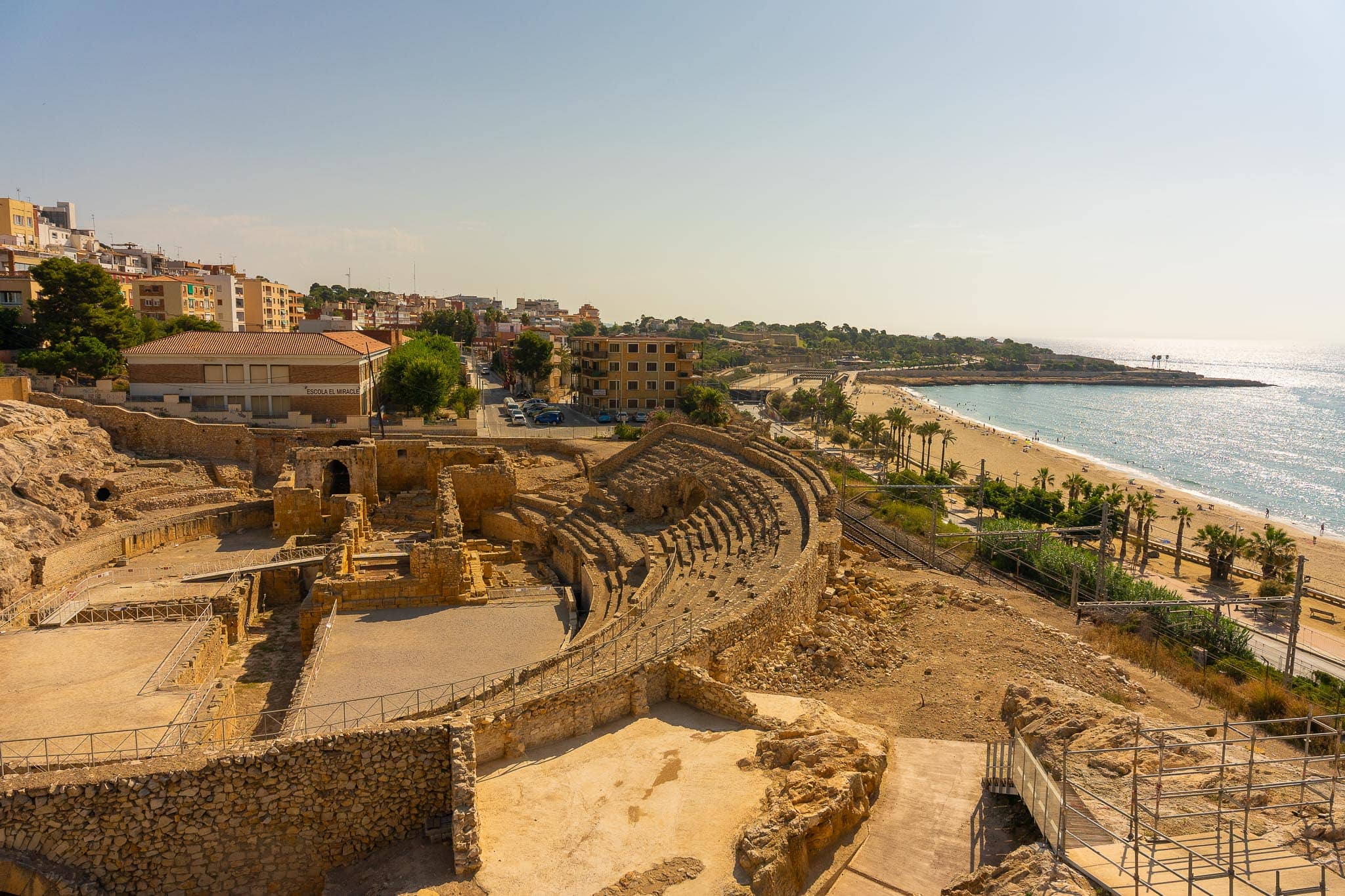
Tarragona — Roman Tárraco, the amphitheatre on the Mediterranean
Tarragona does not present its Roman past behind glass; it lets the traveller walk straight into it. The amphitheatre is the image the day is built around — an oval of weathered stone benches dug into the green slope above the harbour, open at one end so that the sea itself becomes the backdrop to the arena, the place where, in the second century, the city watched men kill each other for sport with the Mediterranean glittering behind them. In the year 259 the bishop Fructuosus and two of his deacons were burned alive on this sand under the emperor Valerian; the Visigoths later raised a basilica in the middle of the arena to mark the spot, and the medieval town a small Romanesque church on top of that, so that the oval now holds, stacked in one place, the pagan games, the Christian martyrdom, and the faith that outlasted both. Few ruins anywhere fold so much time into one view.
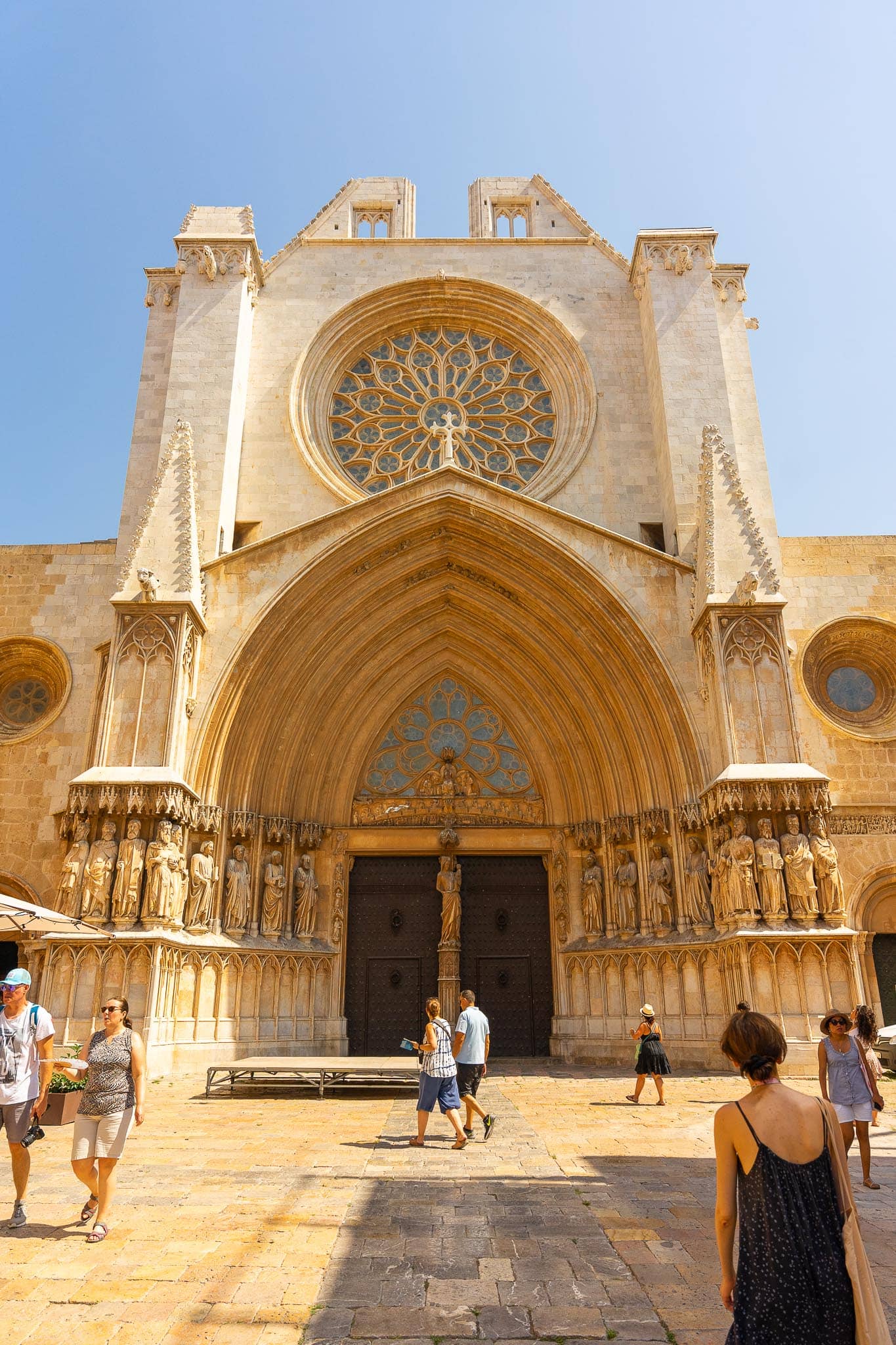
The rest of Tárraco is scattered through the modern city like bones under skin. The Roman circus, where chariots once ran, survives in vaulted underground galleries that emerge beside the towering Praetorium; the provincial forum stands in broken columns among the apartment blocks; and the oldest city walls, three kilometres of them, rise on a base of megalithic stones so large the Romans themselves credited them to giants, walkable now along the leafy Passeig Arqueològic. Four kilometres out of town the Pont del Diable — the Ferreres Aqueduct, the “Devil's Bridge” — strides across a wooded valley on two tiers of perfect arches, as casually monumental as everything Rome built to move water. And at the heart of it all the medieval cathedral sits squarely on the foundations of the Temple of Augustus, the Christian church planted, as everywhere in this city, on the exact stone of the empire it replaced.
When the old stone is done, the city offers its other face: the Balcó del Mediterrani, the iron-railed terrace at the end of the Rambla Nova where Tarragona simply stops and the sea begins, and where the local custom is to tocar ferro — touch the iron railing for luck — before turning back into a town that has been doing exactly this, looking out at this water, for longer than almost anywhere in Spain.
The Holiday on the Sea
Sitges — the white town, the church on the rock, and the long afternoon light
The train north drops the empire behind and arrives, half an hour later, somewhere with no interest in ruling anything. Sitges is a low, white, sea-facing town of narrow lanes and bougainvillea and seventeen separate beaches, and its single great monument is the one thing worth monumentalising on a coast like this: the Església de Sant Bartomeu i Santa Tecla, a honey-and-ochre church standing alone on a rocky point above the water, dividing the long town beach from the old fishermen's cove, photographed from below until it has become the face of the whole Catalan coast. There are no gladiators here and never were. There is the promenade, the Passeig Marítim, running the length of the sand; there is the warm shallow Mediterranean; and there is the particular ease of a town that decided, a long time ago, that the point of the sea is pleasure.
It was artists who made that case first. At the turn of the twentieth century the painter Santiago Rusiñol turned Sitges into the headquarters of Catalan Modernisme, filling his seafront house — Cau Ferrat, now a museum, hung with his collection and two paintings by El Greco — with the bohemian movement that would soon give Barcelona its Gaudí and its dreamlike facades. That inheritance never left: Sitges remains a town of festivals and openness, famous across Europe for its Carnival, for the October film festival that fills it with the fantastic and the macabre, and for being, for decades, one of the most relaxed and welcoming places on the Mediterranean. The traveller does not come here to learn. The traveller comes here to walk the white lanes down to the church on the rock, sit with the light going gold over the water, and let the day soften before the train back to the city.
The Day, Solved
Getting the empire and the holiday into one day, in the right order
The geography does the work, and it runs in a tidy line: Barcelona, then Sitges, then Tarragona, all strung along the southern coast on the same rail. The order that wins the day is to push through to Tarragona first, while the legs are fresh and the morning light is on the Roman stone, then come back to Sitges for the soft end of the afternoon, when a white seaside town is at its best and the only remaining task is to find the right spot to watch the sea. Do it the other way and the day arrives at the ruins tired and leaves the beach in the heat of noon — both halves diminished.
The trip solved it the simple way, with a guided day tour from Barcelona (around A$157) that bundled the driving, the order and the Roman context into one early start (around 08:15) and a late-afternoon return. The independent version is genuinely easy for the confident: regional Rodalies trains reach Tarragona in a little over an hour and Sitges in about thirty-five minutes, and the two towns are themselves only a short hop apart on the coastal line. However the day is done, it ends back in Barcelona, and on this trip it ended in the best small way the city offers: standing up at Quimet & Quimet in Poble Sec, the tiny four-generation bottle-lined bar where dinner is a sequence of montaditos built to order and a glass of something poured from one of a hundred bottles — the empire and the beach both behind, the city close and loud again.
The coast runs back toward the city in the late light, the white town behind and the Roman stone behind that, and the day arranges itself into the two ideas it was always about. Tarragona was ambition turned to architecture — a civilisation that looked at this water and decided to govern an empire from beside it, and left an amphitheatre, a circus and three kilometres of giant-built wall to prove the seriousness of the intent. Sitges was the opposite of ambition, and none the worse for it: a town that looked at the same sea and built a single church on a rock and seventeen ways down to the sand, and asked nothing of the visitor but that they enjoy the afternoon.
The traveller carries both back to the city, and finds them oddly easy to hold together. The empire and the holiday are not opposites so much as the same coast read at two speeds — the one that conquers and the one that finally, gratefully, stops. Barcelona is close again now, the train filling, a tiny bottle-lined bar in Poble Sec waiting with the night's first montadito. The Roman sea and the swimming sea were the same sea all along.