1 Day in Figueres & Girona:
A Day Inside Dalí's Mind
One day north from Barcelona — the surrealist's own museum-tomb in Figueres, then the stacked medieval old town of Girona on its painted river. The dream and the record, in that order.
Some links in this chronicle are affiliate links. If you book through one, I may earn a small commission at no extra cost to you.
There are museums a city builds to hold an artist, and then there is the one an artist built to hold himself. Two hours north of Barcelona, in the flat, light-struck farmland of the Empordà where the Pyrenees come down to meet the sea, Salvador Dalí spent the last decade of his life turning the burnt-out shell of his home town's theatre into a single enormous artwork — a museum that is not a building full of Dalís so much as one continuous Dalí the visitor walks around inside. He is buried beneath its stage. The traveller who comes up from Barcelona for the day is not visiting a collection. They are walking through the inside of a dead man's head, by his own design and on his own terms.
The day pairs that with its opposite. An hour back down the line sits Girona, a city that did not dream itself into being but accumulated, slowly, across two thousand years — Roman wall on Carolingian wall, a Jewish quarter folded into the dark, a cathedral with the widest Gothic nave in the world, all of it stacked up a hillside above a river hung with painted houses. Where Figueres is one man's imagination poured into concrete, Girona is the patient opposite: real centuries, real lives, layered into stone until the city became a thing no single mind could have planned.
Two registers of Catalonia in one day. The dream and the record. The traveller takes them in that order, and the order matters.
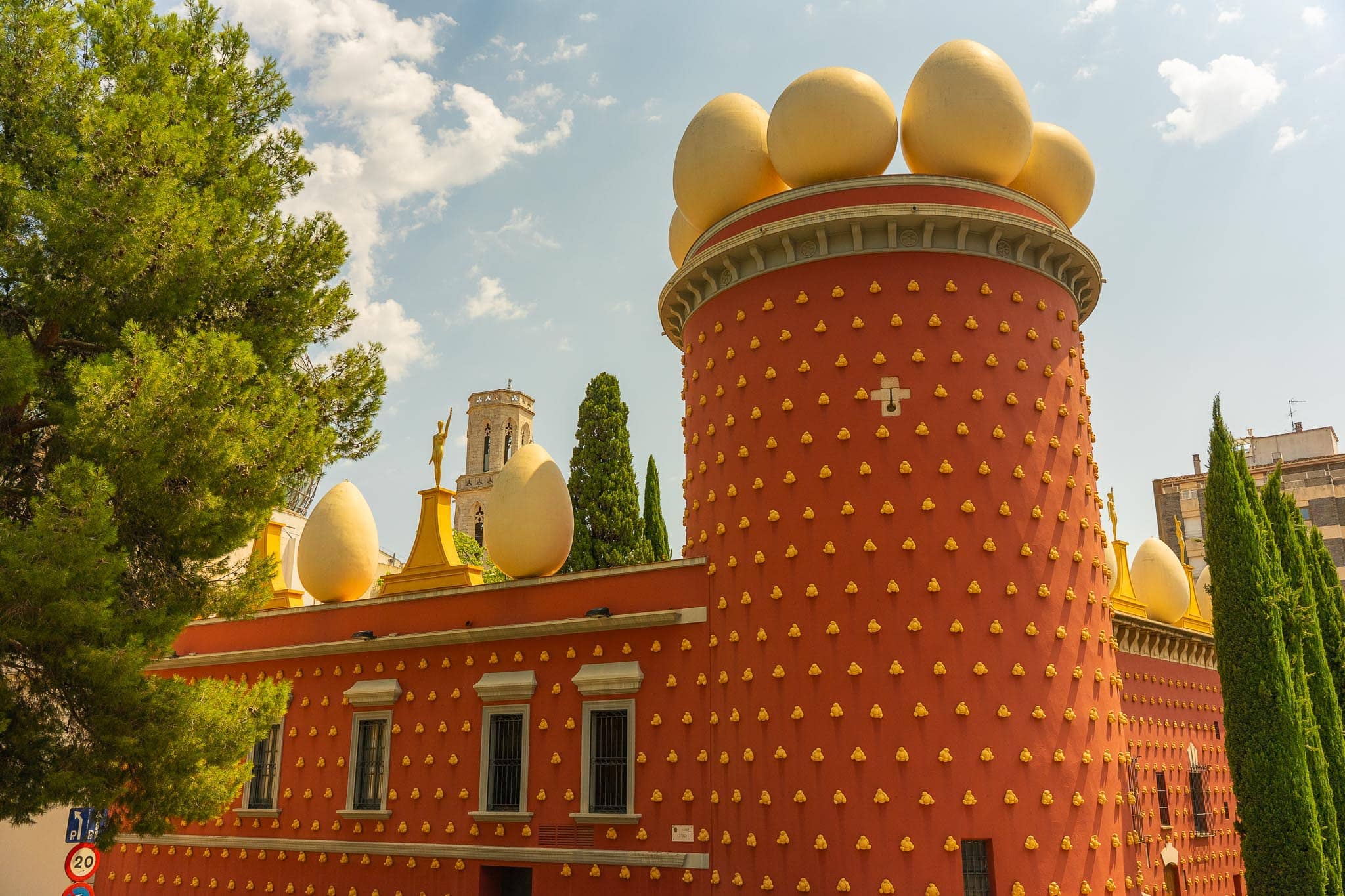
The Egg-Crowned Theatre
Figueres — the Teatre-Museu Dalí, the largest surrealist object on earth
The building announces itself before any of its contents do: a dusty-red tower-block of a thing, its parapet lined with rows of enormous white eggs and studded all over with golden bread-rolls, topped by a vast geodesic dome of glass that catches the Empordà light like a faceted soap-bubble. This was the Teatre Municipal de Figueres, where a teenage Dalí held his first public exhibition, and which burned in the last days of the Spanish Civil War. Dalí spent his final years rebuilding it not as a theatre but as a tomb and a manifesto — opened in 1974, and meant from the start to be experienced as a single coherent object rather than a set of rooms. “I want my museum to be a single block, a labyrinth,” he said, “a great surrealist object.” It is exactly that.
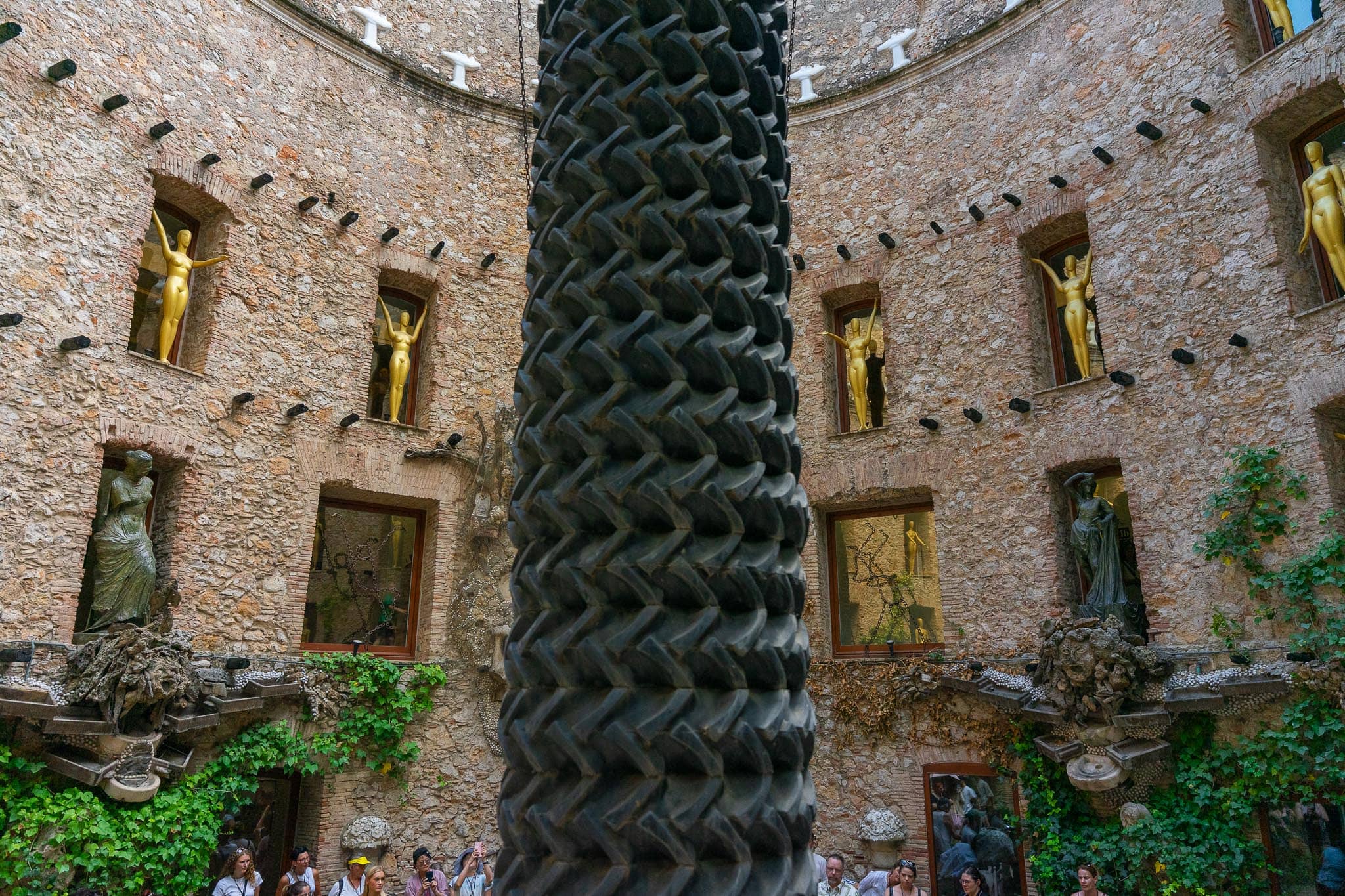
Inside, nothing behaves. A black 1941 Cadillac sits in the central courtyard with rain falling inside the car onto mannequins and snails — the Taxi Plujós, the Rainy Taxi — beneath a tower of stacked tyres crowned by a fishing boat that drips blue beads. Upstairs, a room resolves, from one precise spot through a lens, into the face of Mae West: a sofa for lips, a fireplace for a nose, two framed landscapes for eyes — the Sala Mae West, a face you have to stand in exactly the right place to see, which is the whole museum's logic in miniature. There is the great trompe-l'oeil canvas that, viewed from across the room, dissolves the nude figure of Gala at a window into the brooding portrait of Abraham Lincoln. There is the ceiling of the Palau del Vent, where Dalí and Gala float upward seen from below, the soles of their giant feet looming over the visitor. And there is, beneath the stage where the old theatre's audience once sat, the plain crypt with the single flat stone: Salvador Dalí, 1904–1989. He arranged to be buried inside his own masterpiece. People walk over his grave by the thousand without always realising it.
What the museum refuses to be is restful or explained. There are no long wall-texts, no chronology, no attempt to teach. Dalí built a machine for disorientation and put himself at the centre of it, and the only honest way to take it is to surrender to the spectacle and stop demanding that it make sense. An hour and a half is enough to feel thoroughly worked over by it; much longer and the relentlessness begins to tire. Then back out into the ordinary sunlight of a modest Catalan market town that happens to contain the strangest building in Spain.
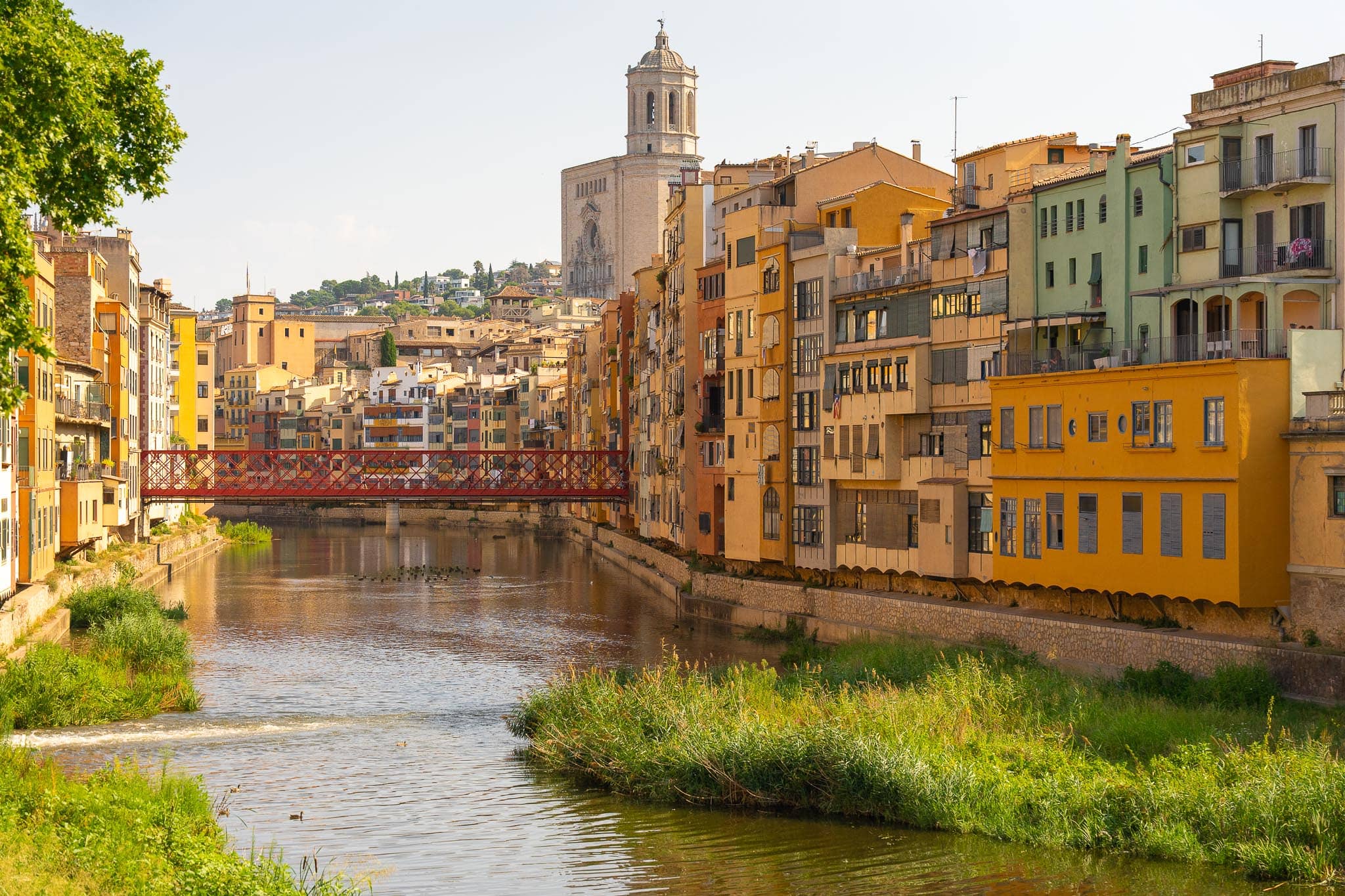
The City on the Onyar
Girona — the painted river, the widest Gothic nave, and the quarter folded into the dark
Girona is the counterweight, and after the engineered delirium of Figueres it lands like cool water. The first sight is the Cases de l'Onyar — the tall, narrow houses jammed shoulder to shoulder along the river, their faces washed in ochre and rust and faded gold, doubled in the slow green water below. From the Pont de les Peixateries Velles, the red iron footbridge built by Gustave Eiffel's workshop a dozen years before the tower in Paris, the whole stacked old town rises behind them up the hill, and the city's entire two-thousand-year argument is visible at once: layer on layer, nothing thrown away.
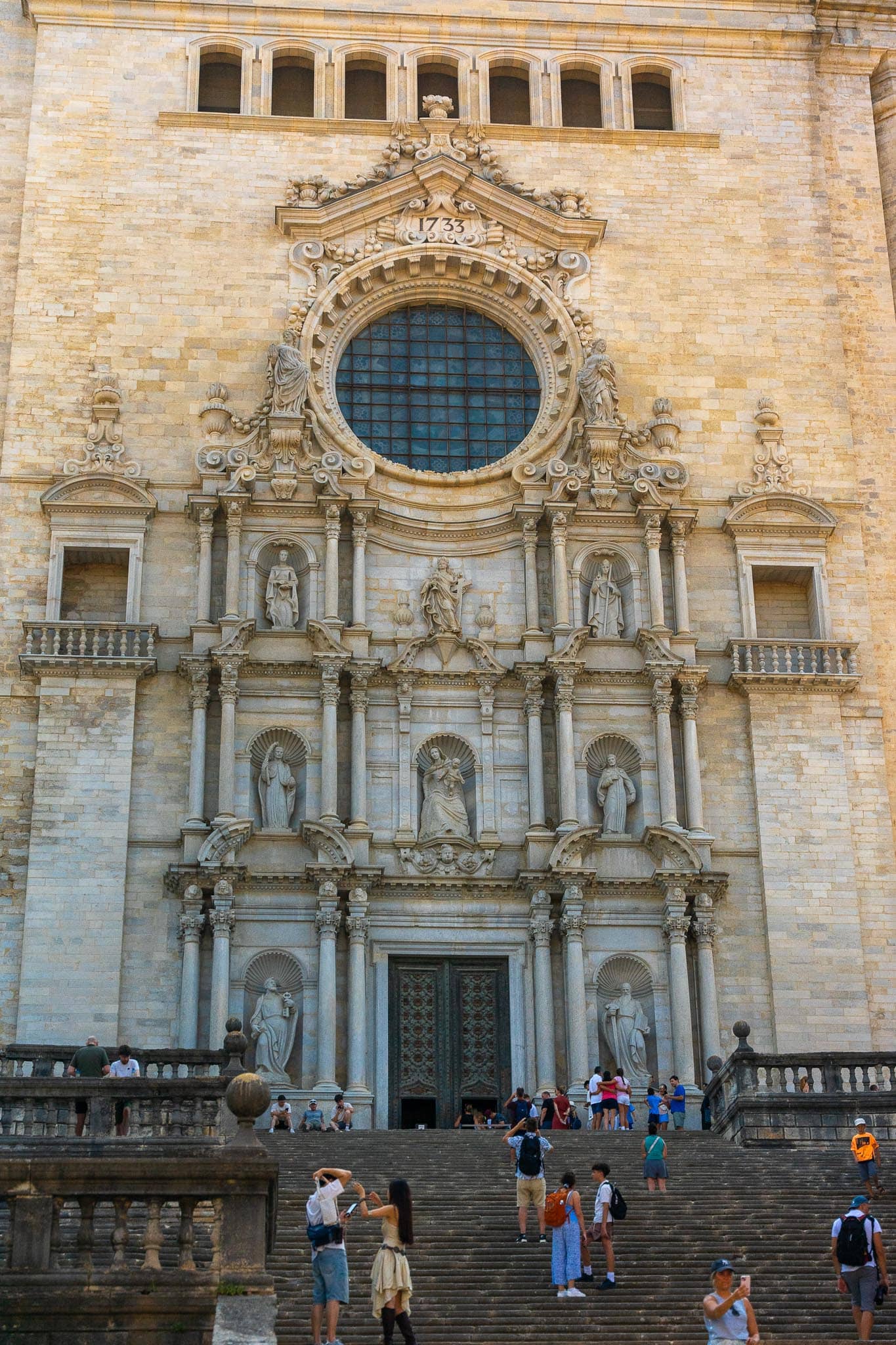
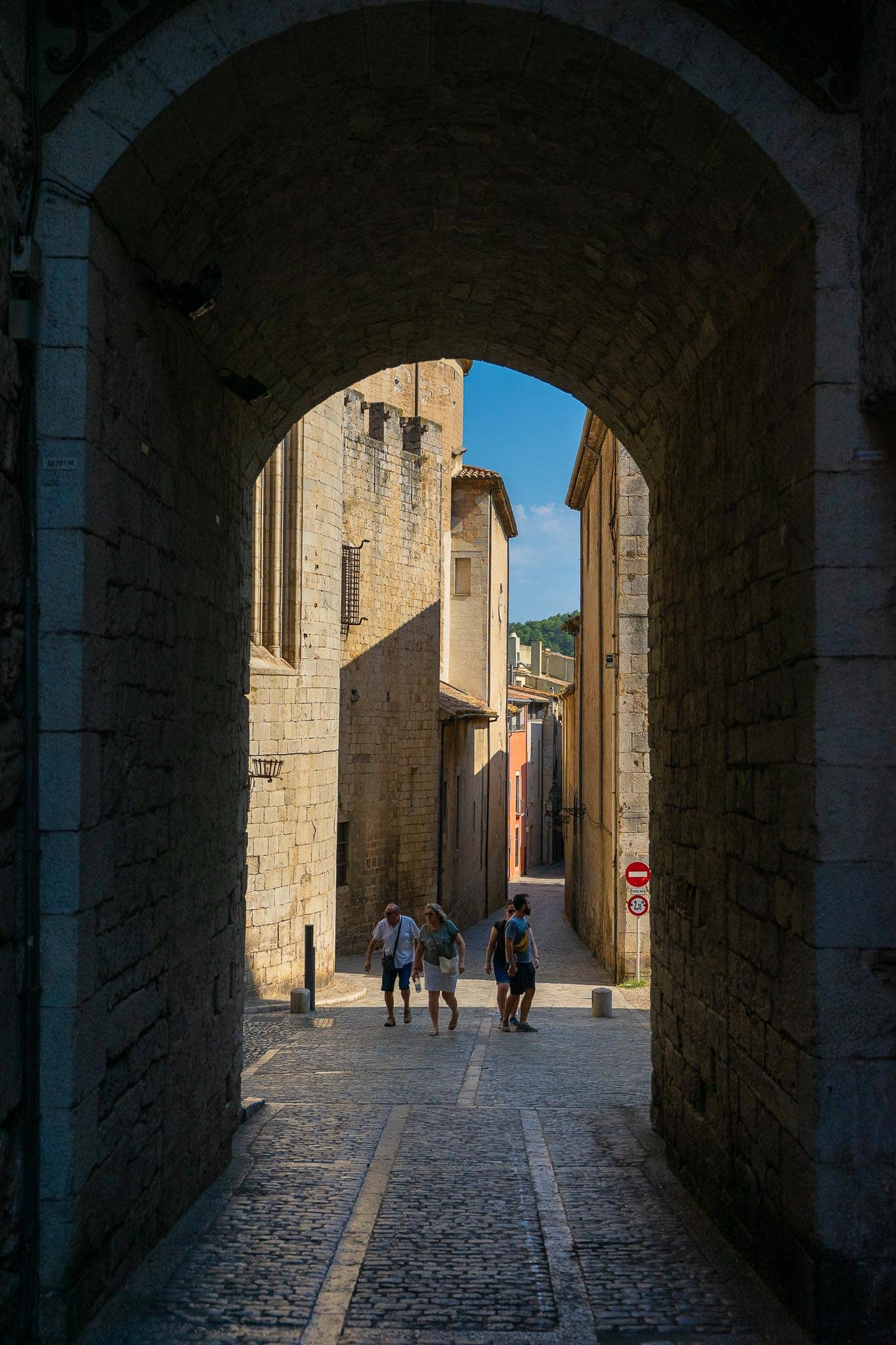
Climbing into it, the lanes narrow and darken into El Call, one of the best-preserved medieval Jewish quarters in Europe — stepped alleys barely a shoulder wide, stone passages that duck under buildings and emerge into sudden small courtyards, a place that held a thriving Jewish community for six centuries until the expulsion of 1492 and then simply sealed shut, preserving itself by being forgotten. Above it all the Catedral de Santa Maria crowns the hill behind a theatrical Baroque staircase of ninety steps, and inside holds its quiet world record: a single Gothic nave 22.98 metres wide, the widest in the world, a single vast unbroken vault of stone that the medieval builders gambled everything on and won. Television hunted this scenery down — the cathedral steps stood in for the Great Sept of Baelor, the Call for the alleys of Braavos — but the city wore its strangeness long before any camera found it. Walk the Passeig de la Muralla, the rampart path along the old Carolingian and medieval walls, for the long view back over the rooftops to the Pyrenees, and drop into the twelfth-century Banys Àrabs for the cool, domed quiet of a Romanesque bathhouse built in the Moorish manner.
Where Dalí's museum is a single mind turned inside out, Girona is the accumulation of thousands — Roman engineers, Jewish scholars, medieval masons, Catalan merchants — none of them planning the whole, all of them adding to it. The traveller who has just spent the morning inside one man's dream feels the difference physically: this is what time builds when no one is performing.
The Day, Solved
Getting the two towns into one day without losing either
The geography is generous and the trap is real. Figueres, Girona and Barcelona sit on the same north–south line, so the day is a simple out-and-back — but the Dalí museum is the thing that fills up, and the order is what saves the day. Figueres first, ideally not long after opening, before the coach tours from the coast arrive and the labyrinth turns into a queue; then south to Girona for the afternoon, when a medieval old town is at its best in the long Mediterranean light; then back to Barcelona for dinner. Done backwards, the day spends its freshest hours in a museum carpark and arrives in Girona tired.
This is precisely the kind of day where a guided tour earns its fare, and the trip took one: a single coach run from Barcelona that handled the driving, the timed museum entry and the order in one solved problem, leaving early (around 07:50) and back in the city by evening. The independent version works just as well for the confident — Catalonia's high-speed trains make Figueres and Girona genuinely easy — but it means buying the Dalí ticket online in advance and watching the connections. Either way the day ends back in Barcelona, and on this trip it ended well: a table at Eldiset in El Born, Catalan small plates and a long pour of wine, the surrealist's eggs and the painted river both receding into the evening.
The line runs south into the dusk, the Empordà flattening out behind, and the day resolves into its two halves the way the Lincoln canvas resolves from across a room. Figueres was a single will made visible — a man who decided his own museum should be his final and largest work, who built a labyrinth of his own obsessions and then lay down beneath its stage so that visitors would walk over him forever. Girona was the opposite lesson: a city no one designed, made beautiful by sheer accumulation, two thousand years of people adding stone to stone with no master plan and no signature at the bottom.
The traveller carries both south. There is something clarifying in seeing them on the same day — the curated dream and the uncurated record, the artist who controlled every angle and the city that controls nothing and is lovelier for it. Barcelona waits at the end of the line with the lights coming on and a table held in El Born, and the question the day leaves, quietly, is which of the two will last longer: the man who built himself a monument, or the city that never tried.