Best Areas to Stay in Barcelona: Seven Bases Between Hill and Sea
The metro shortens every distance in this city and erases almost none of the friction. What the choice of neighbourhood really settles is which half of Barcelona becomes ordinary, and which half becomes an expedition you make twice a day.
A city with one centre can be judged on a radius. Barcelona cannot, because it has never had one. The old city is a knot of medieval lanes wedged between the Rambla, Via Laietana and the water. The Eixample is the nineteenth-century grid laid across the plain above it, holding most of the architecture people come for. Montjuïc rises at the south-western corner. Gràcia — an independent town until 1897 — sits above the Diagonal keeping its own squares and its own hours. And along the eastern edge runs several kilometres of beach that is not a resort strip bolted onto the city but a working part of it. No address is near all five, and the argument that settleswhere to sleep in a compact city like Seville — where everything worth seeing stands inside a two-kilometre oval — simply does not transfer.
The metro is excellent, and it makes this sound like a solved problem. It is not, quite. Two lines do nearly all the work a visitor needs. L3 threads Barcelona Sants to the foot of Montjuïc at Poble Sec and Paral·lel, into the old city at Drassanes and Liceu, up through Catalunya, Passeig de Gràcia and Diagonal, and out at Fontana and Lesseps in Gràcia. L4 runs the other diagonal entirely — Poblenou, Llacuna, Bogatell, Barceloneta, Jaume I at the edge of the Born, Urquinaona, Passeig de Gràcia, Girona, Verdaguer, and Joanic in Gràcia. Between them they touch every area on this page, which is why the honest measure of a Barcelona neighbourhood is not how central it is but whether it sits on a spine, and which one.
What the spines do not do is run all night. Transports Metropolitans de Barcelona has the metro finishing at midnight from Sunday to Thursday, at two in the morning on Fridays and the nights before public holidays, and running continuously through Saturday night into Sunday. After that the night buses take over, and every NitBus line but one stops at Plaça de Catalunya, because the night network is a wheel with a single hub. So lateness has a geography of its own, measured not in the distance from your room to the bar but in how far your bed lies from one square. That, and street noise, and slope, and whether a vehicle can reach your door with a suitcase in it, is what actually varies across the seven areas below.
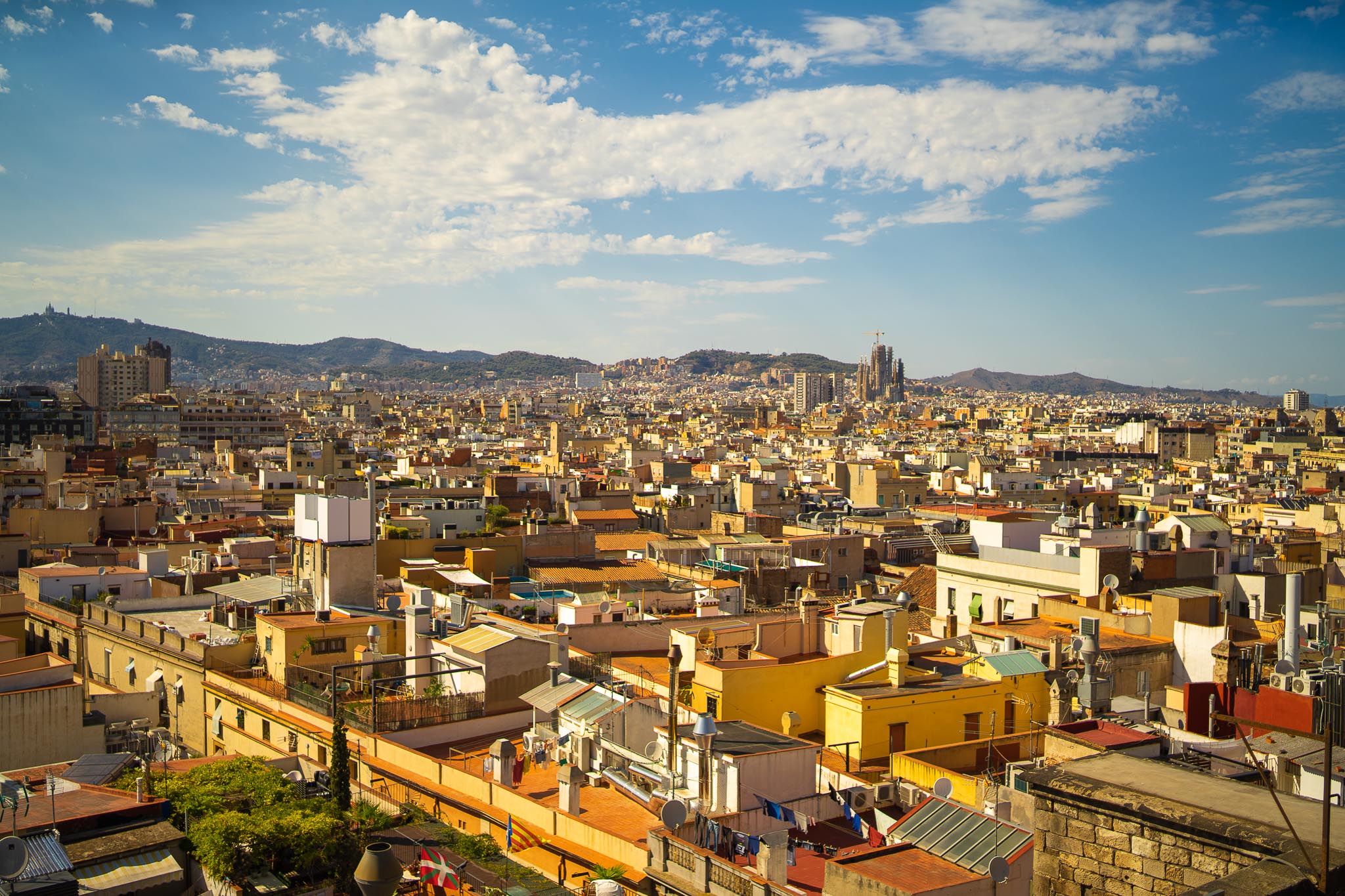
The whole problem in one frame. The old city stops being a maze only when you get above it; the Sagrada Família stands a mile inland in the grid; the ridge behind is where the city runs out. Everything on this page is a decision about which of those three grounds you wake up on.
What this page assumes about you
That you will walk and use public transport rather than drive, because parking a car here is a separate and worse problem. That you have between two and seven nights. That there is no universally best district, only a best answer to your particular week. That the street matters as much as the district, and the room orientation sometimes more than either. That is why no hotel is named on this page: the building you book will have changed hands, name and price by the time you read this, and the street outside it will not have changed at all.
One thing here is documented rather than reasoned. A six-night stay recorded on this site asseven days in Barcelona read through Gaudí was taken on Carrer Sant Pau in the Raval — which is not one of the seven areas below, and the distinction is worth making rather than blurring. What it supplies is first-hand knowledge of sleeping a hundred metres off the Rambla in the old city, and of leaving it by pre-booked taxi at half past four in the morning through lanes that were finally empty. It licenses no opinion about waking up in Gràcia or Poblenou. Those verdicts are assessed — from the city's own district boundaries, from published transport, and from walking the same streets across two August visits. Where a judgement is first-hand, it says so.
The Seven Areas at a Glance
What actually varies: Late-night travel, street noise, slope, luggage access and the minutes each area adds to every crossing of the city. Very rarely the distance on the map.
The two spines: L3 links Sants, the foot of Montjuïc, the old city, the Eixample and Gràcia. L4 links Poblenou, Barceloneta, the Born, the Eixample and Gràcia. Sitting on one is worth more than sounding central.
Shortest stays: Two or three nights — buy the minutes. Central Eixample, or the old city with the street chosen carefully.
Longer stays: Five nights or more — buy the quiet. Gràcia, Sant Antoni or Poblenou, and let the daily twenty minutes amortise.
Area by Area
EixampleBest for a first visit of any length. Advantage: the one place both metro spines cross, with the airport train stopping on top of them. Sacrifice: traffic on the wide streets, and no medieval atmosphere whatsoever.
Barri GòticBest for travellers who want the old city and sleep through anything. Advantage: you step out of the door into the thing you came to see. Sacrifice: sleep, room size, and any hope of a vehicle reaching your door.
El BornBest for two or three energetic nights built around eating. Advantage: the best dinner-to-doorstep ratio in Barcelona. Sacrifice: the bill arrives after midnight, and it varies enormously by block.
GràciaBest for five nights or more. Advantage: a neighbourhood being lived in rather than displayed, with squares that belong to the people around them. Sacrifice: it is uphill, and it is the far end of both spines.
Sant Antoni · Poble-secBest for repeat visitors and food-led stays. Advantage: genuine value, real markets and Montjuïc at the end of the street. Sacrifice: nothing postcard outside the door, and Sant Antoni is a building site until 2027.
PoblenouBest for families, summer and anyone who wants space. Advantage: larger, newer, calmer rooms with the better beaches at the end of the street. Sacrifice: fifteen to twenty minutes on the L4 before the old city begins.
BarcelonetaBest when the beach is the trip rather than a feature of it. Advantage: sand at the end of every street and El Born ten minutes on foot. Sacrifice: the smallest rooms in the city, at a premium.
Eixample — the unglamorous right answer
Ildefons Cerdà laid the Eixample out in the 1860s across the plain between the demolished city walls and the villages above, and the plan still does what it was designed to do: move people and air. The streets are wide, straight and counted in blocks; every crossing opens into the chamfered octagonal corner that is the grid's signature; the buildings are tall, solid and largely nineteenth-century, with a courtyard buried in the middle of each block. Officially the district holds six neighbourhoods. Travellers mean two — theDreta de l'Eixample east of Balmes, which carries Passeig de Gràcia and its Gaudí houses and runs up towards the Sagrada Família, and l'Antiga Esquerra west of it, which is quieter, more residential and costs less. The difference between them is mostly price and calm rather than convenience.
The convenience argument is the strongest on this page and worth stating precisely. Passeig de Gràcia is the only station in Barcelona served by L2, L3 and L4 at once — which is to say, it is where both metro spines cross — and the airport train from Terminal 2 stops there as well. From a room within ten minutes' walk of it you reach the old city, Gràcia, the beach, the foot of Montjuïc, Barcelona Sants and the airport without ever having to plan a route. Nowhere else here offers that. It is why the Eixample is the safest recommendation for a first visit, and equally why it stops being necessary once you know the city well enough not to need every option at once.
What you pay is exposure. The width that disperses noise also admits traffic, and some of these streets carry a great deal of it: Gran Via, Aragó and Balmes are through-routes rather than addresses, and a room facing one of them faces four lanes. This is where the Eixample's one genuinely important piece of advice lives, and it concerns the floor plan rather than the district. Flats here have exterior rooms facing the street and interior rooms facing the block's courtyard. The interior room is darker and often has no view at all; it is also markedly quieter, and in July cooler. If you sleep badly, the courtyard side of a building on a busy Eixample street will serve you better than the street side of a building on a quiet one.
The other cost is atmosphere, and it should not be oversold as a tragedy: you step out onto a broad pavement with plane trees, a pharmacy and a bank — the ordinary machinery of a large European city rather than anything you want to photograph. Against that, arriving here is easy in a way it is nowhere in the old city, with vehicles reaching every door and lifts as standard. One caveat: two of the nine metro stations TMB lists as not yet adapted for reduced mobility sit on this ground,Urquinaona and Verdaguer.
Stay here if it is your first visit, you want maximum optionality, you are arriving with luggage or leaving on an early flight, or someone in the party sleeps badly and you are willing to book a courtyard room. Look elsewhere if you want to walk out of the door into something older than 1870, or you are staying a week and would rather have a neighbourhood than a grid.The trade-off: you buy the best-connected address in Barcelona and pay for it in traffic and in charm.
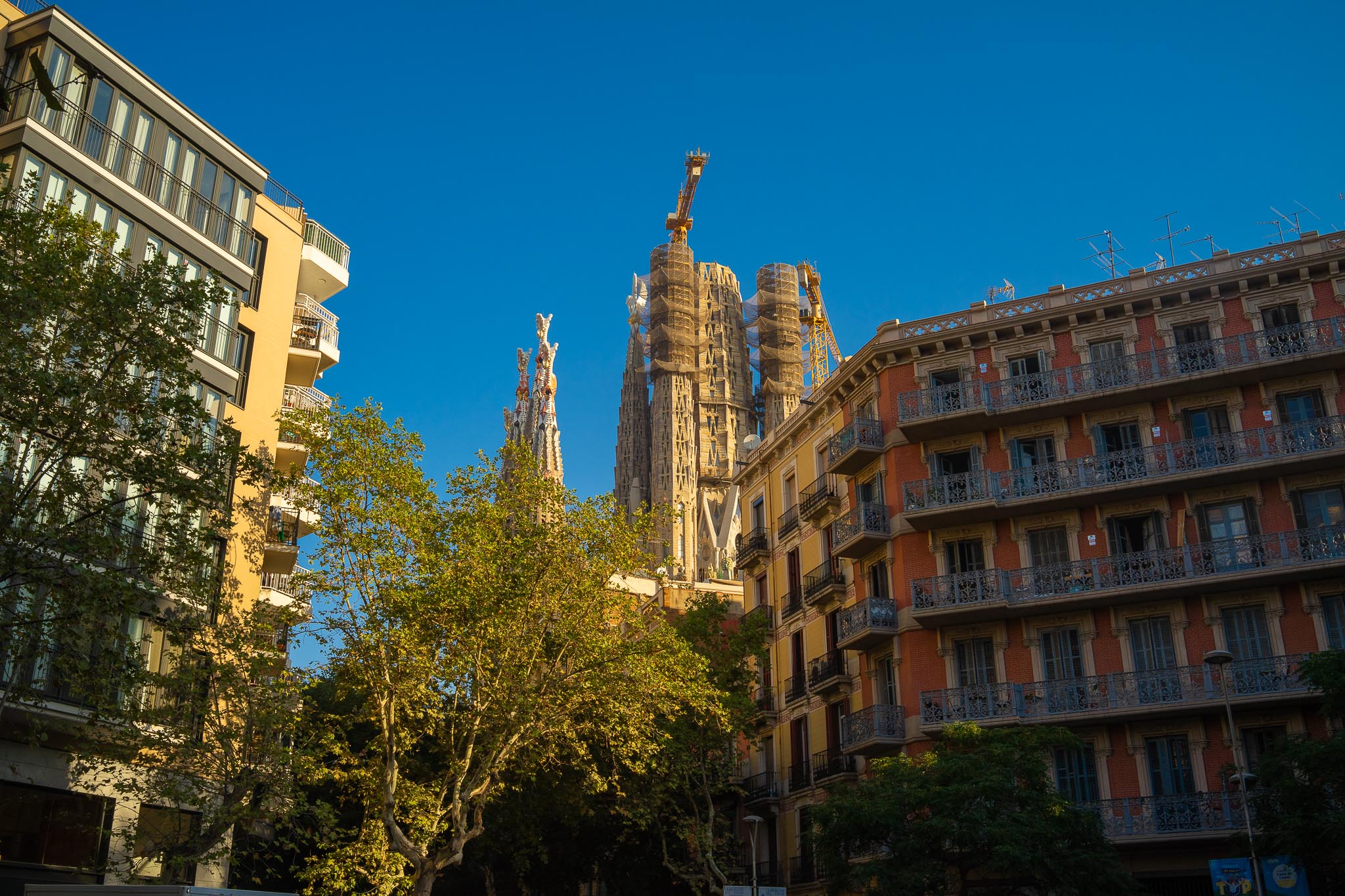
What the Eixample actually offers: not a view of the monument but a street that happens to end at one, above a chemist and a bank. The balconies on the right are somebody's Tuesday.
Barri Gòtic — the most atmospheric bed and the least sleep
The Gothic Quarter occupies the oldest ground in Barcelona, between the Rambla and Via Laietana, with the Cathedral at its heart and fragments of the Roman wall still standing inside later buildings. Its lanes are three or four metres across in places, paved rather than kerbed, walled in stone five or six storeys high, and they open without warning into small squares — Plaça del Pi, Plaça de Sant Felip Neri, the arcaded Plaça Reial. Nothing else in this article is as good to walk through at eight in the morning. Nothing else is as hard to sleep in.
The reason is acoustic, and structural rather than moral. A lane four metres wide between two stone faces is a chamber: sound does not disperse, it bounces, and a conversation at ground level arrives at a second-floor window with very little lost. Add the density of bars, a pedestrian flow that thins but does not stop between one and three in the morning, and the plain fact that Barcelona eats late and drinks outdoors, and you have a district where the difference between a good night and a bad one is not the quarter at all but the specific block — and, again, whether the room faces the lane or a light well. A listing that says only "Gothic Quarter" is telling you nothing you can act on.
Two frictions compound it. The first is luggage: a great many of these lanes are bollarded or pedestrianised, so a taxi sets you down on the perimeter — Via Laietana, the Rambla, Plaça Nova — and the last hundred to three hundred metres are yours, over uneven paving and quite possibly with a step at the door. The second is the building stock. These are old, narrow, deep buildings: rooms are small, lifts are not guaranteed and where they exist they are often cupboard-sized. Against all of which, the quarter is well served by metro — Jaume I on L4, Liceu and Drassanes on L3, Catalunya at the top — and you are already standing in the middle of what most first-time visitors came for.
Stay here if you have two or three nights, travel light, sleep through noise, and want the shortest possible distance between the door and the old city. Look elsewhere ifyou are a light sleeper, have small children, have any mobility constraint, are arriving late with a large case, or are staying more than three nights. The trade-off: the most atmospheric address in Barcelona, bought with your sleep and paid for again every time you arrive or leave with a bag.
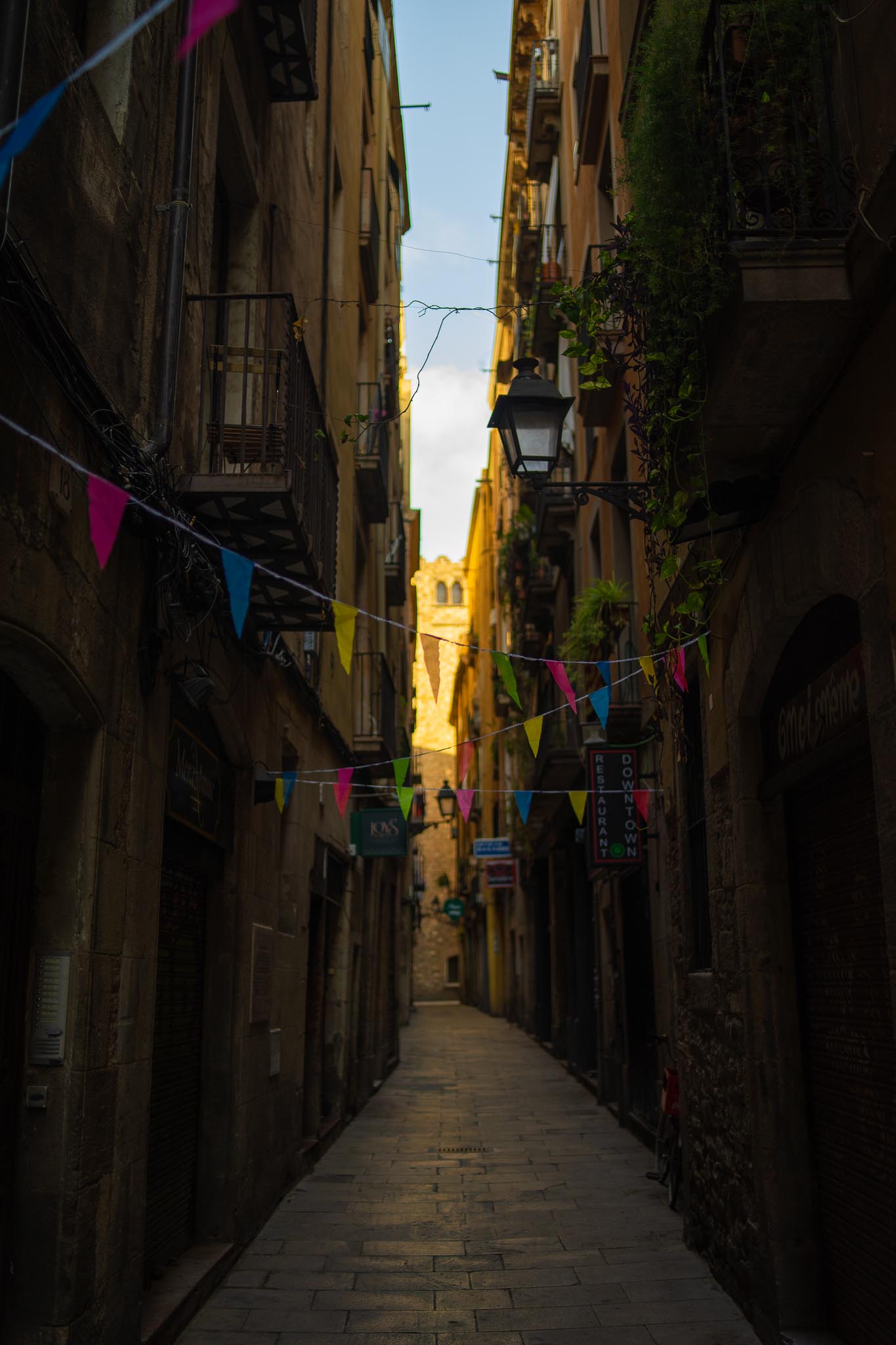
Four metres of stone either side and no sky to speak of. This is why the old city is beautiful at nine in the morning and audible at two — the walls that keep the heat out keep the conversation in.
El Born — the best dinner, and the bill after midnight
El Born is not, strictly, a neighbourhood at all. The city's official map of seventy-three barris puts it inside Sant Pere, Santa Caterina i la Ribera, and what people mean by the name is the eastern end of that: the ground between Via Laietana and the Parc de la Ciutadella, gathered around the great bare Catalan Gothic nave of Santa Maria del Mar and the promenade of the Passeig del Born behind it. The distinction matters when you book, because the same official neighbourhood also contains streets up by Sant Pere that are quiet, residential and cheaper — and they are not what anyone is selling when they say Born.
What the Born does better than anywhere else in this article is dinner. The lanes off the Passeig del Born and around Carrer de Montcada carry the densest concentration of good, small, seriously run restaurants and wine bars in the old city, and unlike the Gothic Quarter across Via Laietana the trade is not overwhelmingly for visitors. You can leave the door at half past nine with no plan and eat properly within four minutes. That is most of the case for staying here.
The cost arrives at closing time, and it varies by block more sharply than anywhere else on this page. The streets immediately around the Passeig del Born and Carrer del Rec are a going concern until well after midnight; three turnings north or east, towards the Ciutadella or up past the Mercat de Santa Caterina, the same official neighbourhood is genuinely quiet. The lanes are medieval in width and behave acoustically like the Gòtic's. Taxi access is better — Passeig de Picasso, Via Laietana and the Passeig del Born itself all take vehicles — but the interior lanes do not. Jaume I on L4 sits on the western edge, Arc de Triomf on L1 at the top, and the park is on the doorstep, which is the closest thing the old city has to a garden.
Stay here if you have two to four nights, eating is a substantial part of why you came, you want the old city without the full saturation of the Gòtic, and you will look at the exact street on a map first. Look elsewhere if you are staying a week, need a lift and a large room, or expect to be asleep by eleven at a weekend.The trade-off: the best evening in Barcelona, and an even chance of having booked a bedroom directly above it.
Gràcia — the one that feels inhabited
Gràcia was a separate town until Barcelona annexed it in 1897, and it has never entirely stopped behaving like one. The history is legible in the street plan: a grid, but tighter and older than the Eixample's, of low buildings and narrow roads opening into a series of proper squares — Plaça de la Vila de Gràcia under its clock tower, Plaça del Sol, Plaça de la Virreina, Plaça de la Revolució. The squares are the point. They are not ornamental spaces that visitors photograph; they are where the surrounding streets eat, drink, hold their meetings and let their children run about, and an evening in one of them is the least performed hour available to a traveller in this city. The Mercat de la Llibertat, an iron hall of 1888 decorated by Gaudí's collaborator Francesc Berenguer, still does the neighbourhood's shopping.
Be precise about which Gràcia you are booking. The district contains five official neighbourhoods; the one travellers mean isVila de Gràcia, between the Diagonal and the Travessera de Dalt. Above and around it, Vallcarca, El Coll and La Salut are further out, steeper and considerably less useful as a base, whatever a listing says about being in Gràcia.
The transport is good, and it is the far end of both spines, which is a genuine cost rather than a quibble. L3 reaches Fontana and Lesseps, L4 reaches Joanic, and the Ferrocarrils station at Gràcia adds a third option. From Fontana you are perhaps fifteen minutes from Passeig de Gràcia, twenty-five to thirty from the old city, and further still from the beach, which needs a change. Add the slope — the ground rises steadily northwards, and Lesseps sits noticeably higher than Diagonal — and Gràcia becomes an area to arrive at in a vehicle rather than on foot from a station with a case in hand. It is also where the night-bus geometry bites hardest: once the metro stops, getting home means Plaça de Catalunya and a transfer, or a fare.
None of that matters much over five nights and it matters a great deal over two, which makes this the clearest length-of-stay argument on the page. On a short trip, twenty-five minutes each way is a meaningful fraction of your waking time; on a longer one it becomes the price of living somewhere real, and you stop noticing it by the third morning. One seasonal warning: the Festa Major de Gràcia in August fills the decorated streets for a week, which is either the best reason to be here or a decisive one not to be, and the squares are loud until very late throughout.
Stay here if you have five nights or more, have been to Barcelona before, want a neighbourhood rather than a district, or would simply rather eat where the people at the next table live.Look elsewhere if you have two nights, the beach is a daily fixture, or hills and stairs are a problem.The trade-off: you spend roughly forty minutes a day getting in and out, and are repaid in squares, in prices, and in the distinct sense of being somebody's neighbour rather than somebody's guest.
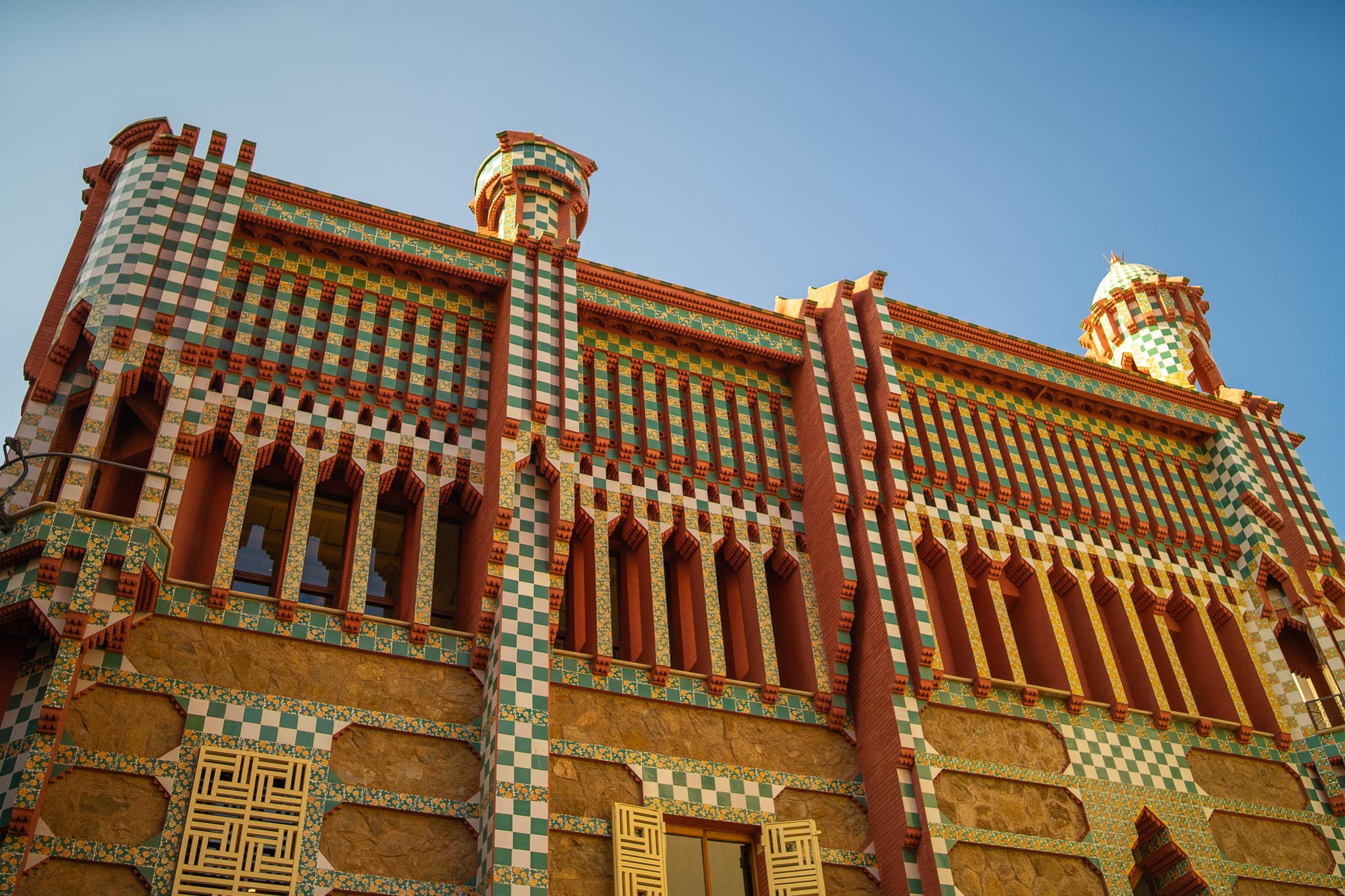
Gaudí's first house, on a residential street in Gràcia with nothing else remarkable on it. That is the neighbourhood's whole character: extraordinary things standing about in the middle of ordinary life, with no plaza built around them.
Sant Antoni and Poble-sec — two neighbourhoods, one avenue apart
These are routinely sold as a single area, and they are not one. The city's own boundaries put Sant Antoni in the Eixample district and Poble-sec in Sants-Montjuïc, with Avinguda del Paral·lel between them, and the two feel as different as that suggests. Sant Antoni is Cerdà's grid continued — wide streets, chamfered corners, tall regular blocks. Poble-sec is older, denser and lower, built up the first slope of Montjuïc in narrow streets that were housing working Barcelona long before the Eixample reached them.
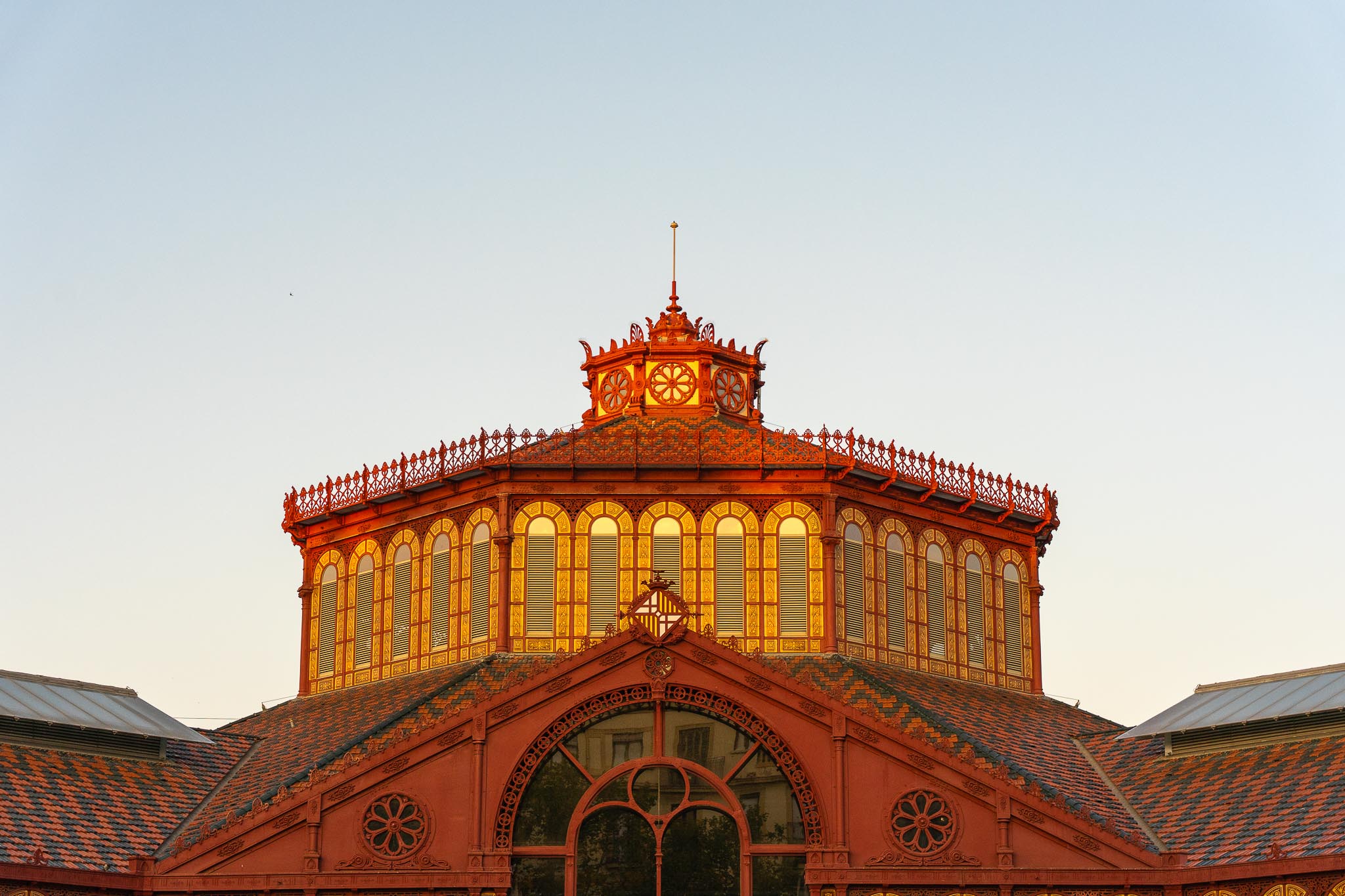
Sant Antoni's centre of gravity is its market, and the market explains the neighbourhood. Cerdà planned it into the grid; Antoni Rovira i Trias built it in iron between 1872 and 1882 as the first market outside the demolished walls, four great arms in the shape of a cross under an octagonal dome twenty-eight metres high. It closed in 2009 and reopened in May 2018 after a refurbishment that turned up the old Sant Antoni bastion of the city wall, now visitable on the floor below. It is three markets in one — the food hall, the Encants, and the Sunday book and collectors' fair that has run since the 1930s — and around it the streets have filled with the small, confident restaurants and vermouth bars that follow a restored market. Carrer del Parlament is the spine of that.
There is a caveat here with a date on it. Barcelona City Council began work on 25 June 2026 to make the neighbourhood's traffic-calmed layout permanent, on Carrer del Comte Borrell between Manso and the Paral·lel and on Carrer del Parlament between Viladomat and the Ronda de Sant Pau, together with the new square at their junction. The council states plainly that while the work is on there will be disruption to circulation and to the use of public space, and that it should be finished in June 2027. The result — kerbless, wider, greener streets with priority given to pedestrians — will be better than what was there before. Until then, the heart of Sant Antoni's eating quarter is a construction site, which is a real consideration for anyone booking on those two streets this year.
Poble-sec across the avenue is the cheaper and livelier half after dark. Carrer de Blai is a pedestrian street of pintxo bars that fills from eight and stays full; the streets climbing off it — Blesa, Poeta Cabanyes — are steep, residential and quiet by comparison. Montjuïc begins at the top: the funicular runs from Paral·lel, and the museums, gardens and the long view over the port are twenty minutes from the door rather than a half-day expedition. Transport is good and slightly awkward — Sant Antoni sits on L2 alone, Poble Sec and Paral·lel on L3, with Paral·lel the interchange — and Plaça d'Espanya is a short walk, which also puts the Ferrocarrils line out toGaudí's crypt at Colònia Güell on the doorstep. What you do not get, in either half, is a postcard when you open the door.
Stay here if you have been to Barcelona before, are staying four nights or more, want proper value, and care more about eating and drinking well among locals than about the view from the window. Look elsewhere if this is a short first visit and you would resent the fifteen minutes into the old city, or if you were about to book Carrer del Parlament itself before mid-2027.The trade-off: the best price-to-quality ratio in central Barcelona, bought by giving up the scenery outside the door.
Twenty-eight metres of iron lantern over the crossing of four arms — the first market Barcelona built outside its walls, shut for nine years and reopened in 2018. Neighbourhoods reorganise themselves around a restored market, and this one did.
Poblenou — space, and the beach without the crush
Poblenou is the part of Barcelona that was its factories. Textile mills and foundries covered this ground so thoroughly that it was called the Catalan Manchester; the 1992 Olympics cleared the seafront, and the 22@ programme has spent two decades filling the interior with offices, studios and new flats among the surviving brick chimneys. The result is the least old-feeling and most genuinely comfortable base on this page. Blocks are larger, buildings are newer, lifts and air conditioning are normal, and a given budget buys appreciably more floor space than anywhere between here and Montjuïc.
Be careful with the name, because the official map is unusually helpful here. El Poblenou and la Vila Olímpica del Poblenou are two separate neighbourhoods, and the difference is exactly the one you care about. The Vila Olímpica is the Olympic rebuild around Port Olímpic — the marina, the towers, the clubs — a nightlife destination with the noise profile to match. El Poblenou proper lies inland and north-east of it, and its axis is the Rambla del Poblenou: a genuine neighbourhood promenade of low buildings, benches under the plane trees, and almost nobody carrying a map. If a listing says Poblenou, establish which of the two it stands in.
The beaches are the other half of the case. Nova Icària, Bogatell and Mar Bella run north-east from Port Olímpic, and they are wider, better spaced and considerably calmer than Barceloneta — the same water, a fraction of the density, and a five-to-ten-minute walk from most of the neighbourhood. For a family in August that is not a nuance; it is the difference between a holiday and a daily negotiation. Transport is straightforward: Llacuna, Poblenou, Bogatell and Selva de Mar sit on the L4 spine, with the T4 tram alongside, which puts the old city fifteen to twenty minutes away without a change. Those minutes are the entire price of the area, and they are charged twice a day.
Stay here if you are travelling with children, staying five nights or more, coming in summer, want a real apartment rather than a small room, or have been to Barcelona already and do not need the Gothic Quarter outside the window. Look elsewhere ifyou have two or three nights and a first-visit checklist, or if evenings on foot among old stone are the reason you came.The trade-off: the most comfortable rooms and the calmest sand in Barcelona, at the cost of never being able to walk home from dinner in the old city.
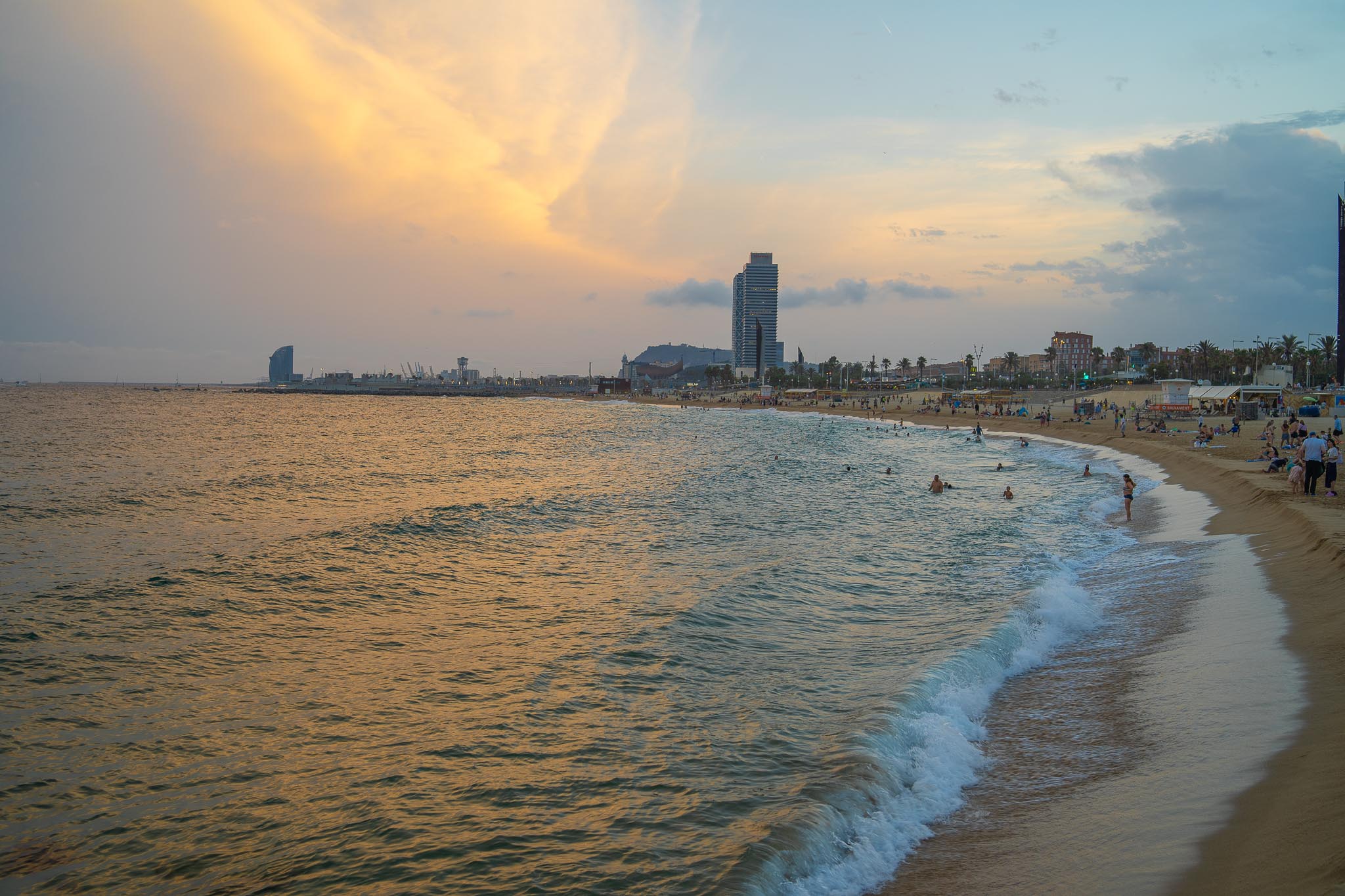
Half past eight in August, looking back along the sand towards the Olympic towers. Everything beyond that tower is dense and famous; everything behind the camera gets steadily quieter, which is the whole argument for sleeping further up the coast.
Barceloneta — only when the beach is the trip
Barceloneta is a planned neighbourhood, and its plan explains almost everything a visitor needs to know. It was laid out in 1753 on reclaimed ground to rehouse people whose homes had been demolished to build the Ciutadella fortress, and the blocks were drawn deliberately long and extremely shallow so that every dwelling could take light and air from both sides. Those shallow blocks are still there, which is why the flats are small — not by accident or by anyone's greed, but because the eighteenth century built them that way for fishermen, and the centuries since subdivided them further.
The compensation is immediacy. The beach and the Passeig Marítim begin where the houses stop, El Born is ten to twelve minutes on foot, the old city barely further, and the seafood restaurants along the Passeig Joan de Borbó have been doing this a long time. On a February weekend, with the beach empty and the light coming off the water, it is one of the more appealing places to be in Barcelona.
In August it is a different proposition. This is a small, dense peninsula with one metro station on it — Barceloneta, on L4 — and in high season it absorbs both the beach crowd and the port traffic through streets three metres wide. Late pedestrian noise on those streets is constant rather than occasional in summer, and the neighbourhood's long and public friction with holiday flats is a straightforward consequence of a resident population living at that density beside that many visitors. The value equation is poor: a beach premium for the smallest rooms in the city, frequently without a lift. Anyone who wants the sea but also space, quiet and a second bedroom is better served three stops up the L4 in Poblenou, where the beaches are better anyway.
A blanket dismissal would still be wrong, because there is a traveller for whom this is exactly right: two or three nights, out of season or untroubled by the crowd, in the water twice a day, eating fish with the boats in view, walking to the Born in the evening without ever touching a metro. If that is your trip, nothing else here does it as well, and the small room is not a defect but the entry fee.
Stay here if the beach is the primary reason for the trip, you are travelling alone or as a couple, the stay is short, and you are coming outside July and August.Look elsewhere if you need space, are travelling with children or a large case, sleep badly in summer, or simply want the beach as one feature of a broader week.The trade-off: the shortest walk to the sea in Barcelona, and the least room and the worst value once you come back from it.
Barcelona does not punish a bad neighbourhood choice with a ruined trip. It punishes it with twenty minutes, twice a day, for the length of the stay — and with the hour after midnight, when the metro has stopped and the map quietly changes shape.
How to decide
Four questions settle this faster than any amount of comparison, and they are worth answering honestly before you look at a single listing.How many nights? Under four, buy proximity and accept the noise; over four, buy the quiet and spend the minutes. The arithmetic genuinely reverses somewhere around the fourth night, and almost every disagreement about Barcelona neighbourhoods turns out on inspection to be a disagreement about length of stay.
How late will you be out? This is the question people skip and then regret. If your evenings routinely end after midnight on a weekday, you are either walking home or paying for a taxi, and the areas that make that painless are the old city and the central Eixample.What are you optimising for? Atmosphere, food, beach, quiet and value point at different answers; picking two is realistic, picking four is not. And how are you arriving? A large case, a late landing, a pram or a mobility constraint all argue for streets a vehicle can enter, which quietly eliminates most of the old city before anything else is considered. What follows applies those answers directly, and introduces nothing the sections above have not already earned.
📍 Barcelona — Where to Stay
🛏 Seven areas · verified 2 August 2026
The shortest route to a decision
First visit, two or three nights — central Eixample, within about ten minutes of Passeig de Gràcia. Everything is one ride away and nothing needs planning.
Five nights or longer — Gràcia. The daily twenty-five minutes stops mattering and the neighbourhood starts paying you back. Sant Antoni or Poblenou for the same logic with better rooms.
Families — Poblenou. Larger flats, lifts, calm streets, and the best of the city beaches at the end of them.
Light sleepers — Eixample, in a courtyard-facing room, on one of the quieter streets away from Gran Via, Aragó and Balmes. That beats a quiet-sounding district with a street-facing window every time.
Nightlife — El Born for eating and drinking that runs late; the Vila Olímpica end of Poblenou if you specifically mean clubs. Do not book the Born and then complain about the Born.
Beach priority — Poblenou if you want space and quiet with it; Barceloneta only if the beach genuinely leads the decision and the stay is short.
Food priority — Sant Antoni and Poble-sec for value and locals, El Born for the best cooking within walking distance of a bed, Gràcia for eating in a neighbourhood rather than a destination.
Early train from Barcelona Sants — Eixample or Sant Antoni, both a short ride on L3. Sants sits about three kilometres west of the old city and further still from everywhere else here, so an early departure is one of the few reasons to weight the west of the city at all.
Airport convenience — Eixample near Passeig de Gràcia, where the airport train stops, or anywhere close to the Aerobús line through Plaça d'Espanya, Gran Via–Borrell, Plaça Universitat and Plaça de Catalunya.
Mobility limitations — Eixample or Poblenou. Flat ground, wide pavements, vehicle access to the door and lifts as standard. Avoid the old city, and check the specific station rather than the line.
Large luggage — anywhere a taxi can reach the door, which means the Eixample, Poblenou, Sant Antoni or Poble-sec. Assume a walk with the case in the Gòtic, the Born and Barceloneta.
Repeat visitors — Sant Antoni, Poble-sec or Gràcia. All three give a neighbourhood instead of a district, and all three cost the same fifteen to twenty-five minutes that stopped being expensive the second time you came.
What each area is like after midnight
Loud late: the Gothic Quarter throughout · the streets around the Passeig del Born and Carrer del Rec · Plaça del Sol and the other Gràcia squares · Carrer de Blai in Poble-sec · Barceloneta's narrow streets in summer · the Vila Olímpica and Port Olímpic.
Moderate: most of the Eixample, where traffic replaces voices as the noise source · Carrer del Parlament in Sant Antoni, which thins after one · the Rambla del Poblenou.
Quiet: Eixample courtyard rooms · the northern streets of Sant Pere behind the Born · the streets climbing off Blai in Poble-sec · the interior grid of Poblenou · Vila de Gràcia three turnings from any square.
Watch-outs
"Central" and "Gothic Quarter" tell you nothing actionable in a city this size. Find the exact street on a map, look at how wide it is and what is on the ground floor opposite, then ask the property whether the room faces the street or the courtyard. Those two checks are worth more than any district recommendation, this one included.
The metro stops at midnight from Sunday to Thursday. If you plan to be out later than that on a weekday, work out the walk or the farebefore you book, not at half past twelve on the second night.
Sant Antoni's Comte Borrell and Parlament are under construction until around June 2027 — an excellent neighbourhood with disrupted streets. Check which side of the works a room sits on.
August changes the ranking. The Festa Major de Gràcia fills that neighbourhood for a week, Barceloneta is at its most crowded, and Poblenou's advantages are at their largest. In February none of that applies.
Lines close sections for engineering work, usually in summer. TMB publishes current service alterations line by line; check the specific line before you rely on it, and treat any journey time quoted anywhere — here included — as an estimate rather than a timetable.
Arriving with luggage
The airport is Josep Tarradellas Barcelona–El Prat, and which terminal you land at changes your options. The Aerobús runs around the clock — A1 from Terminal 1, A2 from Terminal 2 — and comes into the city by way of Plaça d'Espanya, Gran Via–Borrell, Plaça Universitat and Plaça de Catalunya. Read that list again, because it is the whole point: the airport coach is an Eixample and old-city-edge machine. It does nothing directly for Gràcia, Poblenou or Barceloneta, each of which needs a metro leg on the end of it.
The train has one wrinkle. Aena puts the Renfe station on floor 0 of Terminal 2, and the line is R2 Nord, which runs into Barcelona Sants and Passeig de Gràcia before continuing to El Clot–Aragó. From Terminal 1 you must first take the free inter-terminal shuttle, which runs twenty-four hours — a step that turns a simple journey into a two-part one, and the reason the train suits Terminal 2 arrivals while the Aerobús often suits Terminal 1. Themetro, line L9 Sud, serves both terminals but ends at Zona Universitària on the far western side of the city and carries an airport fare supplement. It is a route to a change, not to the centre.
Barcelona Sants is the long-distance station, and it is not central — roughly three kilometres west of the old city, in a working neighbourhood rather than a place most visitors sleep. It sits on L3 and L5, and L3 is the useful one: from Sants Estació it runs straight through Espanya, Poble Sec, Paral·lel, Drassanes and Liceu to Catalunya, Passeig de Gràcia and on into Gràcia. Anyone with an early departure — including the trains carrying the day tripsnorth to Figueres and Girona andsouth to Tarragona and Sitges — should weight a bed within a few stops of that line accordingly.
Two last practicalities. Taxis cannot reach a great many old-city addresses. The lanes of the Gothic Quarter and the interior of the Born are bollarded or pedestrian, so the driver stops on Via Laietana, the Rambla, Plaça Nova or the Passeig de Picasso and you walk the last stretch over stone. Budget for that when choosing between a beautiful lane and a dull street with a kerb outside it. Andthe metro is not uniformly step-free. TMB reports lifts in 156 of its 165 stations, with nine not yet adapted; four of those bear on the areas here — Urquinaona and Verdaguer in the Eixample, Espanya beside Sant Antoni and Poble-sec, and Plaça de Sants by the main station.
Seven areas, two spines, and one square that everything comes back to after midnight.
If a single ranking is wanted, here it is.Eixample is the safest first recommendation and the hardest to regret, because it is the only address that keeps every option open. Gràcia is the better answer the moment a stay passes five nights. El Born is right for a short, late, food-led trip and wrong for most other things.Sant Antoni and Poble-sec are what repeat visitors choose once they stop needing the scenery, allowing for the works.Poblenou is the answer whenever space, calm, children or summer enter the question. Barceloneta earns its place only when the sea leads the decision. And theBarri Gòtic is the one to be honest with yourself about: extraordinary to walk out into, and a genuinely poor place to sleep unless you are certain that noise does not reach you.
None of which is as decisive as the smaller choice inside it. The best rooms in Barcelona are rarely on the streets in the photographs; they are one turning away, facing a courtyard, on a block with no bar on the ground floor opposite. Four minutes with a map will do more for the week than moving between neighbourhoods will — and once the room is settled, what remains is the city itself, argued at length inseven days in Barcelona, reached at the end ofa month overland from Porto, and gathered with everything else inthe archive and onthe map by region.