Three days is enough for Seville, provided the days are arranged in the right order — a route that begins at the Alcázar gate, crosses the river once, and ends above the rooftops.
Most of what first draws a traveller to Seville stands inside a walkable oval barely two kilometres across. On a map that looks like permission to wander. The clock argues otherwise. The great monuments are gathered so tightly around a single square that three days can be spent orbiting the same four hundred metres, and it is entirely possible to discover, on the last afternoon, that the river was never crossed, the gardens never entered and the quiet palaces of the northern lanes never found at all.
The difficulty of three days here is not distance. It is sequence. The Alcázar and the Cathedral both admit visitors by the clock. The Cathedral opens late on a Sunday, the archive is shut on a Monday, and the market that anchors the far bank keeps a market's hours and is finished by lunch. For much of the year the middle of the day belongs to the shade — not an inconvenience to be worked around, but the shape a city settles into after several centuries of being too hot to argue with. Get the order wrong and the same afternoon is crossed three times. Get it right and the ground covers itself.
What follows is a route rather than a diary. It is built from the city's geography and its published hours rather than from a single walk through it, and it draws on a longer stay recorded elsewhere on this site asten days using Seville as a base. That chronicle is for the traveller with a week or more, who can afford to let the place accumulate. This one is for three days and a return flight; for less than that, there isa single day.
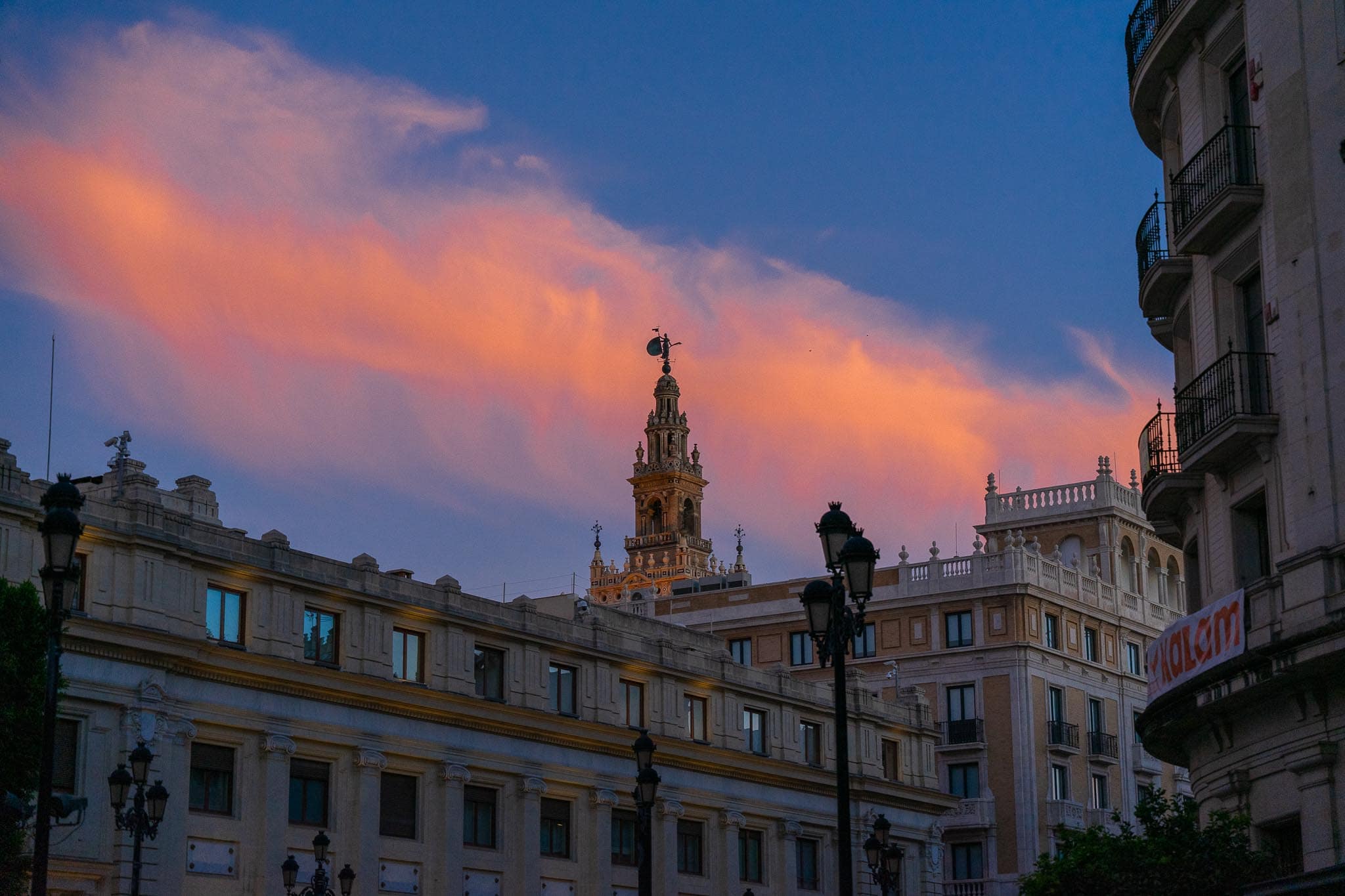
The Giralda holds the last light long after the streets below have gone blue — the one fixed point in a city that is otherwise easy to lose your bearings in.
Who this route suits
This is a first visit, made on foot. It assumes an appetite for the buildings that carry Seville's reputation, one full day on the far bank of the Guadalquivir, and enough unstructured time in the late afternoons that the city stops behaving like a list. Two tickets are booked before you fly; nothing else needs to be. It is neither a sprint nor a survey, and what it leaves out is named plainly at the end, because an itinerary that claims to be complete is only a badly edited one.
The Three Days at a Glance
Shape: One tight radial day, one linear river day, one south-to-north traverse. No day retraces another.
On foot: Roughly 2 km, 3 km and 3.5 km respectively — comfortable, with one optional short taxi on Day 3.
Book ahead: The Real Alcázar, then the Cathedral and Giralda. Everything else can be bought on the day.
Best months: March to May, and late September through November. July and August work only with a long midday break.
Day by Day
Day 1Real Alcázar at opening, Cathedral and Giralda, Archivo General de Indias, then Barrio de Santa Cruz as the shadows lengthen.
Day 2Mercado de Triana early, Centro Cerámica Triana, the Triana riverfront and Calle Betis, one bridge crossing to the Torre del Oro and the Maestranza, back to the water for the evening.
Day 3Plaza de España before the crowds, Parque de María Luisa for shade, north to Casa de Pilatos, and the Setas de Sevilla at dusk.
I.
The Monumental Core
A palace, a cathedral, an archive and a quarter of narrow lanes — all inside four hundred metres
The first day is bounded by walls. The Real Alcázar closes the southern side of Plaza del Triunfo, the Cathedral the northern, and between them stands the Archivo General de Indias, a building most visitors walk past without discovering that it holds one of the more extraordinary rooms in Spain. Three of the city's essential sights face one another across a single square, the Giralda's bells carry over all of them, and two kilometres is the whole of the day's walking. Whatever else Seville withholds, it does not make the first morning difficult.
Begin at the Alcázar gate, at opening. This is not a preference. Entry is timed, the early slots go first, and the decision is therefore made weeks before arrival rather than on the morning itself — the first of the small ways this city rewards planning and declines to reward improvisation. Inside, the palace has been lived in without interruption since the twelfth century, and what makes it strange is not any single room but the choice the Christian kings made when they inherited it: they extended what the Moors had built rather than replacing it. Eight hundred years of one civilisation finishing another's sentence. The Patio de las Doncellas and the dome of the Salón de Embajadores are the set pieces; the gardens beyond them are half the visit and are almost always under-budgeted. Give the palace an hour and the ground outside it another, and paths will still be left unwalked.
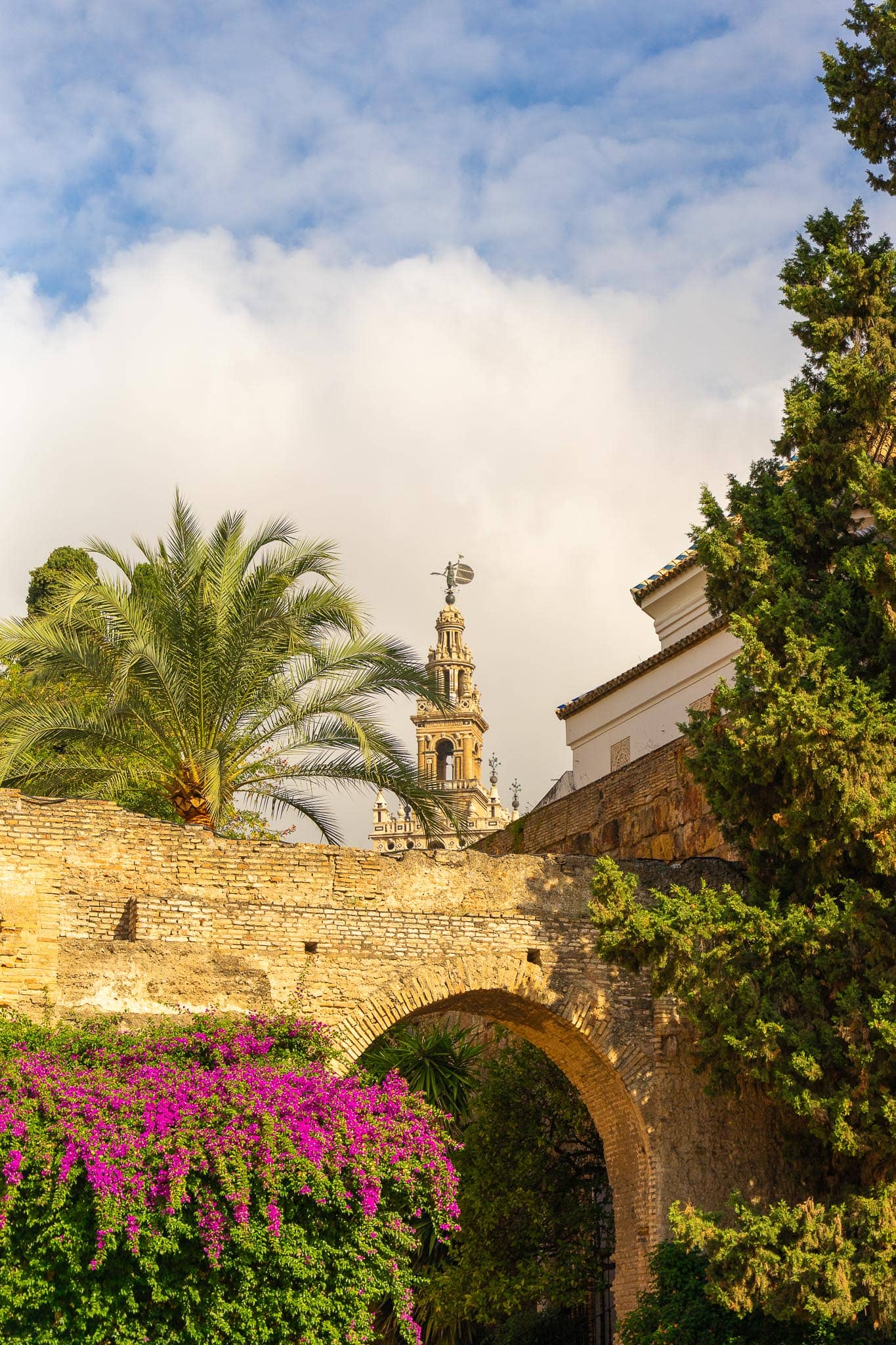
From inside the Alcázar grounds the Giralda arrives in pieces — belfry, brick, bougainvillea. Palace and Cathedral are neighbours, which is why the first day can afford to be slow.
Three or four minutes separate the Alcázar gate from the Cathedral: long enough for a coffee, not long enough to plan one. The general ticket is worth reading properly, because it covers three things rather than one — the Cathedral, the ascent of the Giralda, and the Church of El Salvador a few streets north, which a good many visitors pay for without ever discovering they have.
The Giralda is the minaret of the mosque the Cathedral replaced, converted rather than demolished, and it is climbed by ramps rather than stairs — built wide enough, the story goes, for a rider to ascend on horseback. One caution belongs to this year rather than the twelfth century: work on the belfry has been under way through 2026, the Cathedral has moved its visiting hours more than once because of it, and no completion date has been published. The climb remains open and included in the ticket, although visiting hours can change while work continues on the belfry. Check the official page in the week before you travel, and trust it over any itinerary, this one included.
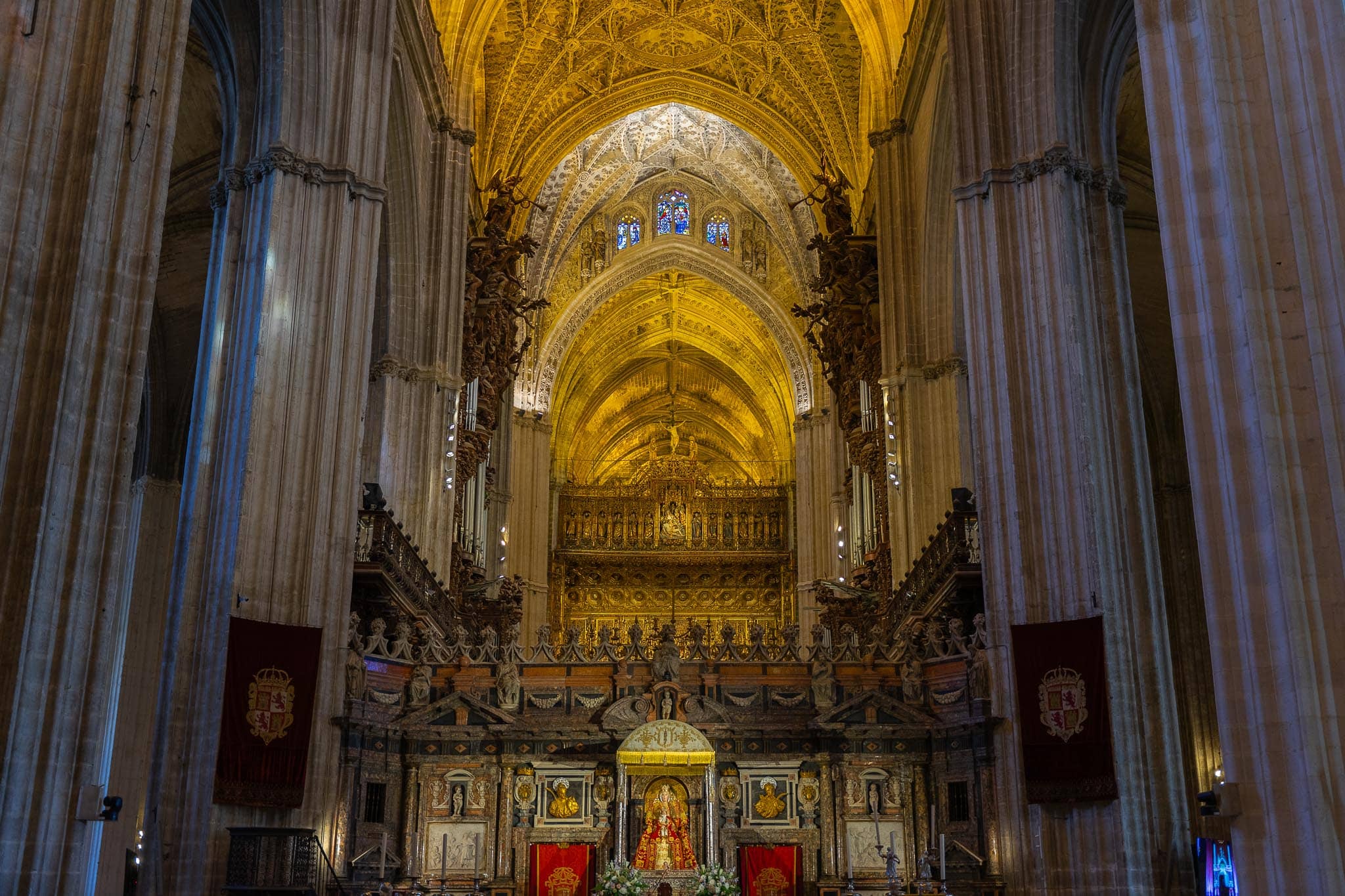
The Capilla Mayor under the vaults. The Cathedral gives more to a slow circuit of the ambulatory than to a march between its famous objects.
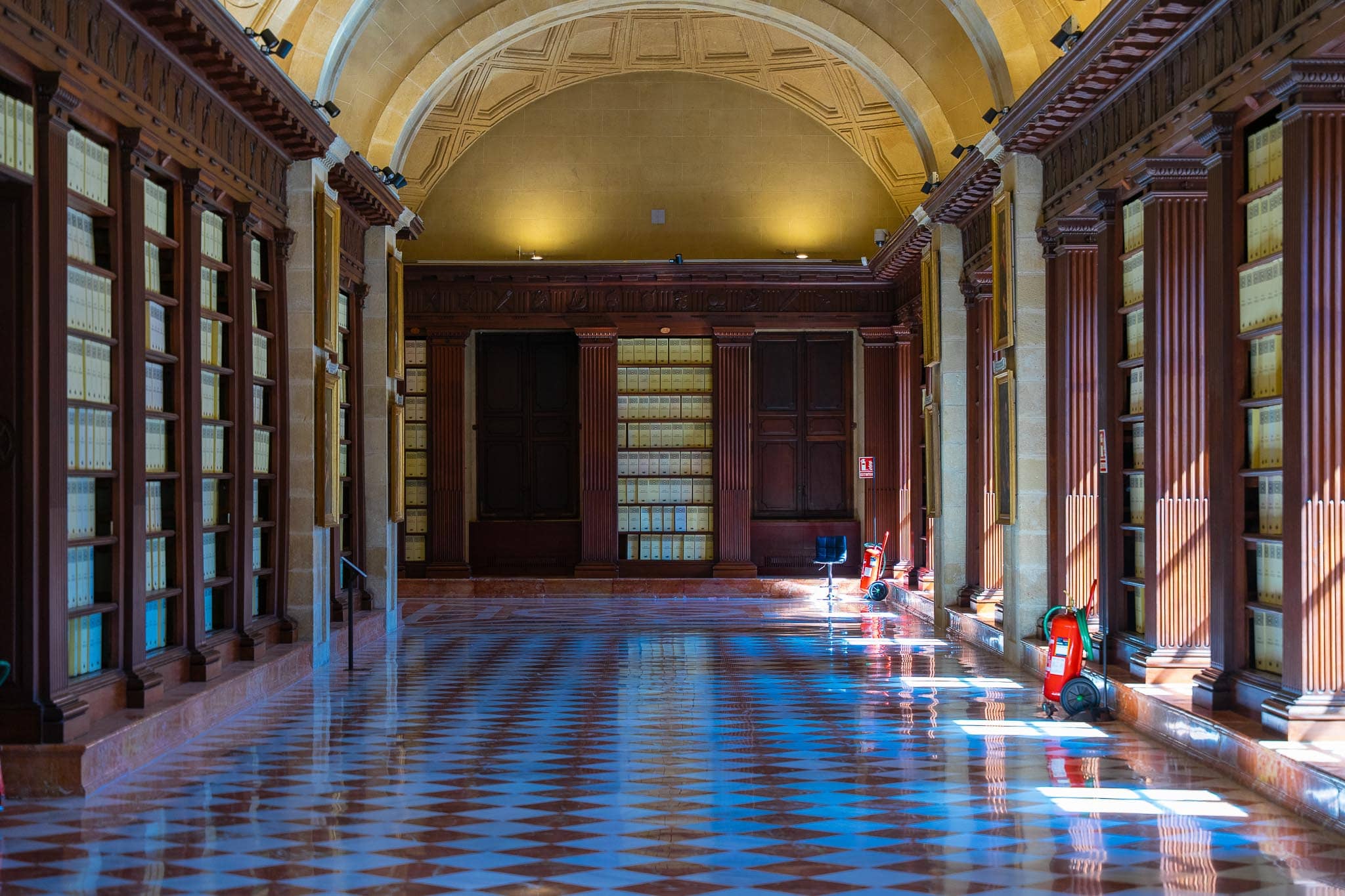
By the time the Cathedral is finished it will be early afternoon, which for much of the year is the worst hour to be out in the open. This is what the Archivo General de Indias is for. It is free, it is cool, it takes half an hour, and it holds the paper record of the Spanish empire in the Americas — the whole colonial project reduced to uniform boxes on eight kilometres of mahogany shelving, in a vaulted Renaissance gallery with a chequered marble floor cut by window light. Few rooms hold so much consequence so quietly. The longer chronicle on this site calls it a building that deserves more time than it usually gets, and that remains true. One fact about it matters more than any other: it closes on Mondays, and that single closure breaks more three-day plans than anything else in Seville.
Leave Barrio de Santa Cruz until the shadows have crossed the lanes. The old Jewish quarter begins a few minutes east of the Cathedral and is the part of the day with no ticket, no queue and no fixed route: whitewashed walls, orange trees, courtyards behind iron gates, and alleys narrow enough in places that two people cannot comfortably walk them abreast. At noon it is an oven with a crowd in it. At six it is one of the pleasantest places in Andalucía to be lost on purpose, and it drifts of its own accord into an evening — the bars thicken towards Calle Mateos Gago and Plaza de la Alfalfa, and the first day ends without anyone having to decide that it should.
The Archivo General de Indias: free, cool, and half an hour long — eight kilometres of shelving holding the paperwork of an empire.
📍 Seville — Day 1
🚶 Monumental core · ~2 km on foot
The route in order
Real Alcázar — first timed slot of the day. Allow 2 to 2½ hours including the gardens. Open 09:30–19:00 from 1 April to 30 September and 09:30–17:00 from 1 October to 31 March. Closed 1 and 6 January, Good Friday and 25 December.
Catedral de Sevilla and the Giralda — 3 minutes' walk. Allow 1½ hours including the tower. The general ticket also admits you to the Church of El Salvador, which the Cathedral lists as closed on Sundays in July and August.
Archivo General de Indias — 2 minutes' walk, free entry, 30 to 45 minutes. Tuesday to Saturday 09:30–17:00; Sunday and public holidays 10:00–14:00. Closed Mondays.
Barrio de Santa Cruz — 5 minutes' walk. An hour or two, unstructured, late in the afternoon.
Tickets
Alcázar general admission €15.50; reduced€8.00 for over-65s, students aged 14–30 and European Youth Card holders. The Cuarto Real Alto is a separate€5.50 supplement. Free for under-13s with an adult and for visitors with 33% or greater disability plus one companion. Buy online in advance through the official site.
Cathedral and Giralda €13.00 online / €14.00 at the ticket office; reduced €7.00 / €8.00. Free entry applies to under-13s with an adult and to visitors with disability above 65%. Prices current from 1 January 2026.
The Cathedral releases a limited number offree tickets for Sunday-afternoon visits, outside public holidays. They must be reserved online in advance and are not available as walk-ups. Published start times have varied during 2026, so take the exact time from the official booking calendar for your date.
Watch-outs
Alcázar entry is timed and the morning slots sell out well ahead. This is the one booking that will actually change your day if you leave it late.
Cathedral hours are published as Monday to Saturday 11:00–18:00 and Sunday 14:30–19:00, with the Giralda closing at 17:00. The general schedule changes in July and August, and temporary works or worship can alter individual dates. Confirm the date-specific booking calendar before building the day around it.
The Giralda has no lift. The ascent is a long spiral of shallow ramps with a short flight of steps at the top.
Three monuments in sight of one another, and a quarter of lanes to lose the rest of the day in.
II.
Triana and the River
A market at trading hour, the far bank, and one crossing of the Guadalquivir
The second day belongs to the river. Everything on it stands within sight of the Guadalquivir, and the day runs from the far bank to the near one across a single bridge.
The river is the reason Seville took the shape it did. It carried the Almohad fleet, and then, for two centuries, the whole of Spain's trade with the Americas, which by law had to pass through this one river port — a city the better part of a hundred kilometres from open water, growing rich on an ocean it could not see. The river also divided the place. Triana stands on the west bank and has always been slightly other: sailors, potters, flamenco, a neighbourhood that knows it is not the centre and has never much wanted to be.
Start there, and start early, because the Mercado de Triana keeps a market's hours rather than an attraction's. It stands at the foot of the Puente de Isabel II on the foundations of the castle of San Jorge, and it is where the neighbourhood does its shopping: fish on ice, hams on hooks, olives in tubs, and a volume of conversation that falls away sharply once the morning is spent. If you eat anywhere on this day, eat here — the counters between the stalls serve what the stalls sell, which is the whole argument for a market breakfast. On a Sunday the produce trade stops and the building becomes a handsome hall rather than a working one.
Two minutes away, in the shell of an old tile works, the Centro Cerámica Triana explains why the rest of the city looks the way it does. Triana made the glazed tile that covers Seville's walls, benches, bridges and towers; the museum stands on the kilns that fired it. Half an hour, and everything already seen reads differently afterwards.
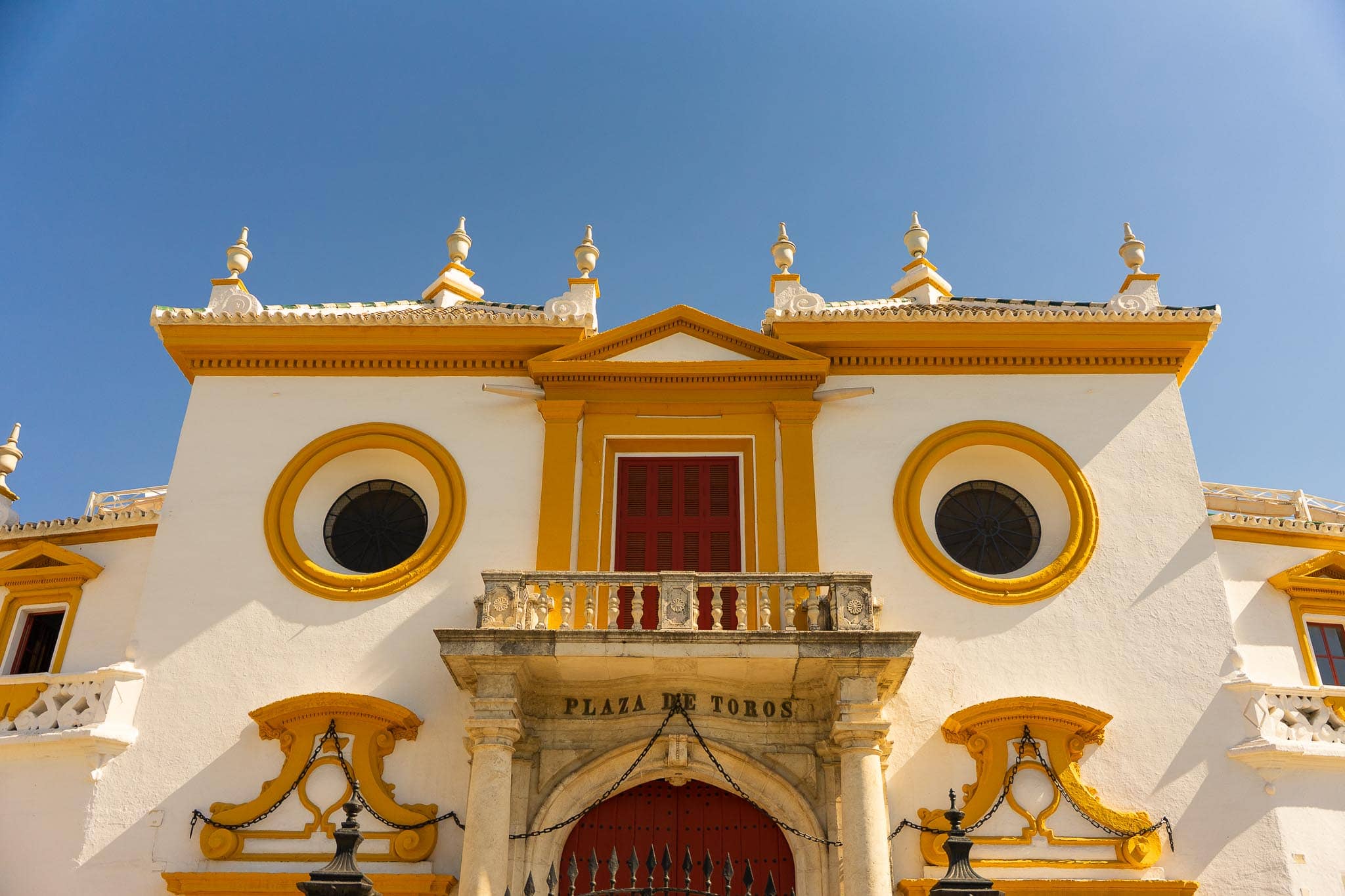
Then the water itself. Calle Betis runs along the Triana bank in low houses of ochre and white, facing the old city across the current — walk it now and return to it later, because the street at nine in the morning and the street at nine at night are not the same place. Cross the Puente de Isabel II and the afternoon is on the near bank: the Torre del Oro, the Almohad watchtower of 1221 that has since been a prison, a store and a maritime museum, and a few minutes beyond it the Plaza de Toros de la Real Maestranza, white stucco and ochre mouldings with its own name cut into the lintel. Its museum traces the corrida from the eighteenth century onward. Some travellers will decline the interior on principle; the façade and the walk along the water stand perfectly well without it.
Then let the afternoon go. In any season the hours after lunch belong to shade, and this day has been built to stop rather than continue: back over the bridge as the light drops, and Calle Betis again with the old city lit on the far side of the current. It is the one deliberate doubling-back in three days, and the only one worth making.
The Maestranza names itself in the lintel. It stands a few minutes from the Torre del Oro, which makes the near-bank half of the day very nearly a straight line.
📍 Seville — Day 2
🚶 Triana and the river · ~3 km, one bridge
The route in order
Mercado de Triana — early. Retail and produce stalls trade Monday to Saturday and are closed on Sundays and public holidays; hospitality inside the building may still operate on a Sunday. 30 minutes, or an hour if you eat.
Centro Cerámica Triana — 2 minutes' walk. About 30 minutes.
Calle Betis and the Triana riverfront — a slow half hour along the water.
Puente de Isabel II — the single crossing of the day, about 15 minutes' walk to the Torre del Oro on the far side.
Torre del Oro — 30 to 45 minutes, including the viewing platform. Plaza de Toros de la Real Maestranzais 5 minutes further; interior visits are guided and run on a cycle through the day, or see the façade and walk on.
Evening — back over the bridge to Triana. Calle Betis faces the old city and gets the light late.
Watch-outs
Schedule this day Monday to Saturday if the working market matters to you.
Bring cash for the market stalls; the bars and counters take cards.
The bridge is level; several riverbank access points are not.
One bank, one bridge, one bank again. The river does the organising.
III.
South to North
An early, empty Plaza de España, a shaded park, a quiet palace, and the city from above
The third day is a passage rather than a circuit. It begins in the south on ground the city built for a world's fair and ends in the north on a canopy of modern timber, and between the two it crosses the old city on foot — about three and a half kilometres in all, with one uninterrupted leg of roughly two. In April that leg is among the better walks in Spain. In August it is not, and a five-minute taxi is simply the better decision.
It is also the day on which Seville stops being one city and becomes several. Exposition brick and glazed tile in the morning, a park of deep shade behind it, then Mudéjar plasterwork, a Renaissance courtyard and Roman marble carried home in a sixteenth-century traveller's luggage, and at the end a timber lattice the city argued about for years before absorbing it into its own vocabulary. Four ages of one place, walked in a single line.
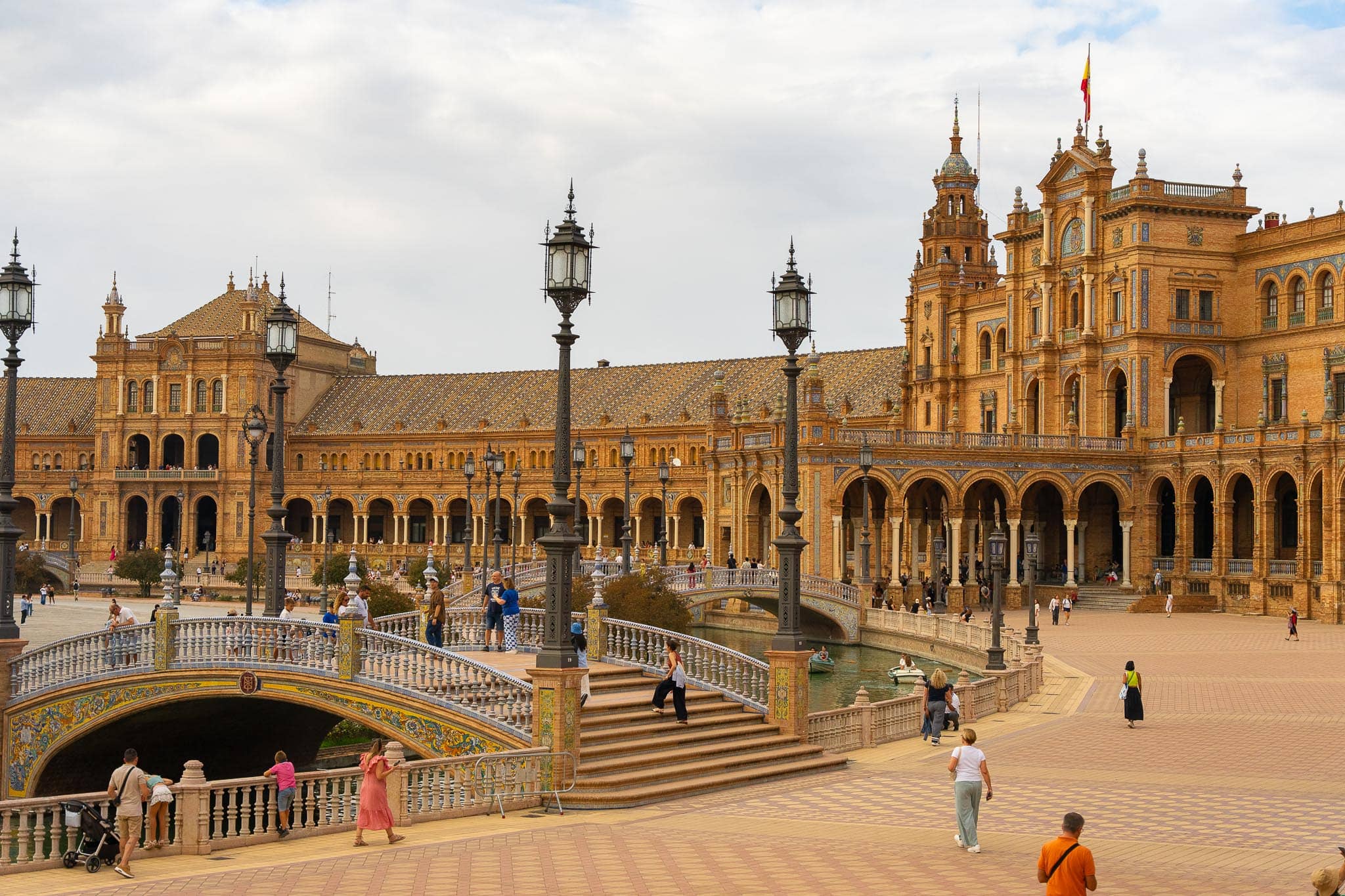
Begin at Plaza de España, and begin as early as it can be borne. This is the strongest single instruction in the itinerary and the reason is physical rather than aesthetic. The plaza is a vast unshaded semicircle of brick and glazed tile, free, ungated, with no opening hour to obey. Before about half past nine it is close to empty and the low sun comes across the tilework and the canal at an angle it will not find again all day. By noon the same ground is the hottest and most crowded place on this route, with nowhere at all to stand out of the light. Fitting Plaza de España into a spare afternoon is the most reliable way to see it at its worst.
Parque de María Luisa begins immediately behind it, and the order is deliberate: the most exposed place on the route is followed at once by the most shaded. Park and plaza were laid out together for the 1929 Ibero-American Exposition, and the park has kept its Moorish fountains, its tiled benches, its ponds and its very large trees. Give it an hour. The Plaza de América at the far end has the pavilions and the pigeons and is a reasonable place to stop moving for a while.
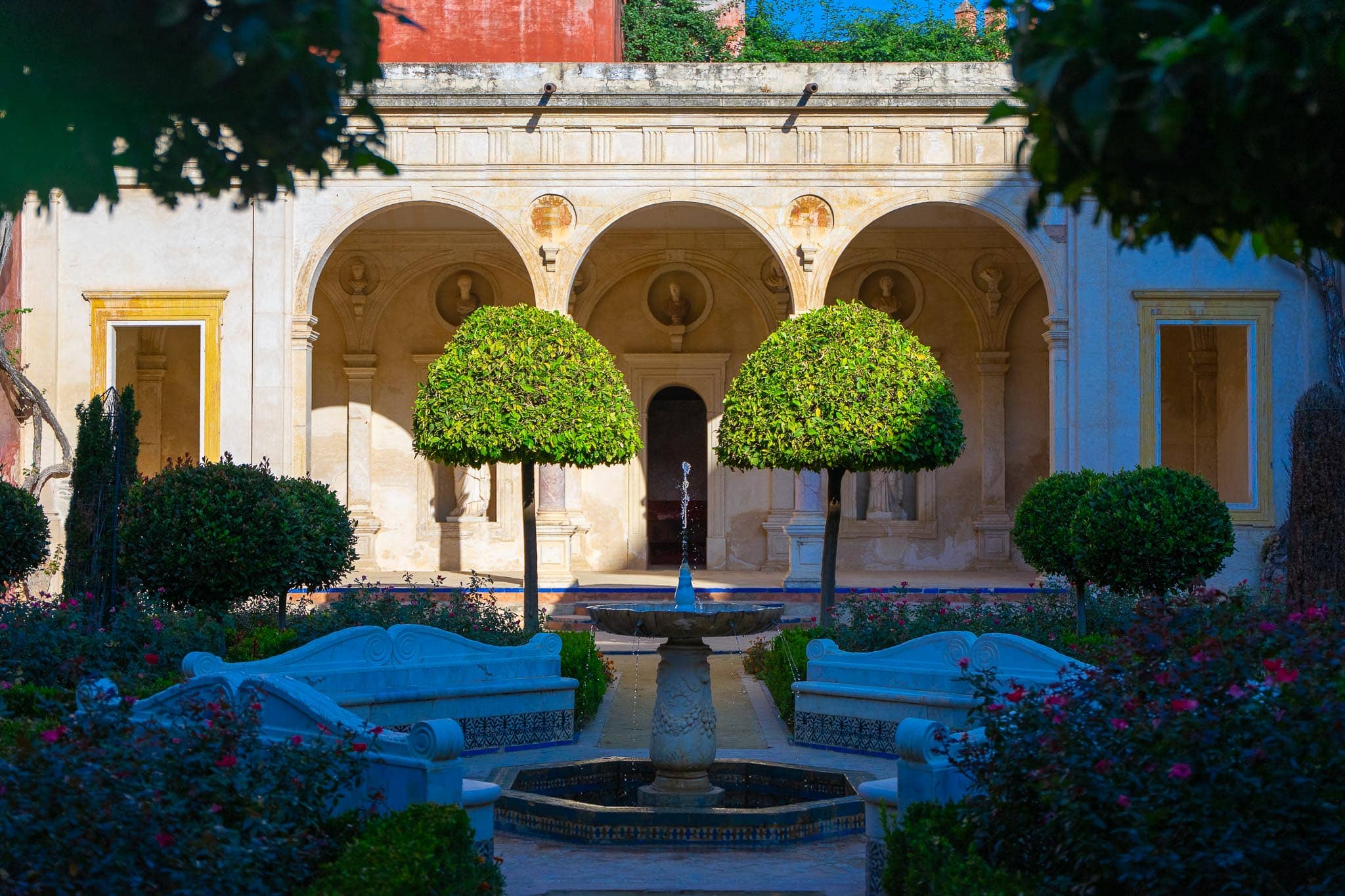
Then north, and this is the traverse — through the old city, past lunch and the worst of the heat, into a quiet square east of the Cathedral. Casa de Pilatos is the finest of Seville's private palaces, if a choice has to be made: a sixteenth-century house built by an owner who had travelled to Italy and the Holy Land and came home determined to reconcile what he had seen. Roman busts sit in the arches of the garden loggia, above azulejo benches and roses and an octagonal tiled fountain, and nothing in the composition looks borrowed. It needs no timed ticket and it opens every day of the week, which is what makes the third day the flexible one.
Finish ten minutes further north, at the Setas de Sevilla in Plaza de la Encarnación. The timber lattice carries a walkway across its upper surface, and from it the old town lies out below with the Giralda on the skyline — the tower that has been fixing your position for two days, seen from above for the first time. Time this for dusk. The Setas stay open long after dark, which in high summer is the difference between a viewpoint and a furnace, and from April to October a light installation runs across the canopy in the late evening.
Mid-morning, and the plaza is already filling. An hour earlier the bridges are empty and the light comes across the tiles rather than down onto them.Casa de Pilatos keeps its best room outdoors. The Roman busts came home in the luggage of a sixteenth-century traveller.
📍 Seville — Day 3
🚶 South to north · ~3.5 km, one long leg
The route in order
Plaza de España — arrive between 08:30 and 09:30. Free, unenclosed, no ticket. 30 minutes to an hour.
Parque de María Luisa — directly behind the plaza. An hour, longer if you walk to the Plaza de América.
North to Casa de Pilatos — about 2 km, 25 to 30 minutes on foot through the old city, or a short taxi. Break for lunch and the worst of the heat on the way.
Casa de Pilatos — open every day 09:00–18:00.€12 for the ground floor and garden;€6 more for the upper floor, which is shown on a guided visit. Allow an hour, or 90 minutes with the upper floor.
Setas de Sevilla — 10 minutes' walk north. General admission from €16, including the rooftop walkway, a short film and the evening light installation, which runs April to October. Allow an hour and aim for dusk.
Watch-outs
Sunset moves by three hours and more across the year in Seville. Check the time for your dates before fixing the Setas as a dusk stop — in December it comes soon after six, in June well after nine.
The Setas walkway is reached by lift but undulates once you are on it. Confirm current opening hours on the official site: the published times run late into the night and are easy to misread.
Seville city council has discussed enclosing Plaza de España and charging non-residents for entry. Nothing has been implemented and no price has been set, but it is worth a check if you are reading this well after publication.
A city this compact does not punish you for walking. It punishes you for walking the same four hundred metres three times and calling it a visit.
Arranging the days around Sunday and Monday
The order above assumes three ordinary weekdays. Two days of the week interfere with it, and the correction is always the same: move Day 3, which is the only day with nothing closed in it.
If one of your days is a Monday, do not make it Day 1. The Archivo is shut, and with it goes both the building and the cool hour in the middle of the day that the first day is built around. Put Day 3 on the Monday and shift the monumental core elsewhere.
If one of your days is a Sunday, the Cathedral is the problem: outside July and August it does not open to visitors until 14:30. Day 1 still works on a Sunday, but only reversed — Alcázar at opening, Santa Cruz and the Archivo in the late morning, lunch, and the Cathedral in the afternoon, into which a free Sunday pass fits neatly if you have reserved one. A Sunday also removes the working market from Day 2. With both a Sunday and a Monday in your three days, give the Sunday to Day 3 and the Monday to Day 2.
All of this rests on hours that move. The Cathedral has changed its schedule more than once during the current works and says outright that its times may be modified for worship and cultural events. Treat the pattern above as the logic and the official sites as the authority.
What to book, and in what order
Two tickets, bought before you fly, in this order.
First, the Real Alcázar. This is the only booking on the itinerary where leaving it late genuinely damages the trip: a mid-afternoon slot in August is a much worse morning's palace than a 09:30 one. Buy throughthe Alcázar's own visitor page rather than a reseller, and decide on the Cuarto Real Alto supplement at the point of purchase.
Second, the Cathedral and Giralda. Also timed, and €13.00 online against €14.00 at the window. The free Sunday tickets need their own advance reservation and are capacity-limited. Hours, prices and the current state of the belfry works are all published onthe Cathedral's schedules and rates page — the one source worth checking in the week before you travel.
Everything else on these three days is a walk-up.
Heat, and adjusting for the season
Seville is among the hottest cities in western Europe, and the route above is shaped around that rather than warning about it in a footnote. Every day front-loads the exposed ground and keeps something shaded or indoors for the early afternoon.
July and August. Temperatures regularly pass 40°C. The route still works but the middle of the day does not: plan on roughly 08:30 to 13:00 and then nothing until 18:30, and treat the afternoon gap as part of the itinerary rather than a failure of it.
Late September to November. The best compromise: upper twenties into the low thirties in September, easing through October, with the August crowds gone and the city back at work. Watch one thing — the Alcázar drops to a 17:00 closing from 1 October, which tightens Day 1 and makes the early slot matter more, not less.
March to May. Warm, long-lit and green, and the season in which the Day 3 traverse is most obviously a pleasure on foot. One caveat that is not weather: Semana Santa and the Feria de Abril transform the city, close streets, move opening hours and raise room prices substantially. Either is a reason to come or a reason to avoid the dates entirely, but neither is a week in which this itinerary will survive contact with reality.
December to February. Mild days, cold evenings, few crowds and cheap rooms. The constraint is light rather than heat: the Alcázar closes at 17:00, and dusk comes early enough that the Setas finish on Day 3 falls in the first part of the evening.
Walking, arriving, and where to stay
Three days of this route ask for about nine kilometres on foot. The old city is flat and compact, and no bus, tram or metro ticket is needed at any point; the only likely exception is the middle leg of Day 3, where a short taxi across the centre is a sensible purchase in high summer.
Arriving is the only transport worth planning. Trains reachSevilla-Santa Justa, about two kilometres northeast of the Cathedral: half an hour on foot, or a short taxi with luggage. A dedicated airport bus runs into the centre; fares and frequencies change, so check the operator rather than an itinerary. Long-distance coaches, including those from the Cádiz coast and the Tarifa ferry, useEstación de Autobuses del Prado de San Sebastián, central and walkable to most of the old city — the approach taken bya longer overland route from Morocco, and one of several ways into Andalucía covered inthe wider Iberian rail and road chronicles.
Three days is short enough that where you sleep matters more than what you sleep in. The longer stay recorded on this site took its nights inSan Lorenzo, on the edge of the Alameda de Hércules — walkable to everything here, outside the price premium of the tourist core — and argued against Santa Cruz, which is beautiful to walk through and loud after dark. Triana is the other strong choice, given that a third of this route happens on that bank. Both cases are made at length in the ten-day chronicle, and all six central areas are compared inthe guide to where to stay.
A word on ground underfoot: Santa Cruz is cobbled and uneven, the Giralda has no lift, and several access points along the Triana riverbank involve steps. The Alcázar and the Archivo are largely step-free on their principal routes; the Alcázar's Cuarto Real Alto is not. Anyone travelling with a mobility constraint should check each venue's own accessibility page, which is more current than any itinerary.
What three days leaves out
Naming the omissions is part of the itinerary. Left out above, and deliberately: the Museo de Bellas Artes, which deserves a morning and would cost you Triana; the Basílica de la Macarena and the northern churches; Palacio de las Dueñas and the Condesa de Lebrija, either of which could replace Casa de Pilatos but not join it; the Real Fábrica de Tabacos; and the Roman city at Itálica, north of Seville, which is a half-day in itself. Each of those is assessed on its own merits inthe guide to what is worth doing in Seville.
Also left out: flamenco, which is not a sight and does not belong in a route. It belongs in an evening, at a tablao rather than a dinner show, and any of the three nights above will carry it. The same is true of the table. Seville eats late and eats standing, and a route can only say where the good hours fall, notwhat to order in them.
And left out most deliberately of all, the excursions.Córdoba is a day in itself — 45 minutes each way by high-speed train and the Mezquita alone justifies it — andCádiz sits out at the edge of the Atlanticwith three thousand years behind it. Both are excellent. Neither belongs in three days in Seville, because each would take a third of your city and give you a train instead. Which excursions are worth a day, and at what trip length, is worked out inthe day-trips guide.
What this route is arranged around, in the end, is not the monuments. It is the shape of a Seville day: an early start while the stone is still cool, a long middle the city surrenders to shade, and an evening that begins late and refuses to hurry. Fight that rhythm and three days will feel thin. Accept it and three days is enough — not to exhaust the place, which would take considerably longer, but to understand how it was put together, and by whom, and in what order.
Three days withholds a great deal. It does not give you the city on a wet Tuesday in February, or the same bar twice, or the slow business of becoming faintly familiar to somebody. What it gives instead is the Giralda, which stands above almost every open space in the old town and so keeps returning your position to you. On the first morning it is something to photograph. By the third evening, from the walkway of the Setas with the rooftops going blue beneath it, it is simply the thing you steer by — which is as reasonable a definition of having arrived somewhere as travel is likely to offer. Other routes through Andalucía, longer and slower, are gathered inthe archive.