Best Day Trips from Seville: Seven Assessed, Two Refused
Distance is a poor guide to what makes a good day out of Seville. Ronda is closer than Córdoba and four times harder to reach. What matters is the shape of the day the railway lets you have.
Seville sits at the centre of the densest concentration of interesting ground in southern Europe, and the standard list of excursions from it is more or less fixed: Córdoba, Cádiz, Granada, Ronda, and then whichever of Jerez, Itálica or Carmona a particular writer happens to favour. What the standard list rarely does is decide between them, or admit that two of the seven make poor days out and one makes an excellent night.
The reason the list needs deciding is that distance predicts almost nothing here. Ronda is a hundred and thirty kilometres from Seville and Córdoba is a hundred and forty, and the difference in a day is enormous: Córdoba is forty-five minutes on the high-speed line and Ronda is two and a half hours by coach or three and a half by a train that goes round three sides of a mountain. Itálica is twelve kilometres away and takes half an hour, because it needs a suburban bus. What governs an Andalusian day trip is not how far the place is. It is which of three lines out of the city it happens to sit on.
So this page is organised by the shape of the day rather than by the merit of the destination — half day, comfortable full day, full day that earns itself, very long day, and better as an overnight. Three of the seven are documented on this site from a stay recorded asten days using Seville as a base: Córdoba and Cádiz have chronicles of their own, and Granada was made as a day trip from Seville on that stay. The remaining four — Jerez, Itálica, Carmona and Ronda — have not been visited from Seville and are assessed rather than remembered. Where the difference matters, the text says which is which. It assumes no car, because a car changes every answer on the page.
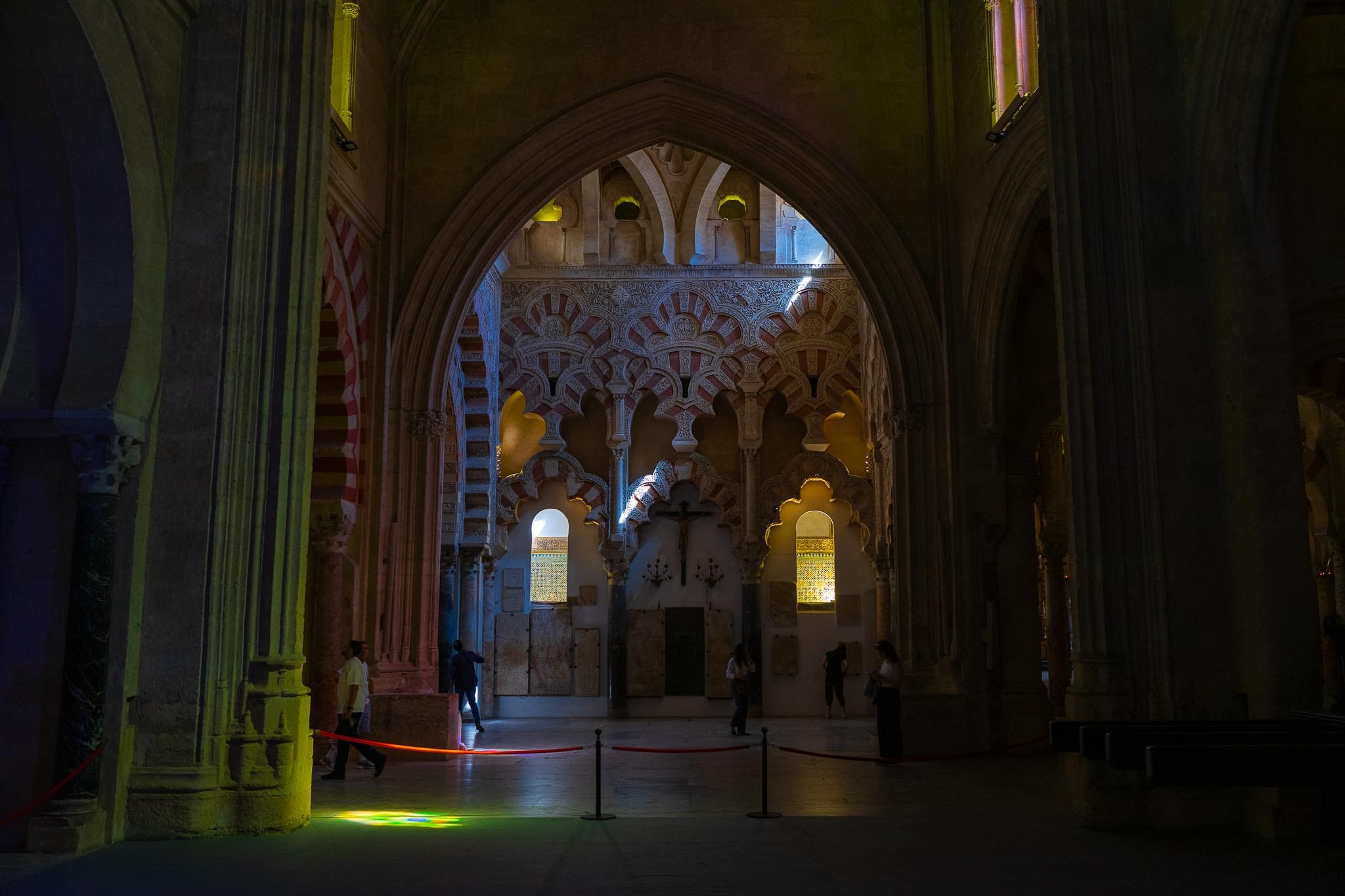
One frame, two religions, and the whole argument for giving Córdoba a day: a Gothic arch looking through into the Islamic hall it was inserted beside. Nothing on this page comes close to it.
The three lines out of Seville
Everything below sits on one of three axes, and the axis explains the verdict better than the destination does.North-east, up the Guadalquivir valley: Itálica at twelve kilometres, Carmona at thirty-three, Córdoba at a hundred and forty on the high-speed line. South-west, down the line to the Atlantic:Jerez at ninety, Cádiz at a hundred and twenty-five, on the same frequent service. East, into the mountains: Ronda and Granada, where the rail geography stops cooperating entirely. The first two axes are the reason day trips from Seville are unusually rewarding. The third is the reason two of them are not.
The Seven at a Glance
If you make one day trip: Córdoba. Forty-five minutes each way on the high-speed line, and the Mezquita-Catedral alone justifies the day.
If you make two: Córdoba and Cádiz. They are opposite in every way — one inland and imperial, one Atlantic and salt-bitten — and neither repeats the other.
If you have half a day: Itálica. A Roman city twelve kilometres out, free to EU residents, reached by a suburban bus, and closed on Mondays.
The two to refuse: Ronda as a day trip — go, but sleep there. And Granada, unless you have Alhambra tickets in hand and accept a fourteen-hour day.
Destination by Destination
ItálicaHalf day · ~30 min by bus · A Roman provincial capital and one of the largest amphitheatres of the empire. Closed Mondays.
CórdobaFull day · ~45 min by AVE · The Mezquita-Catedral, the Judería, the Roman bridge. The strongest day trip in Andalucía.
JerezFull day · ~50 min by train · Sherry, Andalusian horses and an almost empty old town. The most overlooked trip on the list.
CarmonaShort full day · ~1 h by bus · A walled hill town with a Roman necropolis and almost no visitors.
CádizFull day · ~1 h 45 by train · Three thousand years on an Atlantic spit. A day it earns rather than fills.
GranadaVery long day · 2½–3 h+ each way · The Alhambra, and nothing else. Tickets months ahead or do not go.
RondaOvernight · 2–2½ h by bus, 3 h 20 by train · Magnificent, and wrong as a day trip. Sleep there instead.
I.
The Half Day
Itálica — a Roman city twelve kilometres out, and the best value on this page
Before Seville there was Hispalis, and beside Hispalis there was Itálica: founded in 206 BC for the veterans of a campaign against Carthage, grown into a provincial capital, and the birthplace of two Roman emperors, Trajan and Hadrian. It stands at Santiponce, twelve kilometres north-west of the city, and what survives is a street grid, mosaic floors still in their houses, a theatre, and an amphitheatre built for something like twenty-five thousand people — one of the largest in the empire, and emptier on a Tuesday morning than any comparable Roman site in Spain. Television has found it: the amphitheatre stood in for the dragonpit in the later seasons of Game of Thrones, which brings a certain kind of visitor and has not yet brought crowds.
It is the only genuine half day on this list, and the only one that costs essentially nothing. A metropolitan bus from Plaza de Armas takes about half an hour; two hours on the site is generous, three is thorough, and you are back in Seville for lunch. That makes it the right answer for a traveller with a spare morning rather than a spare day — and the right answer for anyone who is going to visit the Palacio de la Condesa de Lebrija in the city, whose drawing-room floors are Roman mosaics lifted from these ruins in the 1900s. Seeing the ruins first turns that house from a curiosity into something closer to an accusation.
Getting there metropolitan bus from Plaza de Armas, roughly 30 minutes; confirm the current line and timetable with the Consorcio de Transportes rather than a guide ·Time on site 2 to 3 hours ·Practicalities free to EU residents, otherwise about €1.50. Tuesday to Saturday 09:00–18:00; Sundays, public holidays and Mondays that precede a holiday 09:00–15:00;closed on ordinary Mondays. Andalusian archaeological sites generally shorten their hours through high summer, so check before a July or August visit · Verdict yes, and the easiest yes here. Assessed rather than visited from Seville.
II.
The Comfortable Full Days
Córdoba, Jerez and Carmona — three destinations the transport genuinely wants you to visit
Córdoba — the one to make if you make only one
Córdoba was, in the tenth century, plausibly the largest city in Europe and the seat of a caliphate whose libraries and mathematics had no northern equal. What remains of that is one building, and it is enough to organise a day around and probably a trip. The Mezquita-Catedral begins as a forest: hundreds of columns of jasper and marble carrying red-and-white striped double arches that recede in every direction, so that the eye cannot find a wall and the mind cannot settle on a scale. Into the middle of that forest, in the sixteenth century, the cathedral chapter inserted a complete Gothic church — a decision their contemporaries called desecration and which the emperor who authorised it is said to have regretted. The result is not beautiful in any ordinary sense. It is stranger than beautiful, and it is the whole history of Andalucía made architectural.
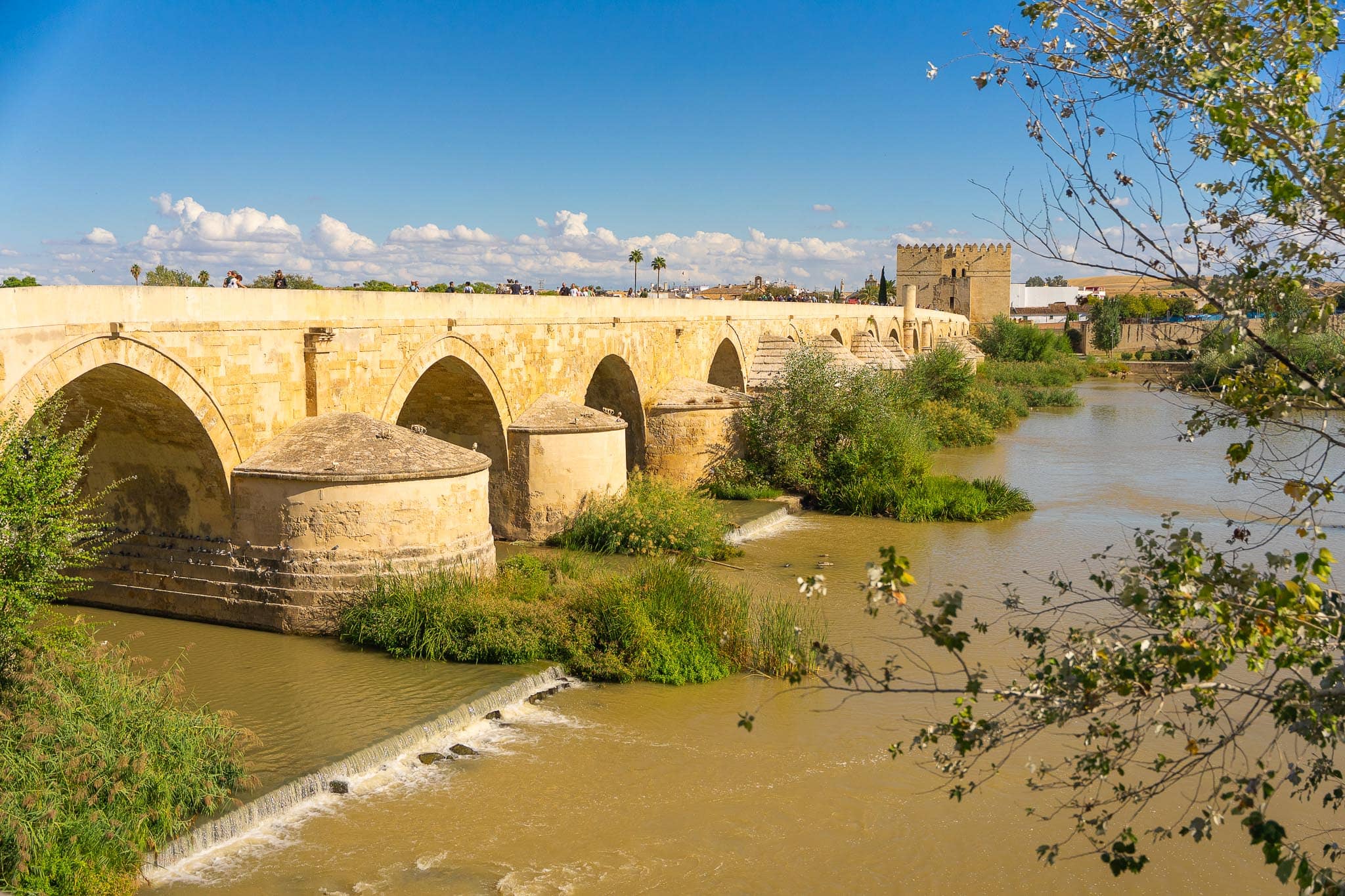
The rest of the day is easy and good: the Judería, the only surviving medieval synagogue in Andalucía, the flowered lanes, the arcaded Plaza de la Corredera, and the Puente Romano over a Guadalquivir that here runs wide and shallow over weirs with reed islands in it. The day trip documented on this site departed Sevilla-Santa Justa at a quarter past seven, was in Córdoba by five past ten, and came back on the half past eight train — eight hours in the city, which is the right amount.
What this page will not do is tell you how to spend those eight hours, becausethere is a full account of one day in Córdobaon this site already, written from that visit. Read it after you have decided, not instead of deciding.
Getting there AVE from Sevilla-Santa Justa, about 45 minutes; slower services take around an hour and a half. Book ahead — the fast trains fill · Time on site 6 to 8 hours ·Practicalities the Mezquita takes timed entry booked online, opens at 10:00, and deserves two hours minimum. The synagogue closes on Mondays. Start early: Córdoba is hotter than Seville in high summer and the Mezquita is the only air-conditioned part of the day ·Verdict the strongest day trip from Seville, without qualification. Documented.
Five o'clock at the Roman bridge, with the Calahorra tower at the far end. The river here is wide, shallow and full of islands — nothing like the deep working channel at Seville.
Jerez de la Frontera — the trip nobody takes
Fifty minutes down the Atlantic line, and the most overlooked destination on this page. Jerez gave sherry its name — the English word is a mangling of the Arabic Sherish — and the wine is made here by a method that is genuinely unlike anything in Bordeaux or Burgundy: the solera, a cascade of barrels in which older wine is continuously refreshed by younger, so that no bottle is of any single year and the cellar itself becomes the vintage. The bodegas are cathedral-scaled, cool, and open to visitors. It is the best possible use of an Andalusian afternoon in July.
The other half of Jerez is horses. The Real Escuela Andaluza del Arte Ecuestre keeps a school of Andalusian stallions in a nineteenth-century estate on the edge of town and performs an exhibition — a kind of choreographed dressage, which sounds absurd on paper and is not — on selected days of the week. On the other days the estate can be visited for the training sessions, the stables, the carriage museum and the saddlery. The show days and times move by season and are not published far ahead: check the school's own calendar, and book, before building a day around it. Beyond those two things there is a Moorish alcázar, a cathedral on a rise above the vineyards, and an old town that is close to empty on a weekday.
Jerez also solves a problem, which is the strongest argument for it. It is a stop on the Cádiz line, so a traveller who has already given a day to Cádiz can take Jerez as a second, quite different Atlantic day without repeating any of the ground.
Getting there Renfe from Sevilla-Santa Justa, about 47 to 52 minutes, with something like seventeen services a day ·Time on site 6 to 7 hours ·Practicalities bodega visits are guided, generally need booking, and often close on Sundays. The equestrian exhibition runs on selected days only — confirm on the official calendar and buy in advance. Do not attempt Jerez and Cádiz in one day: the train makes it look possible and both places deserve better ·Verdict yes, for anyone interested in wine, horses, or an Andalusian town without a coach park. Assessed rather than visited.
Carmona — a walled town on a ridge
Thirty-three kilometres east, on a ridge above the farmland, Carmona has been fortified by every power that has held this valley: Carthaginians, Romans, Moors, and Castilians who built a fortress on the highest point that is now a parador. Two things make it more than a pretty walled town. The Roman necropolis on its western edge is a field of chambered tombs cut into the rock, several of them large enough to walk down into, with painted walls and niches for urns — an unusually intact piece of Roman domestic religion. And the Puerta de Sevilla is not a gate but a small fortress with a Carthaginian base, Roman upper works and a Moorish courtyard stacked on top of one another, which can be climbed.
It is the quietest destination on this list. It is also the one where the transport is least generous: a metropolitan bus rather than a train, about an hour for the full run, with a separate timetable through July and August. That makes Carmona a short full day rather than a comfortable one — five or six hours in the town, and a bus at each end that you should look up properly rather than trust to frequency.
Getting there metropolitan bus line M-124 from Seville, operated by CASAL, roughly an hour end to end; the Seville terminus is Plaza de Armas. The line has variants and a separate summer timetable, so check the Consorcio de Transportes listing for your date ·Time on site 5 to 6 hours ·Practicalities the necropolis and the gate-fortress both keep museum hours and Monday closures are common in Andalucía; confirm both. Little shade on the ridge ·Verdict yes, for a second or third visit to the region, or for anyone who has had enough of queues. Assessed rather than visited.
Two railway lines and a bus route, and everything the transport likes is worth going to.
III.
The Day That Earns Itself
Cádiz — an hour and three quarters each way, three thousand years, and a different Spain entirely
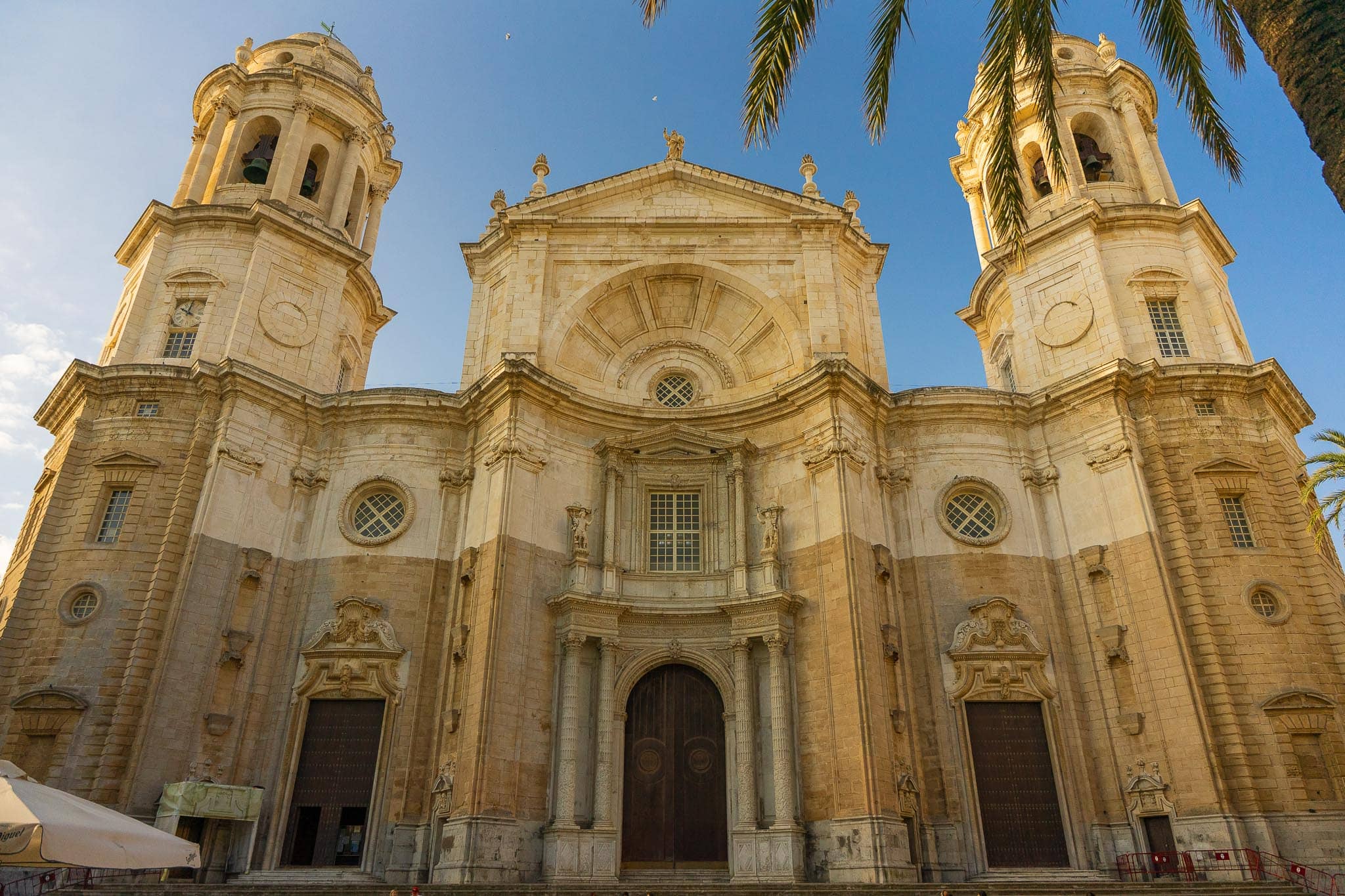
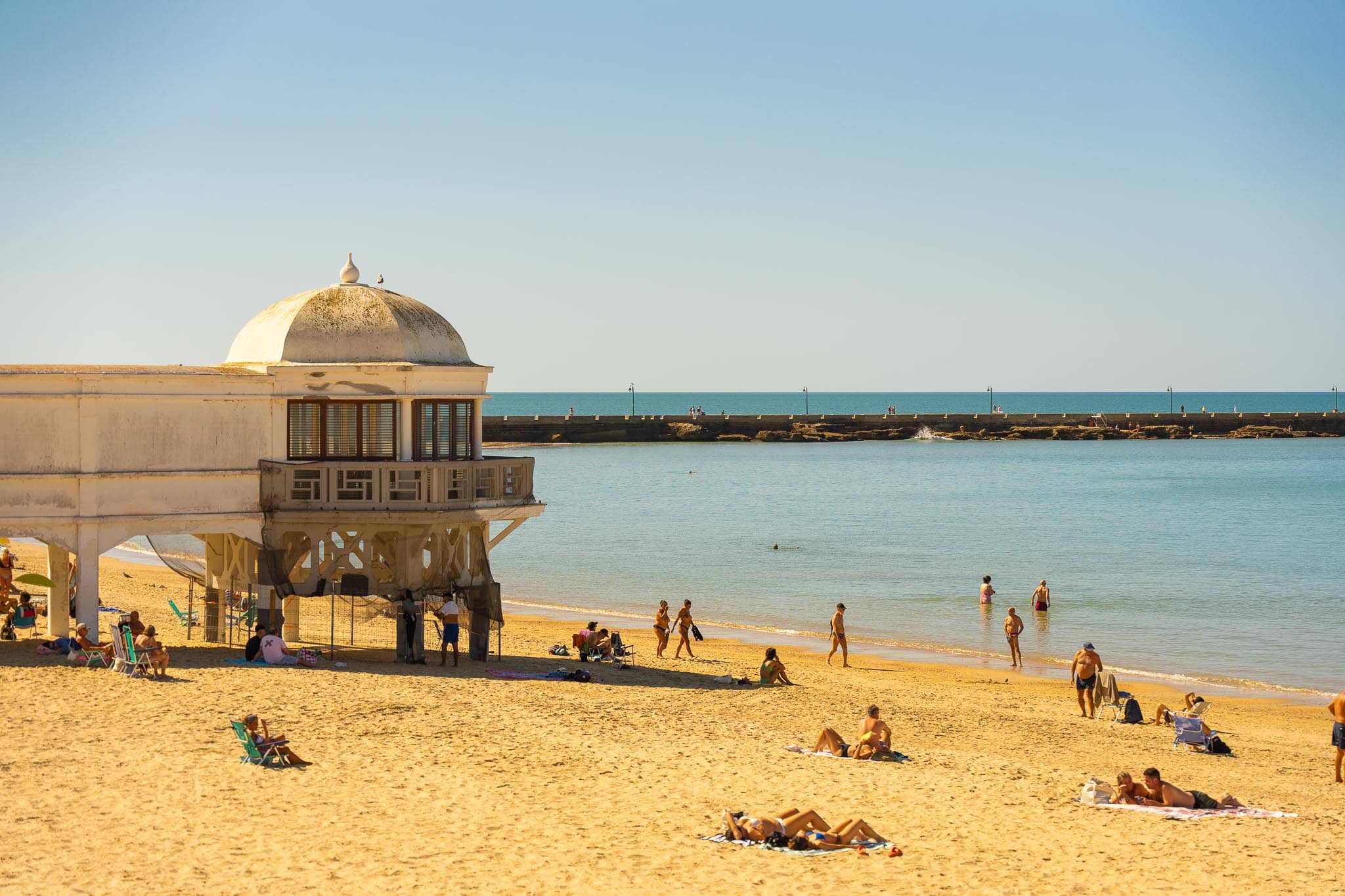
Cádiz is the oldest continuously inhabited city in western Europe by most reckonings — Phoenician, then Carthaginian, then Roman, then a port that received the silver of the Americas and was raided for it by the English and the Dutch. It stands on a spit of Atlantic shore so narrow that the old city is walled by the sea on three sides, and the entire historic centre can be walked in a day without hurrying. Its cathedral was built over a hundred and sixteen years on New World money and changed style twice while it went up. Its beach, La Caleta, is a crescent of sand cupped between two sea forts.
An hour and three quarters each way is a real cost, and the reason to pay it is that Cádiz is not a smaller Seville. Seville is inland, imperial and landlocked in temperament, a city that grew rich on an ocean it could not see. Cádiz is maritime, salt-bitten and open on every side, and the light and the air and the food are all different. Nothing else on this page gives a traveller a second Spain for the price of a train.
The full day is documented on this site asone day in Cádiz, walked in October from the morning train, and it is the account to read once the decision is made. The relevant decision here is only this: Cádiz is a full day and rewards being treated as one. The afternoon day-trippers who arrive at two and leave at six get the cathedral and a coffee and miss the city entirely.
Getting there Renfe from Sevilla-Santa Justa, about an hour and three quarters, hourly through the day; the same line stops at Jerez. On the documented visit in 2025 the fare was around €12–18 each way, which is a 2025 observation rather than a current quote ·Time on site 8 to 10 hours; the last useful train back leaves in the evening ·Practicalities everything is on foot — do not take a car inside the walls. The Museum of Cádiz is free to EU citizens. La Caleta faces west, so if you can stay for the Atlantic sunset from the sea wall, do · Verdict the best second day trip from Seville, and the best first one for anyone who has already seen Córdoba.Documented.
Cádiz Cathedral took a hundred and sixteen years and three architectural fashions to finish, and was paid for with silver landed a few hundred metres away.La Caleta, held between two forts. This is the argument for Cádiz in one frame — nothing in Seville looks remotely like it, or smells like it either.
IV.
The Very Long Day
Granada — defensible for one building, and only if the tickets are already bought
The Alhambra is not primarily a palace. It is an enclosed Nasrid city on a red hill between the plain of Granada and the first ridges of the Sierra Nevada: a fortress at the western end, the Palacios Nazaríes in the centre, and the Generalife summer palaces and their gardens at the east. The water everywhere — channels, fountains, reflecting pools — is not decoration. It is an engineering achievement and a philosophical statement at once, because in a dry country the control of water was the most eloquent expression of power available. It is the finest surviving building of Islamic Spain and one of the two or three most extraordinary places in Europe.
And it is two and a half to three hours from Seville on the fastest services, appreciably longer on the rest — the average across the day's eleven or so trains runs past three and a half hours, and the day trip documented on this site took a service that ran three and a half hours each way, leaving at seven in the morning and returning on the 18:55. Faster trains now exist; slower ones still do too, and that spread is the whole problem. On the worst plausible combination a Granada day trip is seven hours of travelling for four hours in the city.
The verdict is therefore conditional and the condition is absolute.The Nasrid Palaces take a timed ticket that sells out months ahead in season. The ten-day chronicle on this site puts it without hedging: arriving in Granada without pre-purchased Nasrid Palaces entry means you will be looking at the outside of a wall. If you have those tickets, and you accept a fourteen-hour day, and you understand that you will see the Alhambra and the Mirador de San Nicolás and essentially nothing else of a substantial city, then go — it is worth it, and the return through the Andalusian dark is part of the day rather than a penalty. If any of those three conditions fails, do not.
The better answer, for anyone whose dates allow it, is not to make Granada a day trip at all but to move there for two nights on the way east. That is how it appears in the wider regional routes on this site rather than as an excursion.
Getting there Renfe from Sevilla-Santa Justa; fastest around two and a half hours, typically nearer three, and considerably more on some services. Book at least a fortnight ahead ·Time on site 6 to 7 hours on a good day ·Practicalities book the Alhambra the moment your dates are fixed, through the official channel, and allow three to four hours for the full complex. Entry to the Nasrid Palaces is by half-hour slot and strictly enforced. One consolation the rest of Andalucía does not offer: Granada still gives a free tapa with every drink ordered, which is a different food culture fromSeville's, where tapas are ordered and paid for ·Verdict a qualified yes, for the Alhambra alone.Documented as a day trip on the recorded stay.
V.
The One to Sleep In
Ronda — magnificent, closer than Córdoba, and the wrong shape for a day
Ronda stands on a limestone plateau split by the Tajo, a gorge a hundred metres deep, with the eighteenth-century Puente Nuevo thrown across it and the old town on one side and the new on the other. It holds one of the oldest bullrings in Spain, the Arab baths, a clifftop walk with a hundred kilometres of sierra in front of it, and the ruins of the Roman town of Acinipo half an hour further out. It is one of the most photographed places in Spain and it deserves to be.
It is also the destination on this page that a day trip serves worst, and the arithmetic is straightforward. The train from Seville takes around three hours and twenty minutes, which is longer than Granada; the coach takes between two hours and two and a half and is the practical option. Either way you spend four to five hours travelling to reach a town whose two best hours are the ones a day-tripper cannot have — early morning on the bridge before the coaches arrive from the Costa del Sol, and the hour after sunset when the gorge goes blue and the day visitors have gone. A day trip to Ronda delivers you at the busiest moment and removes you before the good one.
So the verdict is not that Ronda is unworthy. It is that Ronda is worth more than a day trip can extract from it. Take a night there — it is small, the accommodation includes some of the more remarkable rooms in Andalucía on the gorge edge, and it works naturally as a stop between Seville and Málaga or Granada rather than as an out-and-back. Ronda has not been visited from Seville for this site, and no chronicle of it exists here yet; that assessment is made on the transport and on what the town is like at which hours, not on a remembered day.
Getting there coach with Damas, about two hours to two and a half; train around three hours twenty, by a slower route ·Time on site 4 to 5 hours as a day trip, which is the problem · Practicalities if you go anyway, take the earliest coach out and the latest back, and accept that the middle of your day is the middle of everyone else's ·Verdict go, but sleep there. Not a day trip.Assessed rather than visited from Seville.
📍 Day Trips from Seville
🚆 Seven destinations · verified 29 July 2026
By shape of day
Half day — Itálica. ~30 min by metropolitan bus from Plaza de Armas. Free to EU residents. Closed ordinary Mondays.
Comfortable full day — Córdoba (~45 min by AVE) · Jerez (~50 min by Renfe) · Carmona (~1 h by bus M-124).
Full day, treated as one — Cádiz (~1 h 45 by Renfe). Not an afternoon.
Very long day, conditional — Granada (2½ h at best, often more). Alhambra tickets in hand, or do not go.
Overnight, not a day trip — Ronda (~2–2½ h by coach).
Booking, in priority order
Alhambra Nasrid Palaces — the moment your dates are fixed, months ahead in season, through the official channel. No other booking on this page is remotely as urgent.
Mezquita-Catedral, Córdoba — timed entry online; opens at 10:00; allow two hours minimum.
Jerez equestrian exhibition — selected days only, and the days move by season. Check the school's own calendar and buy in advance; a bodega visit needs booking too.
Fast trains — Córdoba's AVE and Granada's services fill in season. Book at least a week out, a fortnight for Granada.
Nothing needed — Itálica, Carmona and Cádiz can all be done on a walk-up ticket bought the same morning.
Watch-outs
Mondays close things across Andalucía. Itálica shuts on ordinary Mondays, Córdoba's synagogue shuts, and municipal museums in Carmona and Jerez commonly do too. A Monday is the day to stay in Seville — where Casa de Pilatos, the Alcázar and the Cathedral all open.
Journey times quoted here are bands, not timetables.Seville–Granada in particular ranges from about two and a half hours to well over three depending on the service, and the difference decides whether the day works. Check the actual departure before you commit.
Do not combine two destinations in one day. Jerez and Cádiz sit on the same line and the temptation is obvious; the result is two rushed half-days and a lot of platform.
Start early, everywhere. Every destination on this page is hotter than Seville in high summer except Cádiz, which is windier. The documented Córdoba day left Santa Justa at 07:15 for good reason.
Four of these seven have not been visited from Sevillefor this site — Jerez, Itálica, Carmona and Ronda. Their sections are assessments built from transport data, published site hours and what each place is, and they are labelled as such rather than written as memory.
Ronda is ten kilometres nearer than Córdoba and four times harder to reach. In Andalucía the railway, not the map, decides what a day can contain.
How to choose, by how long you have
Three days in Seville: make no day trip at all. This is the recommendation and it is firmer than it looks. Any excursion takes a third of a three-day visit and returns a train journey and a second city you will see too fast, and Seville itself has not been finished at that point — the case is made inthe three-day route, which deliberately excludes all of them.
Four or five days: one day trip, and it is Córdoba.Forty-five minutes each way, a building that changes the scale by which you measure other buildings, and you are back for dinner in Seville.
Six or seven days: two, and take Cádiz as the second.The pairing works because the two are opposite. Add Itálica as a half day if a morning is going spare, since it costs nothing and finishes by lunch.
Eight days or more: three, and here the choice opens.Jerez if wine or horses appeal; Carmona if what you want is a town with nobody in it; Granada only if the Alhambra tickets came through and you are willing to give it a fourteen-hour day. This is also the trip length at which the honest answer may be to stop making day trips and move — two nights in Granada, or one in Ronda, in the manner ofthe longer overland routesrecorded on this site.
Considered and cut
Four destinations that appear on other lists are not assessed above, for the same reason in each case: without a car they do not make a day.Sanlúcar de Barrameda and the Doñana boat crossing need a connection at Jerez and a great deal of luck with timings.Osuna is reachable but thin for a full day.Aracena and its cave sit two hours north-west on infrequent buses. And the white villages of theSierra de Grazalema are the best driving in Andalucía and essentially unreachable on public transport in a day. A car changes all four verdicts, and it changes the audience of this page, so they are named here rather than assessed above.
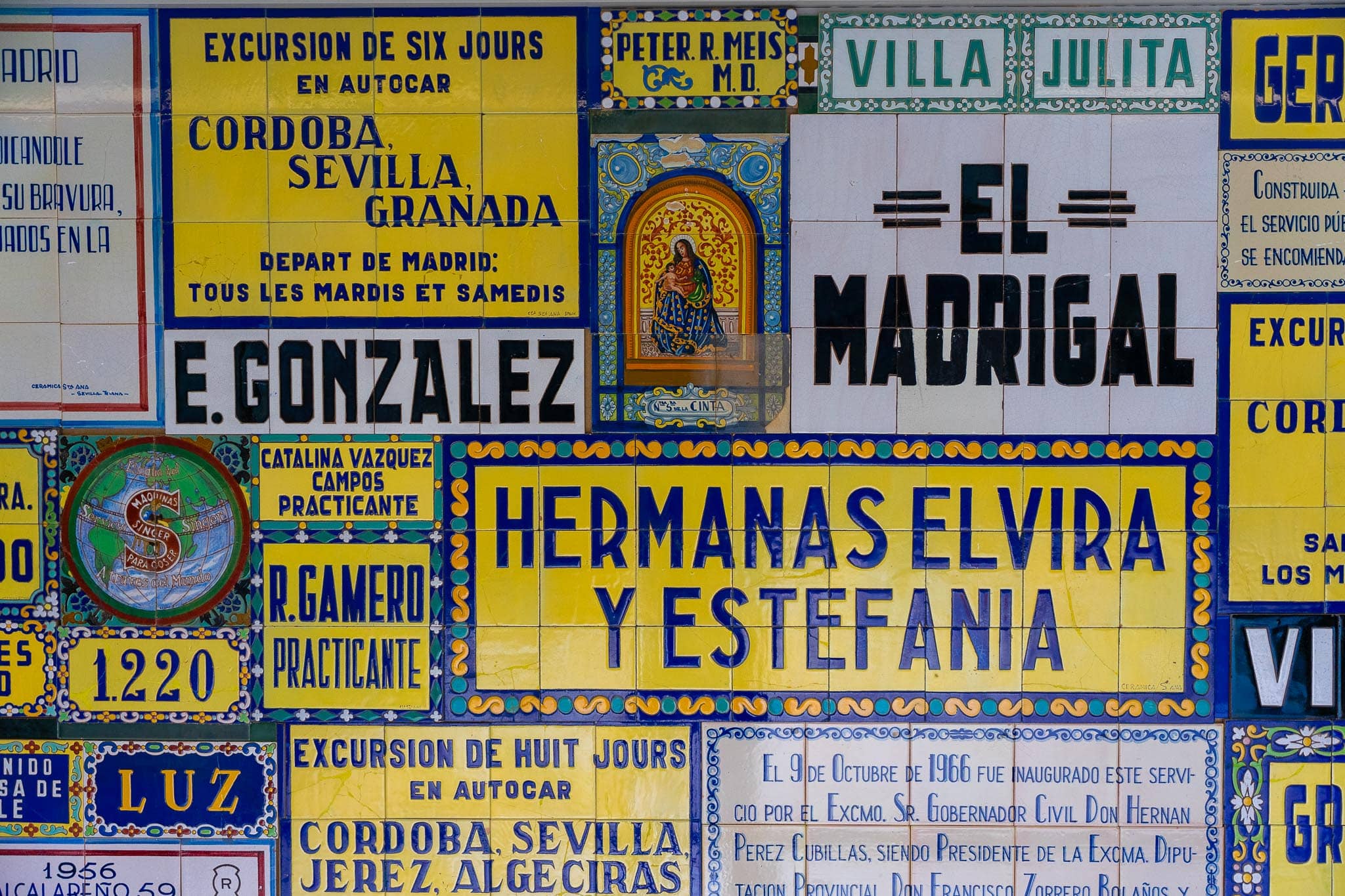
Kept at the Centro Cerámica Triana: a pre-war tiled advertisement for a six-day coach tour of Córdoba, Seville and Granada, departing Madrid every Tuesday and Saturday. The circuit on this page is a century old and was always sold in French.
The tiled advertisement above hangs in a former tile works in Triana, and it is worth a minute because it settles an argument. Córdoba, Seville and Granada were being sold as a package, in French, to Madrid coach passengers, before either world war. The circuit is not a modern invention and neither is the mistake it encourages — six days for three cities, each arrived at and departed from, none of them stayed in.
Which is the whole of the case for being sparing with day trips. Seville rewards return rather than conquest; every day given to a train is a day the city does not get, and the two or three excursions that genuinely earn their place earn it by being unlike Seville rather than by adding to it. Córdoba is a different civilisation's high point. Cádiz is a different sea. Itálica is a different empire. Everything else on this page is a town, and there will be other years. The rest of the region, taken slowly, is gathered in the archive and laid out onthe map by region.