San Marino: Upon the Rock of the Oldest Republic
A day's passage from Bologna to the mountain nation that time forgot to conquer
Some links in this chronicle are affiliate links. If you book through one, I may earn a small commission at no extra cost to you.
There are nations that demand weeks of preparation, that require the ordering of visas and the booking of connections months in advance, that announce their grandeur before the traveller even departs. And then there is San Marino — which announces nothing, which sits quietly upon its improbable mountain, which has been sitting quietly upon its improbable mountain since the year 301 of the common era, and which has somehow outlasted every empire that ever looked up at it and thought: we should probably deal with that eventually.
The traveller arrived in Bologna with several days in hand and a map full of possibilities. Rome lay to the south. Venice shimmered to the northeast. But it was the small notation on the edge of the Emilia-Romagna region — this peculiar microstate pressed against the Italian hills like a barnacle on a cathedral wall — that pulled at something. Not the pull of grandeur. The pull of the curious. The pull of a place that has no right to still exist, and yet does.
San Marino is the world's oldest surviving republic, a UNESCO World Heritage Site, and a country so small you can walk its old town in an hour. A day trip from Bologna, accomplished by train and bus, deposits the traveller atop Monte Titano in time for lunch. It is, in every practical sense, a modest excursion. But modest in distance is not modest in feeling. To stand upon the Guaita Tower — that ancient fortress of dark stone clinging to the rock above the Adriatic plain — and to look out across the rooftops of a nation that has never fallen, is to feel something that the great and obvious cities rarely offer: the particular wonder of the small thing that endured.
The Steel Serpent to Rimini
On the morning rails of the Adriatic coast
The steel serpent that rides the rails from Bologna Centrale to Rimini departs in its own unhurried way, as Italian trains sometimes do, and arrives on the Adriatic coast in just over an hour. Bologna recedes into its red-roofed world of arcades and ancient learning; the country opens out into flatter, more coastal terrain, the light changing as the sea approaches. Rimini itself holds little drama — it is a beach city, practical and seasonal — but it is the necessary door through which one must pass to reach the mountain republic beyond.
The traveller's instructions, received from prior reading, proved exact: exit the station, cross to the Burger King side of the road, and find the small tabaccheria tucked to its left. There, a Bonelli Bus ticket changes hands for six euros. The bus stop itself has migrated since older accounts were written — it now rests in front of the Napoleon Hotel, a short walk along the same street — and the traveller who arrives early enough to queue will be rewarded with a seat. The bus is not a luxury affair. It carries tourists and locals alike, its schedule sparse enough that the timing of one's Trenitalia arrival must be matched carefully against the posted timetable. But it climbs. And it climbs. And then, through the windows, the mountain appears.
The first sight of San Marino from below is the towers — three dark fingers of ancient stone rising from the mountain's spine, impossibly placed, impossibly old, impossibly still standing.
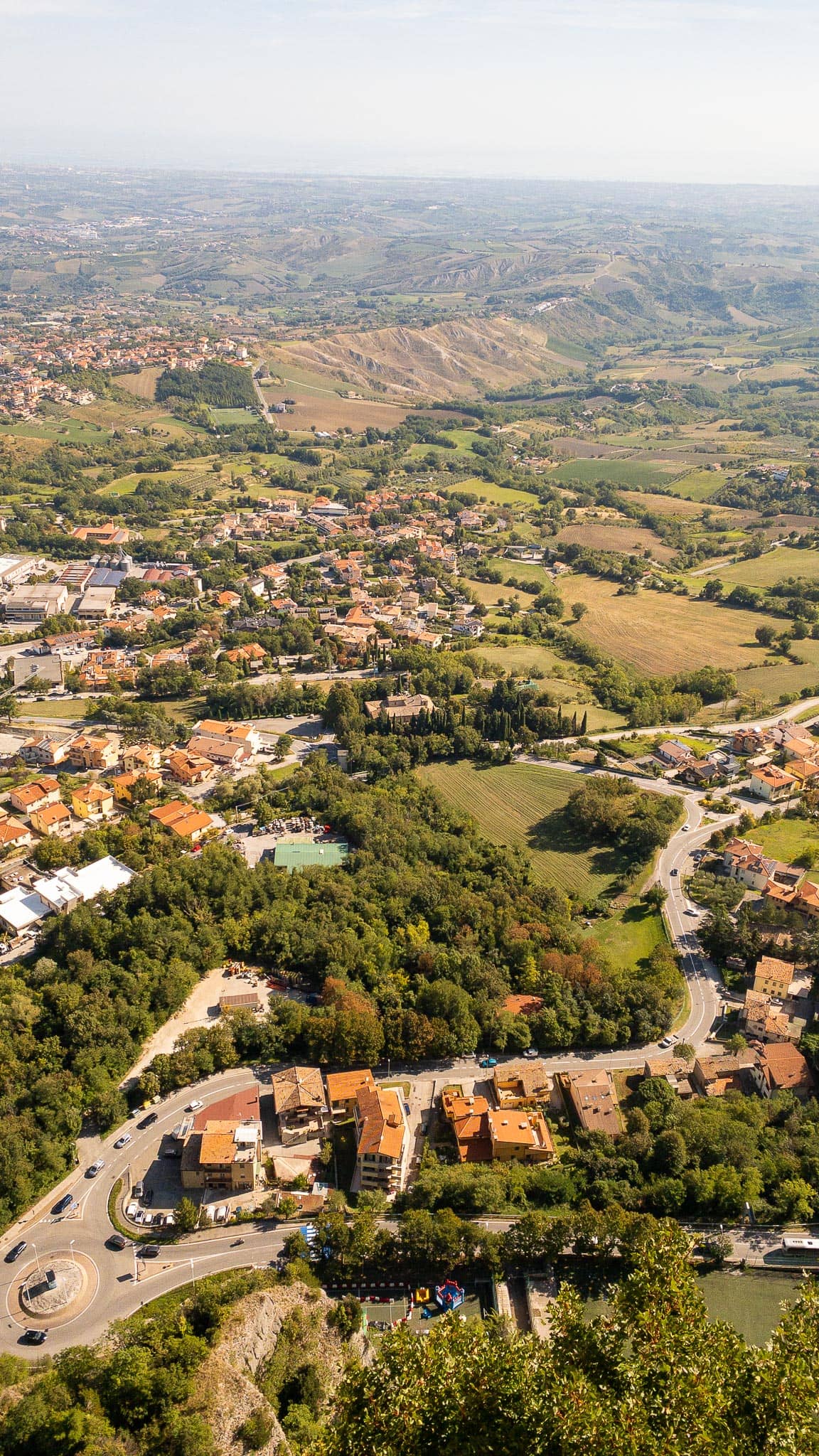
Monte Titano rises from the Adriatic plain without preamble or apology. The bus takes the mountain road in switchbacks, and with each turn the view behind expands — the flat agricultural land, the distant thread of the coast, the blue suggestion of the sea. At 739 metres, the peak claims its republic. The bus deposits its passengers at Piazzale Calcigni, just outside the walls of the old city, and the traveller steps out into air that is cooler and clearer than Bologna's, into a place where the twenty-first century has been politely asked to wait outside.
Among the Three Towers
On the walls of a nation that refused to fall
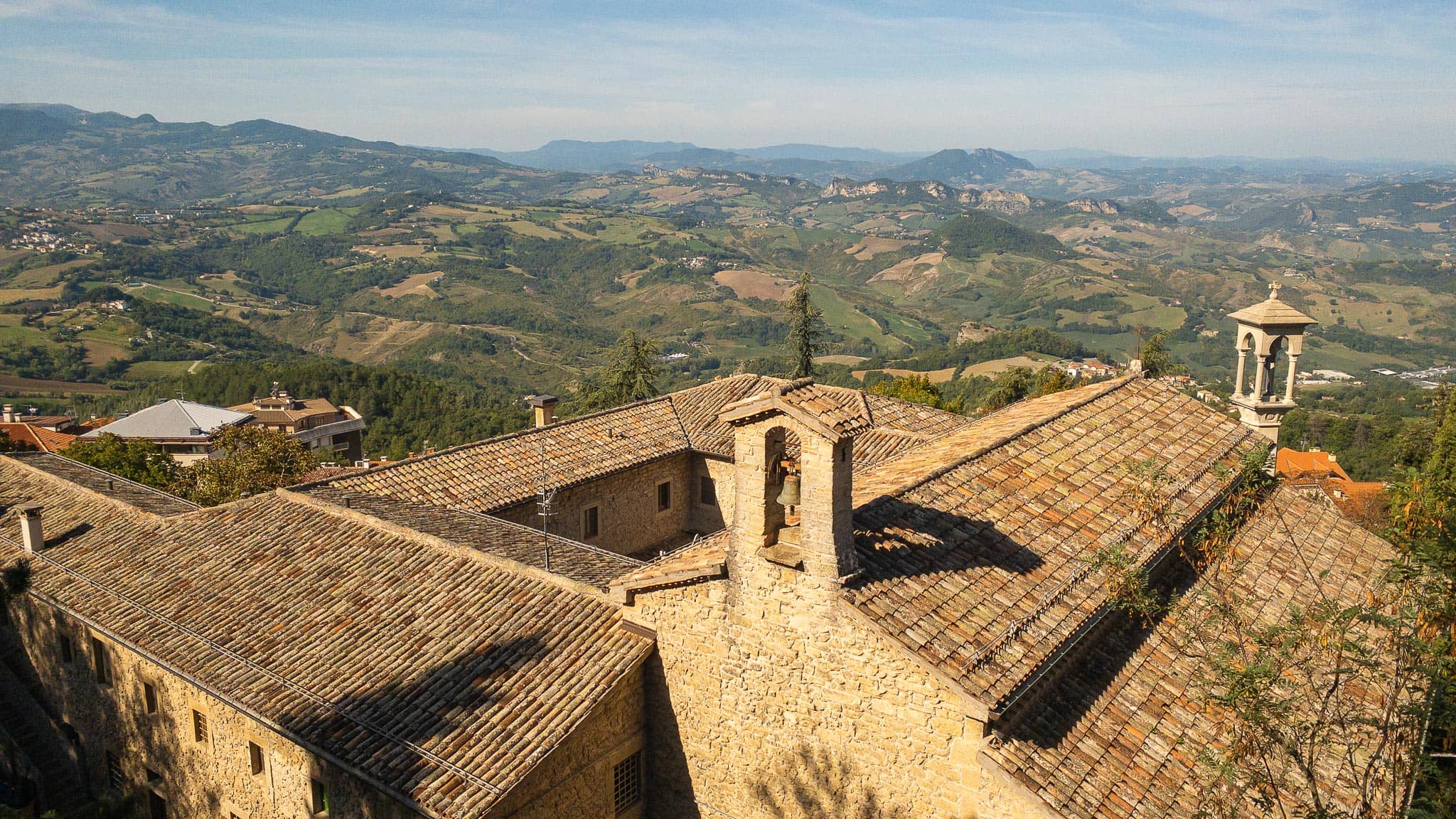
San Marino's old town is small enough that it can be walked end to end in twenty minutes, and rich enough in history that those twenty minutes, if attended to properly, can take the better part of an afternoon. The cobblestone streets wind between medieval buildings in pale stone, past souvenir shops — which skew, with some enthusiasm, toward replica crossbows and antique-style weaponry, San Marino having a long tradition of archery — and up toward the ridge of Monte Titano where the three towers stand against whatever sky the day has offered.
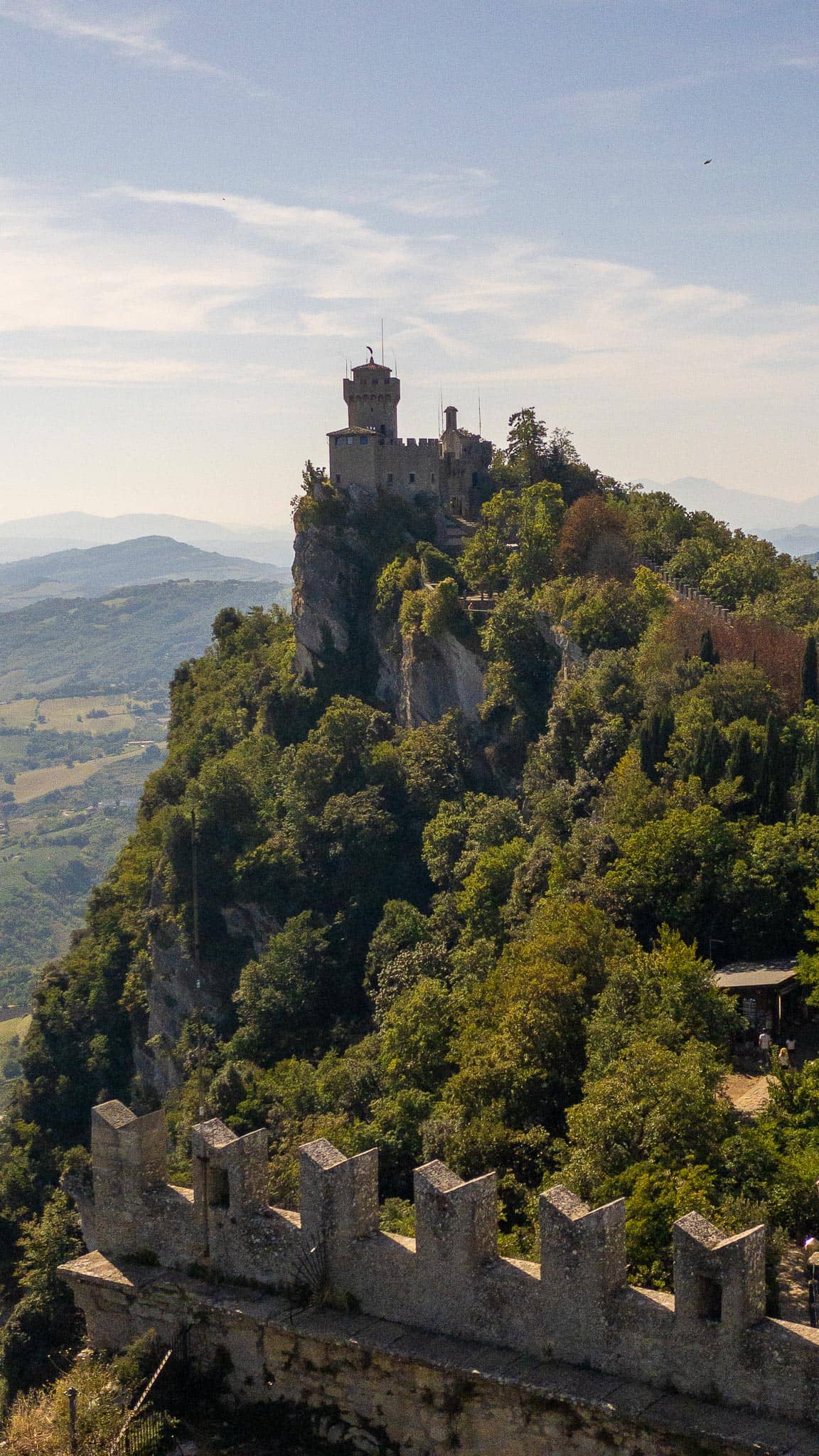
The first tower, Guaita, is the oldest and the largest, and it is the one that appears in every photograph of the republic — pentagonal, battlemented, set directly upon the mountain rock without foundations as though it grew there. The word Guaita means "to guard," borrowed from an older Germanic tongue, and guarding is precisely what it has done since the eleventh century. The traveller who climbs it earns the view: the whole city below, the Apennine mountains to the west, the Adriatic plain stretching east toward the sea, and on a clear day the sea itself, a silver line at the world's edge. Two mortars, gifts of a nineteenth-century Italian king, stand in the courtyard. Former garrisons once imprisoned within these walls still carry the dim weight of that history.
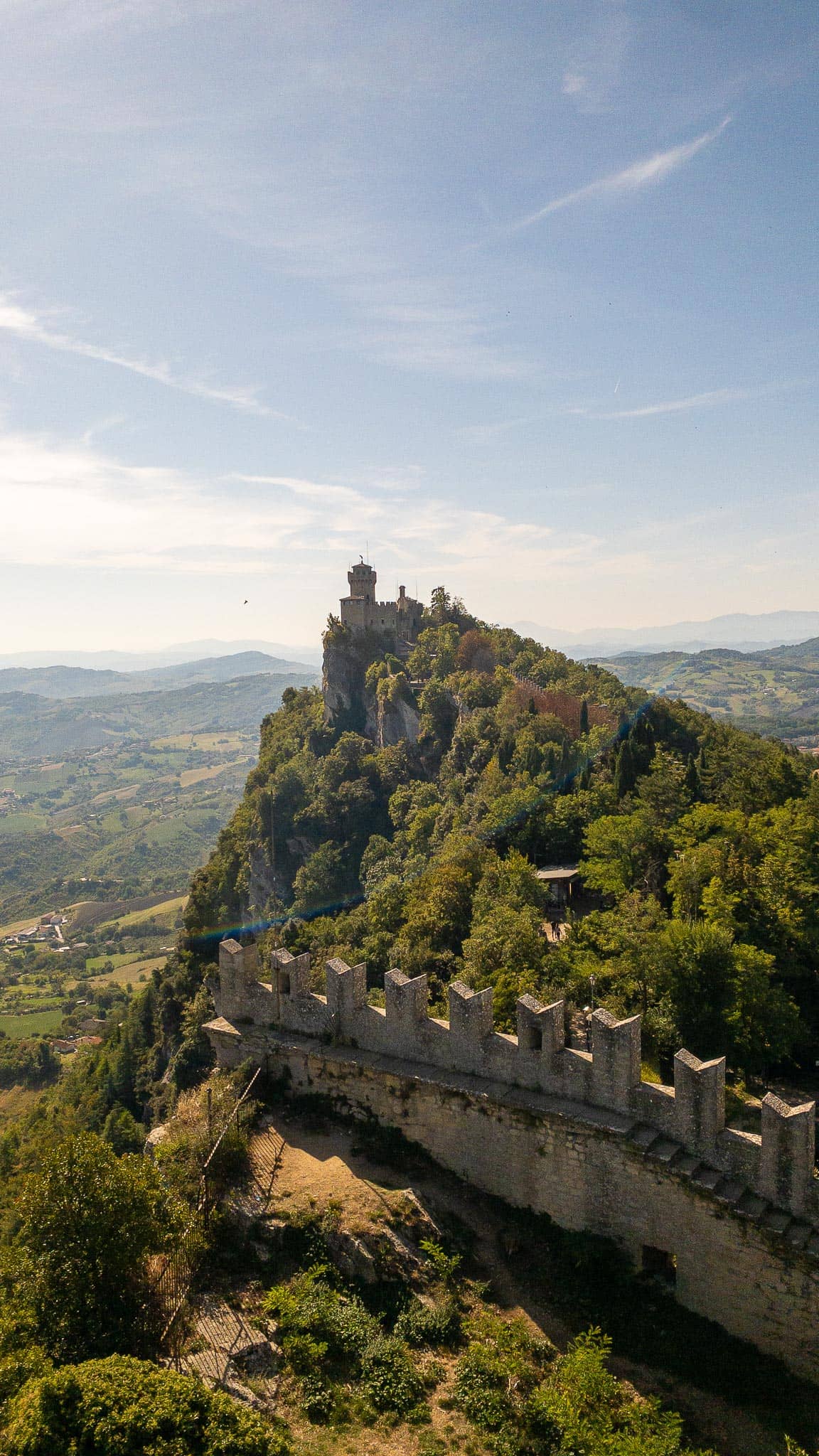
The second tower, Cesta, houses the Sammarinese Museum of Ancient Arms — some two thousand pieces of medieval armour and weaponry gathered across four rooms, a collection that rewards those with patience for the particular poetry of a well-made gauntlet or the geometry of a crossbow's mechanism. From its walls, the view shifts: the second tower shows the plain that stretches toward the Adriatic, the mountains, the spine of the republic's own ridge. The third tower, Montale, stands apart and is visible but not open to visitors — it holds itself at a private distance, as ruins sometimes will.
Below the towers, the Basilica di San Marino stands in neoclassical composure, its eight Corinthian columns keeping a quiet vigil over Piazza Domus Plebis. Built in 1836 on the site of a seventh-century church, it houses relics of Saint Marinus himself — the stonemason from Croatia who fled Roman persecution, was given a mountain by a woman whose son he had healed, and founded, from that act of refuge, an institution that outlasted every Roman emperor, every medieval duchy, every modern fascism that came looking at its walls. The Palazzo Pubblico, seat of the republic's government since 1894, stands nearby in its battlemented dignity — a building that has managed to look both official and slightly theatrical since the day it was built, which is perhaps appropriate for a country that is itself a kind of ongoing theatre of improbability.
For what endures in San Marino is not merely stone — it is the stubborn, quietly radical idea that a small thing, if it refuses loudly enough to be absorbed, need not be.
Lunch was taken in the old town, as it ought to be. San Marino sits in the Emilia-Romagna region, and the regional dishes follow the traveller up the mountain. A piadina — the soft flatbread of the Romagna coast, filled with squacquerone cheese and prosciutto and served warm from a griddle — is the correct meal for this altitude and this hour. Simple, specific, the kind of food that asks nothing of you except that you eat it without ceremony and feel, briefly, entirely correct about where you are.
The bus back to Rimini departs from the same square where it arrived, and the traveller who has spent the afternoon on the mountain boards it with a particular feeling — not quite the satisfaction of a great city absorbed, not quite the daze of an overwhelming museum day, but something more specific: the quiet pleasure of a small country, visited properly. San Marino is not a destination that demands superlatives. It does not need to be called the most beautiful place in Italy, or the most dramatic, or the most moving. It is, simply and remarkably, the oldest. And age, in a landscape littered with ancient things, is still capable of surprising.
The towers diminish behind the bus as it descends the mountain. The Adriatic plain opens up again. Rimini, then the train, then Bologna's red rooftops — the traveller returns to a city of greater size and lesser stubbornness, carrying nothing heavier than a passport stamp, a euro coin, and the memory of a view from a tower that has been watching the world since before most of the world's nations were imagined. Some things are worth the detour. San Marino, old and small and entirely itself, is one of them.
For what is travel, if not the art of being surprised by the things you did not think to expect?