Fez: Into the Labyrinth
of the Eternal City
Two days inside Fez el-Bali — the world's oldest living medina, and the place that resists all description
Some links in this chronicle are affiliate links. If you book through one, I may earn a small commission at no extra cost to you.
There are cities that present themselves plainly — their monuments arranged for the visitor, their streets laid in grids, their meaning legible at a glance. And then there is Fez. Fez does not present itself. Fez swallows you whole, turns you around three times in the dark, and hands you back to yourself somewhat changed, somewhat humbled, and completely unable to explain what just happened. This is a city that has been continuously inhabited since the ninth century of the mortal calendar, and it shows — not in the manner of a museum, but in the manner of a living thing that has simply never stopped.
The traveller arrived by rail from the north, the steel serpent depositing them at Gare de Fès in the early hours of the afternoon on the twenty-first day of the third month. The train had been pleasant enough — Morocco's rail runs reliably and with a certain quiet dignity — though comfort in the conventional sense had been modest. No matter. What awaited on the platform more than compensated.
Fez is, in practical terms, two cities: the modern Ville Nouvelle, broad and French in its bones, and Fes el-Bali — the old medina, the original, the one that matters. The largest car-free urban zone on earth. A place where donkeys still carry goods through passages so narrow that two laden animals cannot pass each other, where the call to prayer echoes off walls that have heard a thousand years of the same words, where the smell of tannery and spice and cedar smoke has soaked so deep into the stone that the stone itself seems perfumed. The traveller had seen Marrakech. They thought they understood Morocco. They did not.
Le Petit Bijou
A jewel in the Golden Triangle — 14th century walls, and a courtyard that stops the breath
The dar had no sign. There was a street — if the word street can be applied to something barely wide enough to extend both arms — and there was a door, ancient and studded with iron, set into a wall that gave nothing away. This is the genius of the Fez medina's architecture: all its beauty faces inward. The world outside sees only stone. Step through the threshold and the revelation is absolute.
Dar Le Petit Bijou dates from the fourteenth century, and its renovation has been done with the reverence such age demands — zellige tilework in geometric patterns that seem to fracture light into mathematics, cedar wood carved into lace overhead, tadelakt walls smooth as old silk, bronze lamps hammered entirely by hand. The leather of the sofas came from the tanneries scarcely a minute's walk away. The patio breathed cool air upward from the stone. The traveller set down their pack and stood very still for a moment, the way one does when something exceeds all reasonable expectation.
The dar sits in what its hosts call the Golden Triangle — the small sacred precinct bounded by the Mausoleum of Moulay Idriss, the great Al-Qarawiyyin University, and the Mausoleum of Sidi Ahmed Tijani, all within four hundred metres of one another. To sleep here is not to be near the medina. It is to be inside it, fully, without qualification. The nearest road that a car might use is a world away.
The Palace on the Roof of the World
Dinner at Mouda Palace — the medina spread below like a map of all time
On the first evening, the traveller climbed. The Restaurant Lounge sur le Toit du Palais de Mouda occupies the rooftop of one of Fez's old palaces on Rue Talaa Sghira, and to reach one's table is to ascend through layers of the city's history — carved plaster, painted ceilings, the gradual opening of space — until finally the terrace presents itself and the whole of the medina falls away below in every direction. The minarets needle the sky. The warren of rooftops, each one a little different, extends to the hills where the Marinid Tombs keep their long watch over the city they once ruled. The call to prayer, when it came, seemed to rise from the city itself rather than from any single source.
The food was traditional Fassi — the cuisine of Fez, which differs from what the rest of Morocco eats in the way that court cooking differs from country cooking. Fez was the imperial capital, the seat of learning, the place where the scholars and the sultans ate. The cooking reflects this. Rich, complex, patient. The traveller ordered kefta — spiced minced lamb shaped into small meatballs and cooked in a sauce of tomato and cumin and something warmer underneath that resisted identification, served with bread for tearing, eaten slowly, with the medina spread below and the first stars arriving above the minarets. It was, in the way that simple food eaten in the right place often is, close to perfect. The booking had been secured in advance, which is advisable: tables here are not easily found on the night.
The Labyrinth Unbound
Into Fes el-Bali — nine thousand alleys, twelve centuries of stone, and no map that tells the truth
There is no way to prepare for Fes el-Bali. The medina of Marrakech is large. The medina of Fez is something else entirely — a different order of magnitude, a different order of experience. Nine thousand alleys, some barely shoulder-width, branching and reconnecting in patterns that defeat all logic and resist all memory. The traveller had walked medinas before. They had navigated souks and derbs and winding stone passages. None of it was preparation. None of it was even close.
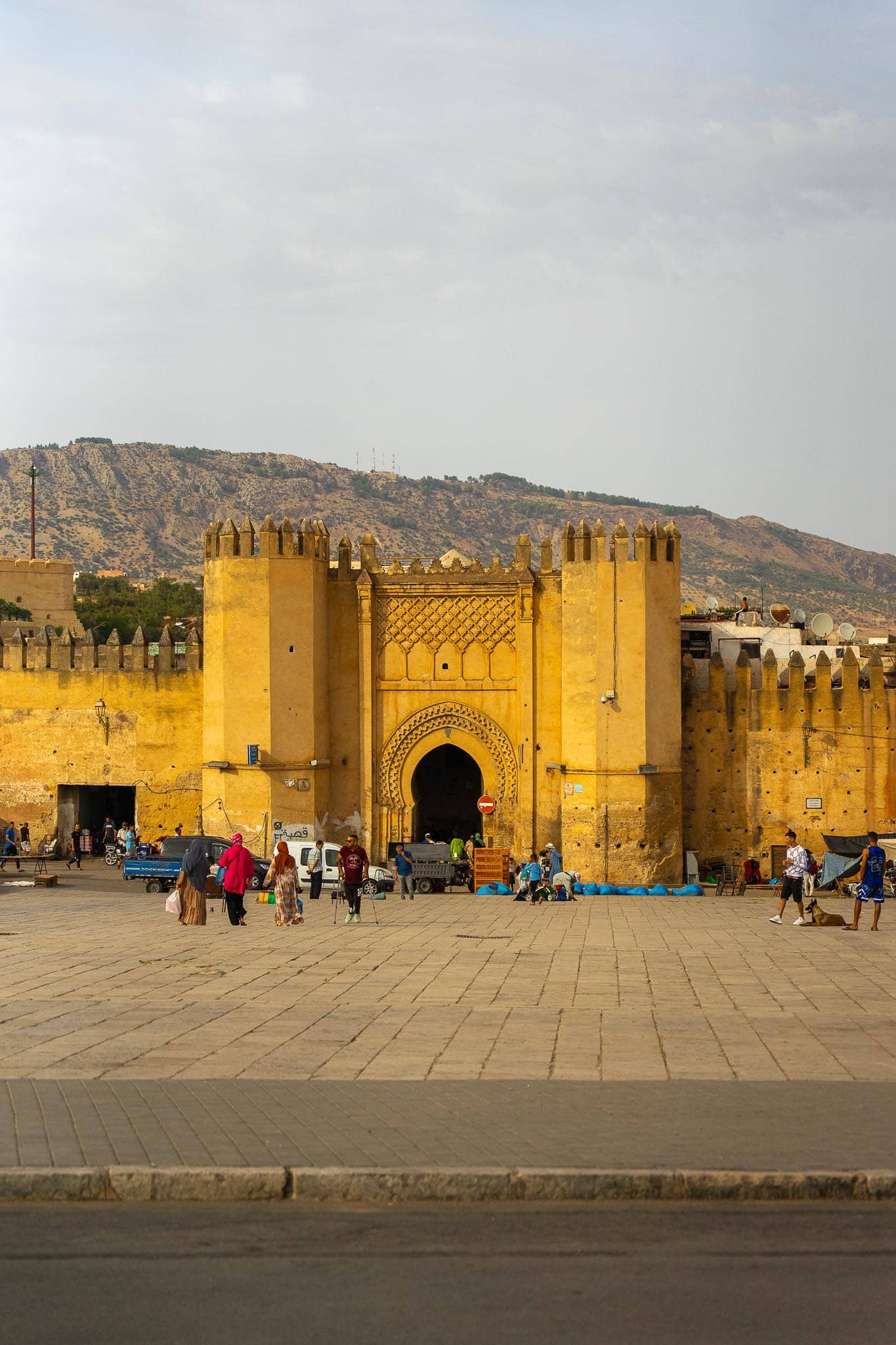
The traveller descended into Fes el-Bali on the second morning through Bab Boujloud — the Blue Gate, its tiles indigo on the outside, green on the inner face — and was immediately absorbed. The city does not so much welcome visitors as incorporate them. The lanes narrow. The overhead passageways multiply. The light comes in vertical shafts between rooftops too close together to admit the sky in any useful quantity. Donkeys pass with loads of cedar wood. Schoolchildren stream past in the opposite direction. A man carries a door.
The traveller lost their way. This is not a failure in Fez; it is a rite of passage, and in truth it is how the city is best encountered — not on a route, but at the mercy of it. A group of young Moroccan men found the traveller consulting a phone that had long since lost its bearing, and with extraordinary kindness walked them back toward a recognisable landmark. The gesture cost those men twenty minutes of their afternoon. The traveller offered two hundred dirhams, which was accepted with grace. It was the best two hundred dirhams of the journey.
"The medina of Fez is the largest car-free urban zone on earth. Nine thousand alleys. Twelve centuries of continuous habitation. There is nothing else like it."
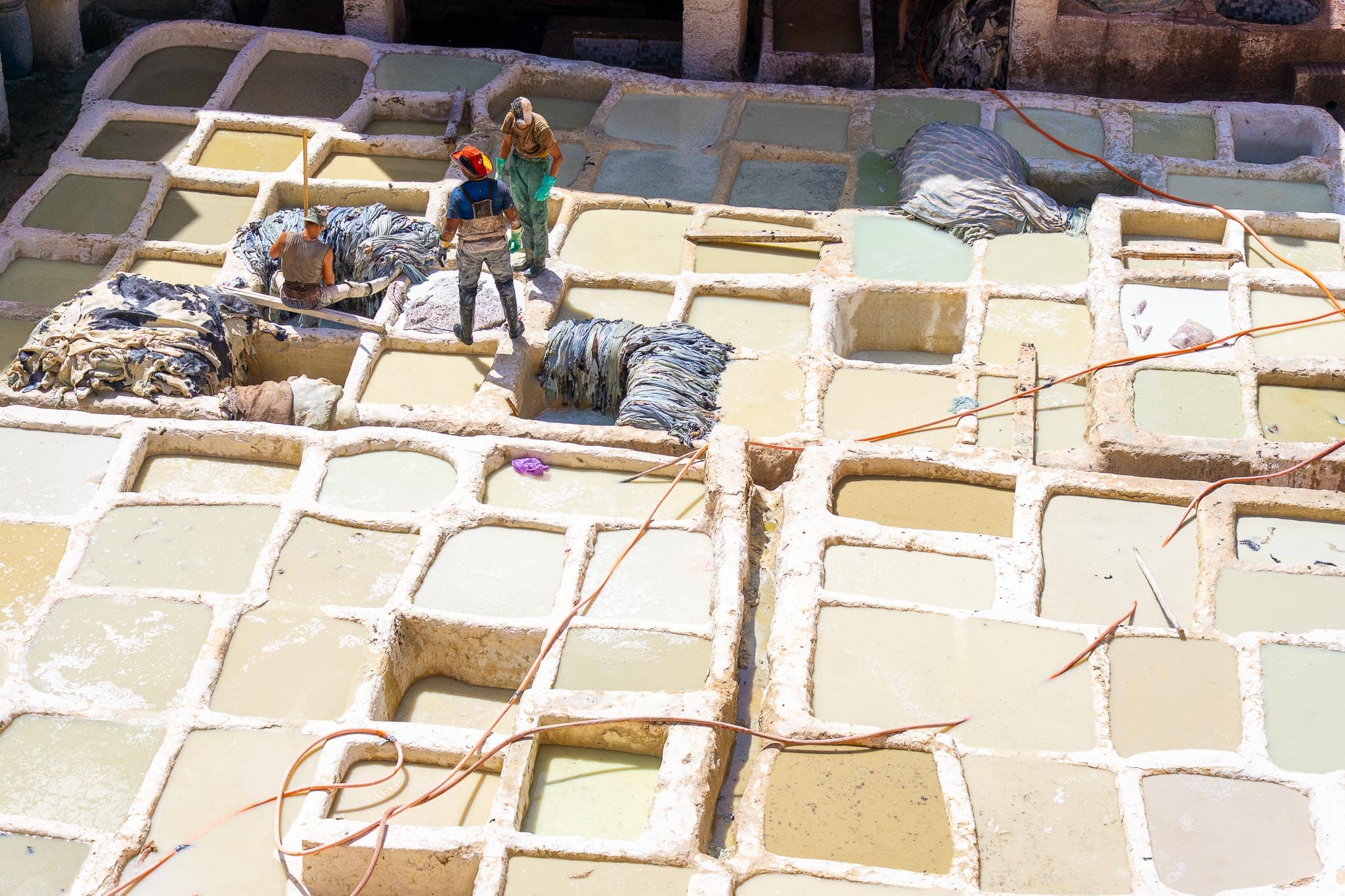
The Chouara Tannery is the oldest working tannery in the world and one of the most striking sights the traveller encountered on the entire journey from Bologna to Seville. The view comes from above — leather shops on the surrounding balconies let visitors stand at their upper floors and look down into the great stone vats below, where hides soak in circles of colour: saffron yellow, poppy red, the deep indigo of sky at dusk. The smell arrives before the sight. Ammonia, sharp and unmistakable — the ancient result of pigeon dung used in the curing process, unchanged in method since the eleventh century. Pungent, yes. Bearable, yes. Worth it, absolutely.
The leather shops press sprigs of mint into visiting hands as a matter of tradition. The traveller accepted, held it briefly, and then pocketed it — preferring, in the end, to smell the place as it actually is. Some things should not be softened.
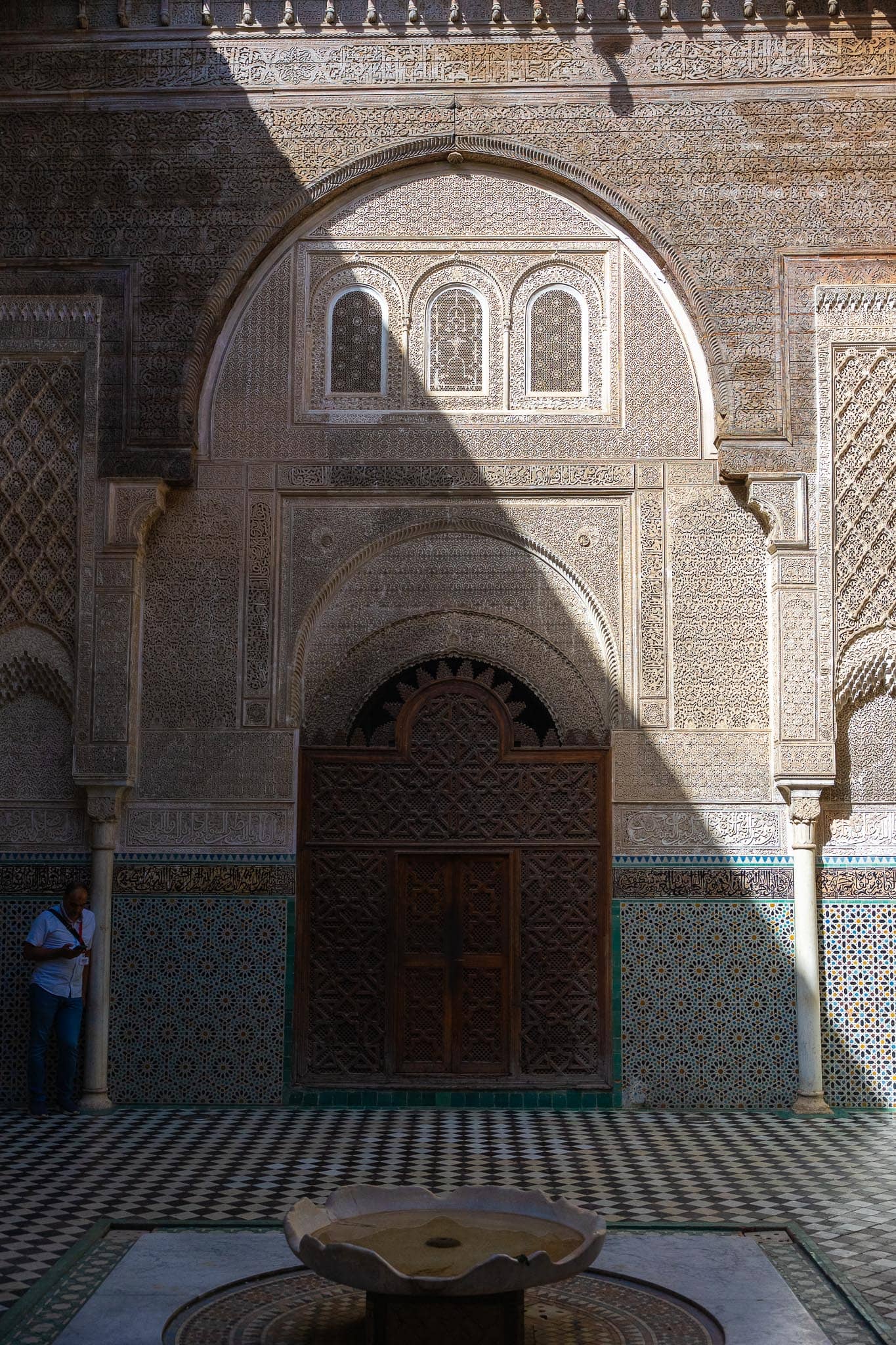
From the tanneries the traveller moved through the quarter of the craftsmen — Place Seffarine, where coppersmiths beat their wares against the persistent soundtrack of ringing metal — and to Al-Attarine Madrasa, the 14th-century theological school whose interior courtyard is perhaps the most beautiful single room encountered on the entire voyage. Zellige to shoulder height. Above that, stucco carved so fine it resembles lace. Above that, cedar screens filtering the light from the gallery above. The Marinids who built it were trying to make something worthy of the God they served. They succeeded.
Lunch was taken at Restaurant Ryad Nejjarine, seated in the cool of a restored riad courtyard with mint tea and a tagine of lamb and preserved lemon. Outside, the Nejjarine Fountain — carved cedar and painted tile, eighteenth century — stood in its square as it has always stood, while the city moved around it in the unhurried rhythm of a place that has survived far longer than hurry.
The second evening's dinner was at Dar Roumana, a short ascent from the medina floor toward the Marinid Tombs. The restaurant occupies a 15th-century townhouse, its dining rooms stacked across multiple levels, each one intimate and softly lit. The cooking is the finest the traveller ate in Morocco — modern in its technique, entirely Moroccan in its soul, and carrying within it the particular history of this city. Fez was for centuries home to one of the great Sephardic Jewish communities of the Arab world, and Dar Roumana's kitchen remembers this. The meal began with jamón alongside local ricotta and a fresh nectarine salad — the kind of opening that announces a cook who understands contrast, who knows that sweetness sharpens salt. A chicken dish followed, tender and deeply spiced. And to close: a Sephardic orange and almond cake with crème, dense and fragrant and tasting of somewhere very old. The kind of meal that makes you understand a place in the way that hours of walking cannot quite achieve — through the intelligence of the food, the layering of history on the plate, the accumulated craft of a cuisine that has had twelve centuries to refine itself.
Afterward, the traveller climbed to the Marinid Tombs in the last light — the ruined tombs of the dynasty that built much of what makes Fez magnificent, now open to the sky on the hill above the city. From here the entire medina is visible below: a dense, breathing, uncountable mass of ochre rooftops and minarets and the faint blue smoke of evening fires, stretching to the modern city on the far side of the valley. The muezzin called. The swallows turned. The traveller stood and looked for a long time, knowing they could not hold it, knowing they were trying anyway.
On the morning of the twenty-third day, the traveller gathered their things in the cool of the dar's patio, the light coming down through the cedar lattice in its usual slanted geometry, and prepared to leave. The train north would depart at a quarter past the eleventh hour. There was time for mint tea and nothing else.
Fez is not a city that can be adequately described. The traveller had tried, in the quiet of those evenings on the rooftop, to find the words — and had found instead that the city defeats language by design, that it was built for experience and not for telling, that the only honest thing one can say about Fez el-Bali is that you must go, and that when you go you must surrender the idea that you will understand it, and that in the surrendering something opens that does not close again.
The door of Dar Le Petit Bijou shut behind them with its old iron click. The alley absorbed them. And then the alley gave them up, and the city gave them up, and the train took them north toward Tangier, toward the strait, toward the last chapter — but for a long while after, some portion of the traveller remained in those nine thousand alleys, still walking, still lost, still marvelling.